





For more than a century, Canada has had the power to breach the ice. Indeed, from 1876 and 1899, three small icebreaking ferries were built in fulfillment of one of Confederation’s promises: a guaranteed year-round ferry service between Prince Edward Island and the mainland. The Champlain and Montcalm, Canada’s first complete icebreakers, were constructed at the turn of the century to dismantle dams and ice barriers that resulted in yearly flooding at strategic locations along the St. Lawrence River.
In the 1920s, icebreakers were originally employed in the Canadian Arctic to support Canadian sovereignty claims over the ARCTIC ARCHIPELAGO and NORTHWEST PASSAGE, as well as to transport goods and services to remote and Native communities during the brief summer months. The port of Churchill was opened to grain exports in the 1930s, and the government started supplying Distant Early Warning (DEW) line stations around the Arctic every year in 1957.
Ice is an obstacle to any vessel, even an icebreaker, and the inexperienced navigation officer is advised to develop a healthy respect for the latent power and strength of ice in all its forms. However, it is quite possible, and continues to be proven so, for well-found vessels in capable hands to navigate successfully through ice-covered waters.

The first principle of successful ice navigation is to maintain freedom to manoeuvre. Once a vessel becomes trapped, the vessel goes wherever the ice goes. Ice navigation requires great patience and can be a tiring business with or without icebreaker escort. The open water long way round a difficult ice area whose limits are known is often the fastest and safest way to port, or to the open sea when leaving a port.
Experience has proven that in ice of higher concentrations, 4 basic vessel handling rules apply:
- Keep moving – even very slowly, but try to keep moving
- Try to work with the ice movement and weaknesses but not against them
- Excessive speed almost always results in ice damage
- Know your vessel’s manoeuvring characteristics
Warning: excessive speed is the major cause of damage to vessels by ice.
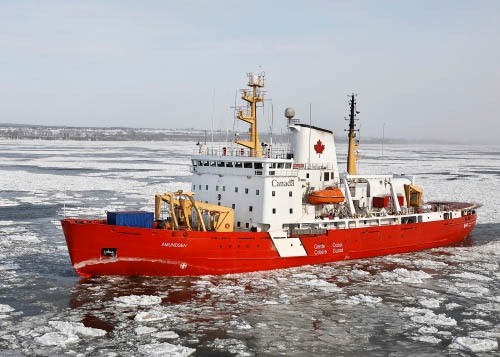
January 7, 2026 – Ottawa – National Defence / Canadian Coast Guard
The Canadian Coast Guard advises that the CCGS Vincent Massey will conduct icebreaking operations near Thunder Bay, Ontario, beginning on or around January 8, 2026. The purpose of this operation is to facilitate safe navigation for commercial vessels in and out of the area, and/or to break up any ice jams that could cause flooding. The timing of these operations is subject to change depending on operational requirements or weather conditions.
The Canadian Coast Guard reminds the public that it can be very dangerous to venture onto the ice and encourages individuals to familiarize themselves with ice safety tips. Broken and fragmented ice tracks and ridging left behind by passing icebreakers or commercial vessels may not freeze over immediately, creating hazardous conditions for ice users. In addition, newly fallen snow will obscure ship tracks. Unsafe ice conditions can persist long after icebreakers have left the area.
Icebreaking on the Great Lakes and connecting waterways is delivered through close co-operation between the Canadian and United States Coast Guards. By working together, the two Coast Guards support the safe movement of scheduled vessel traffic through the shipping channels and in and out of community harbours. Vessels will be assigned as needed to provide this service.
Comments