
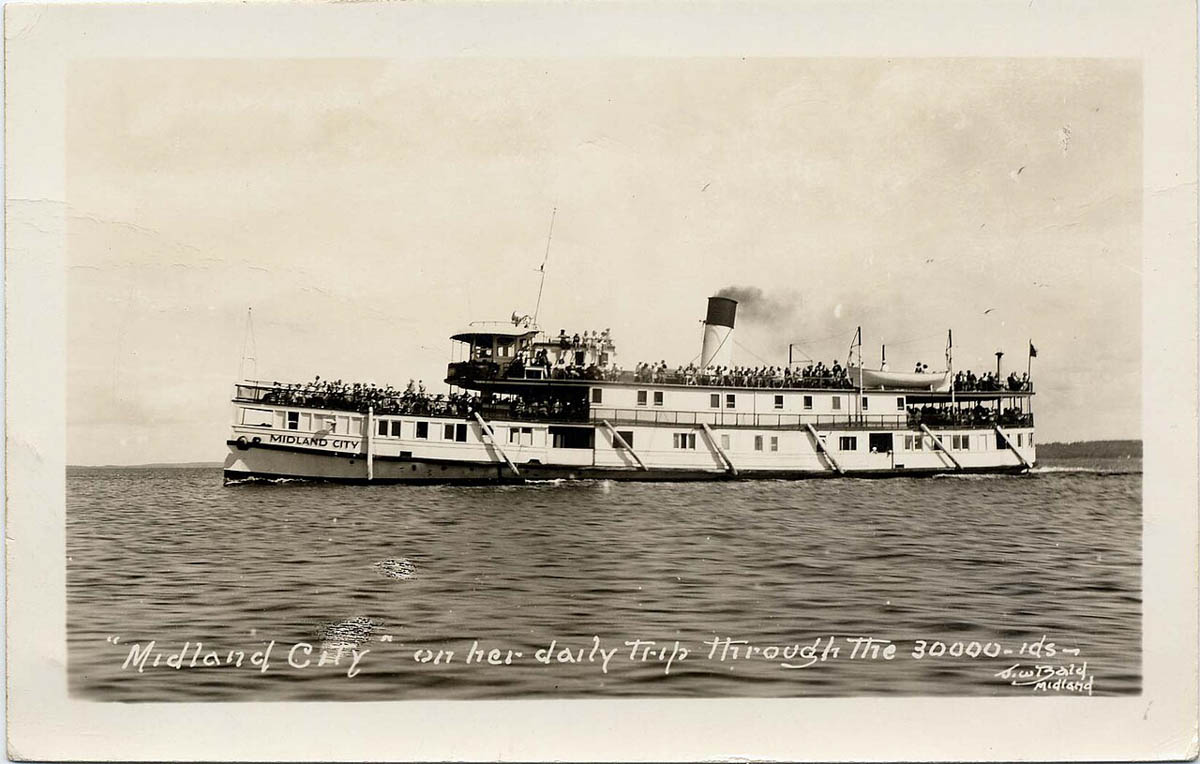

The SS Midland City holds a remarkable place in maritime history as one of the longest-serving vessels on the Great Lakes, operating for over eight decades. Launched in 1871 as a side-wheel steamboat named the Maud, the ship was later rechristened the America before finally becoming the Midland City. Throughout its 84-year tenure, the vessel underwent numerous structural modifications and changed hands several times, serving as a vital link for both cargo transport and passenger travel across the region.
The ship’s long journey came to a deliberate end in 1955. After being retired from service, the vessel was intentionally grounded and set ablaze near the mouth of the Wye River in Midland Bay. Today, the charred remains of the hull are still visible above the water’s surface. While it began as a functional transport ship, the wreck now serves a dual purpose as a historic local landmark and a functional breakwater for the Wye Heritage Marina.
Constructed in 1871, the vessel that would eventually become the SS Midland City began its life as the ferry Maud (sometimes spelled Maude). Her journey was unique from the start: she was pre-fabricated in Glasgow, Scotland, before being dismantled and shipped across the Atlantic to be reassembled in Kingston, Ontario. This initial version of the ship was a side-wheel steamboat measuring 114 feet long and 19 feet wide, with a shallow draft of only 3 feet. Powered by a 200-horsepower engine, she could reach speeds of approximately 13 miles per hour. Despite her modest size—weighing roughly 130 register tons—the ship was built with a sturdy hybrid design featuring a steel-reinforced wooden hull over an iron frame, allowing her to carry up to 550 passengers.
The assembly of the Maud was overseen by the Gildersleeves, a prominent Canadian shipbuilding and political family, and she was officially completed in August 1871. Originally, the ship was commissioned to transport cargo and travelers between Picton and Belleville, Ontario, under the leadership of Captain W. Swales. However, ownership changed quickly; by January 1873, the vessel—then valued at $20,000—was sold to W. Nickle of Kingston. Records from her launch indicate that both Swales and Nickle were deeply involved in the ship’s initial construction and development.
In 1886, ownership of the vessel transitioned to the St. Lawrence River Steamboats Co., based in Kingston. Nearly a decade later, in 1895, the ship underwent a significant expansion and modernization, growing to 153 feet in length and 35 feet in width, which increased her gross tonnage to 521 tons. Following these upgrades, she was renamed the America and spent many years facilitating passenger travel across Lake Ontario. Her long career was further extended by two subsequent major refits, which took place in 1921 and 1933.
Following the conclusion of the 1920 sailing season, the Northern Navigation Company revealed plans to end its steamship route between Midland and Parry Sound. This decision prompted local entrepreneurs in Midland to seek a substitute for the highly frequented excursion service. In response to the growing demand for tourism in southern Georgian Bay, the Honey Harbour Navigation Company and the Georgian Bay Tourist Company were established.
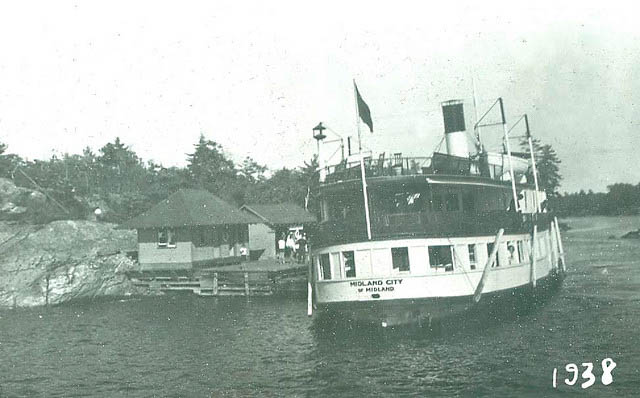

The initial strategy involved securing a vessel with a 400-passenger capacity to depart Midland every day, timed specifically to meet incoming Grand Trunk Railway (G.T.R.) trains. The ship would travel to Sans Souci and return to Midland the following day to synchronize with the rail schedule. This collaborative effort gained the formal support of the Grand Trunk Railway. To complete the service network, a secondary steamboat was also commissioned to transport visitors throughout the Honey Harbour Islands.
In 1955, marking her 84th year of service, the Midland City was steered into the shallows where the Wye Marsh meets Midland Bay. There, the vessel was intentionally run aground and set on fire to be scuttled. While the wreck initially became a popular destination for local divers and snorkelers, it was eventually repurposed; the hull was filled with stone and joined to the mainland to create a functional breakwater for the Wye Heritage Marina. Over time, fluctuating water levels in Georgian Bay have periodically revealed the ship’s wooden structure, though the history of the site has gradually faded from the public’s memory.
Currently, the remains of the ship are easily identifiable via satellite photography, appearing as a short pier extending northwest from the marina entrance. While the bow is largely hidden beneath the boulders that anchor it to the shore, the distinct curve of the stern remains clearly visible. Although the interior is now filled with rock and overgrown with local vegetation, the hull itself remains remarkably well-preserved. A visible trail of debris along the lakebed still marks the path where the historic steamboat was driven ashore for the final time.