




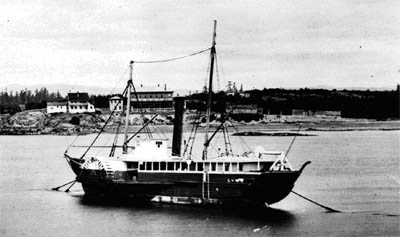

The Beaver was a steam-powered vessel owned and operated by the Hudson’s Bay Company. It holds the distinction of being the first steamship to operate in the Pacific Northwest of North America and played a key role in opening remote stretches of Canada’s west coast to maritime fur trade. For a period, the ship was also chartered by the Royal Navy to assist with coastal surveys of British Columbia. The Beaver remained in service along the coast from 1836 until 1888, when it was ultimately lost in a wreck.
The Beaver supplied Hudson’s Bay Company trading posts located between the Columbia River and Russian America (present-day Alaska) and was instrumental in supporting British authority in British Columbia during the Fraser Canyon Gold Rush of 1858–1859. In 1862, the Royal Navy hired the vessel to help map and chart the coastline of the Colony of British Columbia. She later aided Royal Navy operations at Bute Inlet during the Chilcotin War.
In 1874, a group of investors—later incorporated as the British Columbia Towing and Transportation Company—acquired the vessel and operated her as a tugboat until July 25, 1888. On that date, a crew impaired by alcohol ran the ship onto rocks in Burrard Inlet near Prospect Point in Vancouver’s Stanley Park. The grounded wreck remained visible for several years and finally sank in July 1892 after being struck by the wake of the passing steamer Yosemite, though not before locals had removed many pieces as keepsakes. Today, the Vancouver Maritime Museum preserves several artifacts from the Beaver, including its boiler and two paddle-wheel drive shafts—one recovered in the 1960s and another later returned from a collection in Tacoma. A commemorative plaque marks the location of the sinking. While divers examined the wreck during the 1960s, a later survey by the Underwater Archaeological Society of British Columbia in the 1990s revealed that most of the remains had deteriorated due to decay and strong currents.
Comments