



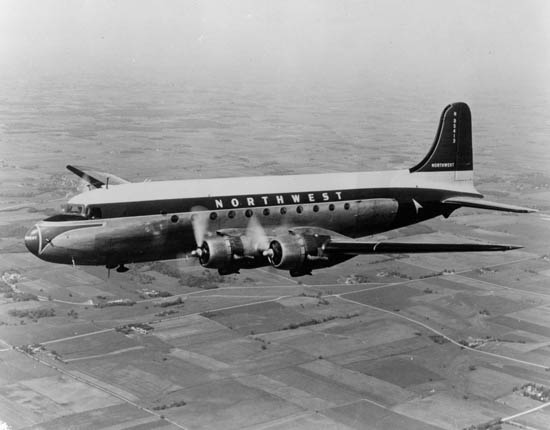
On the night of June 23, 1950, Northwest Orient Airlines Flight 2501 vanished into Lake Michigan while completing a scheduled transcontinental flight from New York City to Seattle. The tragic crash of the DC-4 claimed the lives of all 58 people on board; 55 passengers and 3 crew members, marking it as the worst commercial aviation disaster in United States history up to that date.

According to findings from the Civil Aeronautics Board, air traffic controllers lost communication with the plane shortly after the captain asked to drop altitude to 2,500 feet (760 meters). At the time, the aircraft was flying roughly 18 miles (29 kilometers) north-northwest of Benton Harbor, Michigan, at approximately 3,500 feet (1,100 meters) above Lake Michigan. Near the moment of final contact, several onlookers noted hearing erratic engine sounds and spotting a bright flash. Search operations quickly mobilized, with the Navy employing sonar technology and trawlers to drag the lake bed, though no heavy wreckage was found. Meanwhile, a four-ship Coast Guard fleet retrieved floating upholstery, light debris, and human remains, which were later passed to Northwest Airlines. Additional wreckage and remains continued to wash up along the coastline between South Haven and Benton Harbor, where local authorities collected them.

When radio contact was lost, Flight 2501 was flying into a line of squalls accompanied by severe turbulence. Because the main wreckage on the lake bed has never been located, the official cause of the crash remains unknown, though modern weather hindcast models have simulated the atmospheric conditions present that night. Coverage of the disaster appeared in The New York Times on June 25, 1950 (datelined June 24), reporting:

“A Northwest Airlines DC-4 airplane with fifty-eight persons aboard, last reported over Lake Michigan early today, was still missing tonight after hundreds of planes and boats had worked to trace the craft or any survivors. All air and surface craft suspended search operations off Milwaukee at nightfall except the Coast Guard cutter Woodbine. The airplane, a four-engine ‘air coach’ bound from New York to Minneapolis and Seattle, was last heard from at 1:13 o’clock this morning, New York Time, when it reported that it was over Lake Michigan, having crossed the eastern shore line near South Haven, Mich. The craft was due over Milwaukee at 1:27 A.M. and at Minneapolis at 3:23 A.M. If all aboard are lost, the crash will be the most disastrous in the history of American commercial aviation. The plane carried a capacity load of fifty-five passengers and a crew of three, headed by Capt. Robert Lind, 35 years old, of Hopkins, Minn. In Minneapolis, Northwest Airlines said the craft was ‘presumed to be down,’ and that they were beginning notification of relatives of passengers. In his last report, Captain Lind requested permission to descend from 3,500 to 2,500 feet because of a severe electrical storm which was lashing the lake with high velocity winds. Permission to descend was denied by the Civil Aeronautic Authority because there was much more traffic at the lower altitude.”
Aftermath
The lost aircraft became the focus of a long-running annual search led by the Michigan Shipwreck Research Associates (MSRA), a local non-profit. Launched in 2004 alongside author and adventurer Clive Cussler, the project continued even after Cussler stepped back in 2013. He later dispatched his side-scan sonar specialist, Ralph Wilbanks, to assist the MSRA between 2015 and 2017, though those specific leads yielded only discarded construction materials and a dumped load of scrap metal. The MSRA persisted with its field searches through 2024, scanning roughly 600 square miles (1,600 km²) of lake bed. While team members discovered nine previously unknown shipwrecks, the location of Flight 2501 remained elusive.
In September 2008, MSRA researcher Chriss Lyon discovered an unmarked burial plot in St. Joseph’s Riverview Cemetery containing remains of some of the crash victims. Valerie van Heest, MSRA co-director and author of Fatal Crossing, noted that remains recovered from the lake by the Coast Guard had been interred there secretly without informing the victims’ families. To honor the dead, van Heest arranged a dedicated ceremony in 2008 to unveil a black granite monument, donated by Filbrandt Family Funeral Home, bearing the names of all 58 individuals alongside a commemorative inscription. Roughly ten victim families attended the dedication.
A second forgotten mass grave was uncovered in 2015 at Lakeview Cemetery in South Haven by sexton Mary Ann Frazier and her mother, Beverly Smith, while conducting genealogical research. Containing remains washed up along local shores, this site had similarly lacked a memorial. Partnering with van Heest, Frazier organized a remembrance service ahead of the disaster’s 65th anniversary. Led by Pastor Robert Linstrom and supported by Filbrandt Funeral Home, the June 24, 2015 ceremony included speeches by van Heest, a tolling bell, and a public reading of all 58 names by South Haven Mayor Robert Burr and MSRA representative Craig Rich. A permanent headstone donated by St. Joe Monument Works was installed just days before the event.
The tragic story, van Heest’s outreach to surviving relatives, and the ongoing underwater search were later showcased on Discovery Channel’s Expedition Unknown (February 2020) and History Channel’s The Unbelievable with Dan Aykroyd (December 2023). In June 2025, after two decades of exploration, searchers officially suspended their operations, concluding that the airliner likely disintegrated on impact and settled deep into the muddy lake bottom.
Comments