


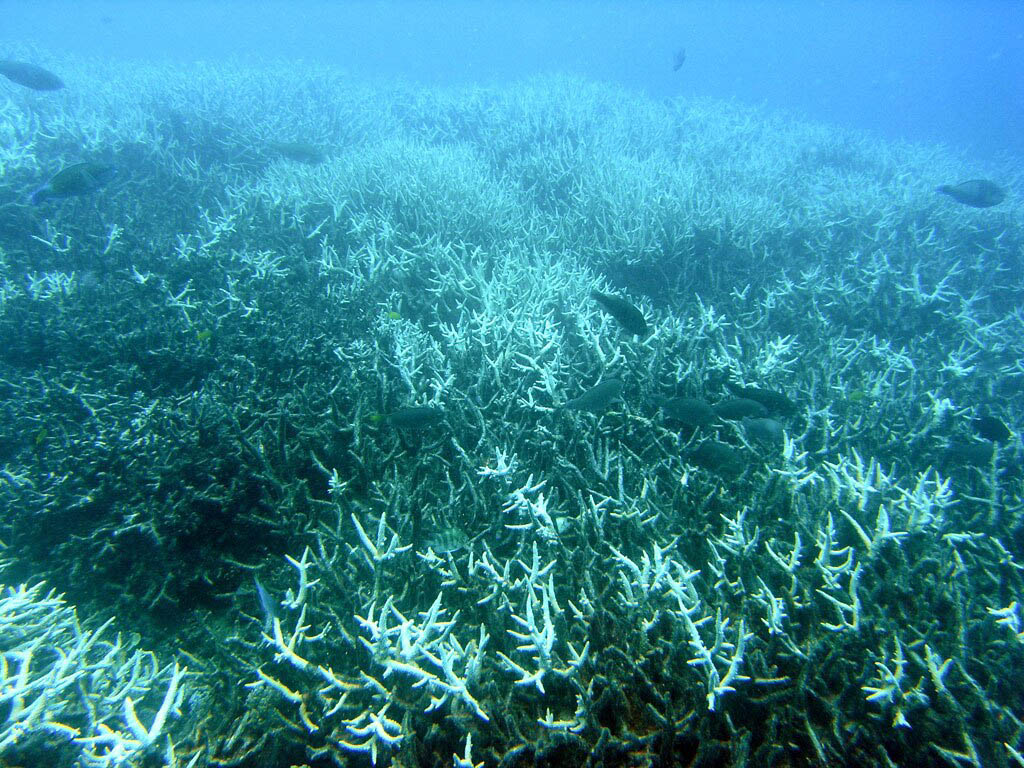

When a reef “bleaches,” it looks like the life has drained out of it. The colour fades, the structure turns ghostly, and the whole scene can feel like a warning sign written in white. But bleaching is not a single outcome. It is the start of a fork in the road, and what happens next depends on how long the stress lasts, how severe it is, what species you are looking at, and what else is happening on that reef at the same time.
At its simplest, coral bleaching is a breakdown in the partnership between reef-building corals and the microscopic algae that live inside their tissues. Those algae, often referred to as zooxanthellae and now more accurately described as Symbiodiniaceae, are a major energy engine for many corals. When heat stress spikes, corals expel these symbionts or the symbionts lose pigments, and the coral’s translucent tissue reveals the pale skeleton beneath. That basic mechanism is well described by NOAA Ocean Service in its explainer on coral bleaching, which also makes a crucial point that divers sometimes forget in the moment: a bleached coral is stressed, but it is not automatically dead.
So what happens after the colour goes?
The first days to weeks: energy crisis, not instant death
Once the symbionts are gone, the coral’s energy budget collapses. Many reef-building corals normally rely heavily on photosynthesis from their symbionts for daily fuel. Without that input, the coral is forced to survive on stored energy reserves and whatever it can catch and absorb from the water column.
Corals can increase feeding during this phase, but it is rarely enough to fully replace what was lost, especially while the coral is still physiologically stressed. This is why the duration of heat stress matters so much. If temperatures drop quickly, some corals can recover their symbionts and stabilise. If the heat lingers, the risk of starvation and cascading failures rises fast, a pattern NOAA scientists also highlight when discussing bleaching and recovery in field monitoring work like this feature on coral recovery after a bleaching event from NOAA Fisheries.
In this early window, you often see a mix of outcomes side-by-side: colonies that remain bleached, colonies that begin to regain colour, and colonies that start to show tissue loss at the margins or across whole sections.
Weeks to months: recovery, partial mortality, or colony death
If conditions improve, many corals can repopulate their tissues with symbionts and regain colour. That repopulation can happen through symbionts already present at low levels in the coral, through uptake from the surrounding environment, or through shifts in which symbiont types dominate.
This is where “recovery” can be deceptive. A coral that has regained colour might still be operating at reduced performance for months. Growth can slow. Immune function can be weakened. Reproductive output can drop. In other words, it may look fine to a diver, but it can be carrying a physiological hangover that affects the next spawning season and long-term resilience.
If conditions do not improve, bleached corals often progress to partial or total mortality. Some species are more vulnerable than others, and the same species can respond differently depending on light, depth, and water flow. The long-term view matters here because repeated, large-scale heat events reduce the time reefs have to bounce back. That shrinking recovery window is one of the central findings in research on increasing bleaching frequency, including the Science paper on global patterns and the shortening interval between events by Hughes and colleagues, available here via Science.
The “new normal” inside the coral: symbiont reshuffling, with trade-offs
One of the most important developments in coral science over the last decade is the growing evidence that bleaching can restructure which symbionts corals host, sometimes favouring more heat-tolerant partnerships after repeated stress. This can be part of why some corals appear to “cope better” after multiple events, at least for a time.
A useful overview of how repeated bleaching can reshape symbiont communities is described in Quigley and co-authors’ open-access paper, Symbioses are restructured by repeated mass coral bleaching, which synthesises evidence that bleaching can shift symbiont composition in both corals and the surrounding environment.
But there is no free lunch. Heat-tolerant symbiont pairings can come with trade-offs, such as reduced growth under non-stress conditions in some cases. And symbiont changes alone cannot protect reefs indefinitely if marine heatwaves keep intensifying and arriving more often.
What happens to the reef around the coral: algae, erosion, and a battle for space
A bleaching event is not only about corals. It is also about what moves in when corals weaken or die.
When live coral tissue is lost, the exposed skeleton becomes real estate. Algae, cyanobacteria, and other organisms can colonise quickly. If herbivorous fish and invertebrates are abundant, grazing pressure can keep algae in check, leaving more space for coral recruits to settle. If herbivores are depleted, or if nutrients and sediments are elevated, algae can dominate and make it much harder for corals to re-establish.
Over time, dead coral skeleton begins to break down through bioerosion and physical storm damage. The reef surface can shift from complex 3D architecture to flatter rubble fields. That matters because structure is habitat. Lose the structure and you often lose fish diversity, nursery areas, and the reef’s ability to buffer waves.
This is one reason global assessments describe bleaching not just as a biodiversity issue, but as a coastal protection and livelihoods issue too, a framing that is consistent with broader climate risk assessments such as the IPCC coverage of ocean and coastal ecosystems in AR6 Working Group II Chapter 3.
Recovery is possible, but it is not guaranteed, and it can be slow
“Will it come back?” is the question every diver asks, and the honest answer is: sometimes, and it depends.
If bleaching causes little mortality, reefs can show meaningful recovery in a few years, especially if surviving colonies can regrow and larval supply is strong. If mortality is severe, recovery can take much longer and may require successful recruitment from elsewhere. NOAA’s reef management guidance on bleaching and recovery, including timelines and the factors that control them, is discussed in this NOAA Coral Reef Conservation Program guide chapter that emphasises how recruitment, predation, sediment, algae, and local conditions shape outcomes.
The catch, increasingly, is frequency. When major bleaching events arrive before corals have rebuilt energy reserves, regrown tissue, and reproduced successfully, reefs can tip into a downwards spiral where each event strips away more resilience than the last.
That “recurrent shock” problem is a major theme in the literature on the 2014 to 2017 global bleaching event and what it revealed about long-duration stress, including Eakin and colleagues’ synthesis, The 2014–2017 global-scale coral bleaching event, which documents widespread impacts and highlights how prolonged heat can drive high mortality and long-lasting ecological change.
A bleached reef is also a warning about the next heatwave
Bleaching events are often described as acute disasters, but their effects are frequently chronic. A reef that “survived” can still be weakened, and a reef that lost a large proportion of coral cover may not simply return to its previous state even if conditions improve. Species composition can change. Fast-growing corals may rebound first, while slow-growing, structurally important corals may take far longer. In some regions, repeated heat stress can steer reefs toward more heat-tolerant but less structurally complex communities.
This is why forward-looking projections focus so heavily on how often reefs will be exposed to severe heat stress in coming decades. One widely cited set of projections is summarised by the UN Environment Programme in its report page on CMIP6-based projections of future coral bleaching conditions, which lays out expected increases in severe bleaching risk under different warming pathways.
What divers can take from this, without sugar-coating it
If you want the most accurate mental model, think of bleaching as a stress test. Some corals fail quickly, some limp through, some recover, and some recover in ways that change what they are.
After a bleaching event, reefs typically move through a period of instability: energy shortage inside surviving corals, increased disease susceptibility, shifts in symbiont partnerships, and intense competition on the reef surface. The trajectory that follows, recovery or decline, is strongly shaped by two overlapping realities: local conditions that determine whether corals can re-establish, and global temperature trends that determine whether they get the time to do it.
For divers, the most important point is also the simplest. Bleaching is not the end of the story. It is the moment the story becomes urgent, because what happens next is where reefs are either given the space to heal, or pushed into a new, diminished state.

