





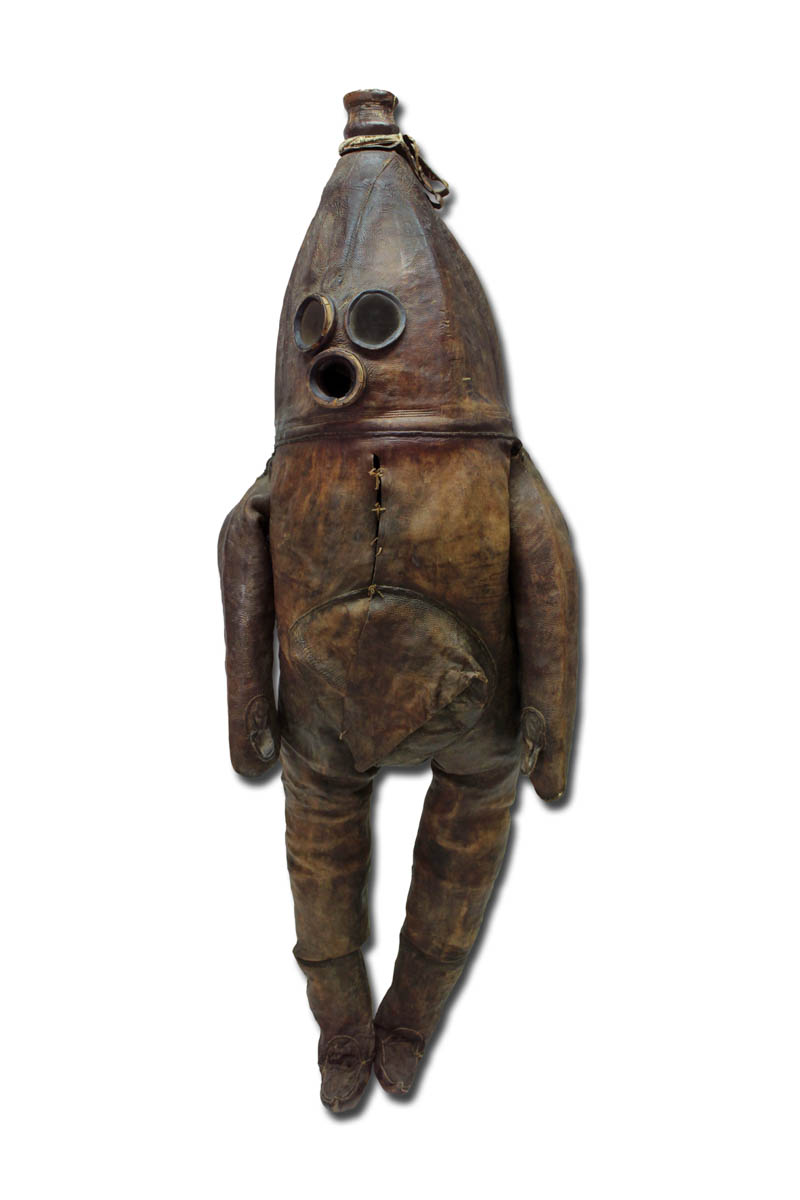
As the oldest local museum in Finland, the Raahe Museum has been preserving history since its founding in 1862. Its collection houses several extraordinary relics, though none are as iconic as the “Old Gentleman of Raahe.”

This remarkable artifact is an 18th-century diving suit crafted entirely from cowhide. Its journey into the museum’s care began in the 1860s, when it was presented as a gift by Captain Johan Leufstadius. Today, it remains one of the rarest and most celebrated examples of early maritime technology in the world.
Regarded as the oldest surviving diving suit in the world, the Old Gentleman of Raahe—or Wanha Herra—is a fascinating relic of 18th-century maritime engineering. This eerie, leather-clad suit was meticulously crafted from cowhide and stitched with pitch-coated thread. To ensure it remained watertight against the freezing Baltic depths, the leather was heavily treated with a pungent mixture of mutton tallow, tar, and pitch. The suit’s distinctive, oversized hood was reinforced internally with wooden slats, a crucial design feature intended to prevent the water pressure from collapsing the suit against the diver’s head.

The suit functioned through a rudimentary but effective surface-supplied air system. A diver would enter the suit through a large opening in the stomach area, which was then sealed by rolling up the leather “tunnel” and strapping it tightly against the body. Air was manually pumped down from the surface using bellows, traveling through flexible wooden pipes that were connected by leather joints. This setup allowed for essential underwater tasks, such as inspecting and repairing ship hulls, without the need for expensive and time-consuming dry-docking.
Today, the original suit is a crown jewel of the Raahe Museum. Because the centuries-old leather is now incredibly fragile, it is permanently housed in the Crown Granary in Finland. To keep the legacy alive, the museum created a functional replica in 1988 known as the “Young Gentleman.” This modern version was successfully tested underwater, proving that the 18th-century design was indeed practical, allowing for dives of up to 40 minutes and ensuring this unique piece of history continues to fascinate audiences worldwide.
Despite various efforts to trace the specific origins and craftsmanship of the diving suit, its exact provenance remains a mystery. However, historians strongly believe the suit was manufactured in Finland due to distinct regional design choices. The feet of the suit feature pointed toes modeled after traditional Finnish countryman’s boots, known as pieksut, while the hands bear a striking resemblance to the mittens typically worn by Finnish foresters. These localized details suggest that even though the concept of the suit may have been inspired by international maritime trends, its physical construction was a product of Finnish traditional handiwork.
Comments