





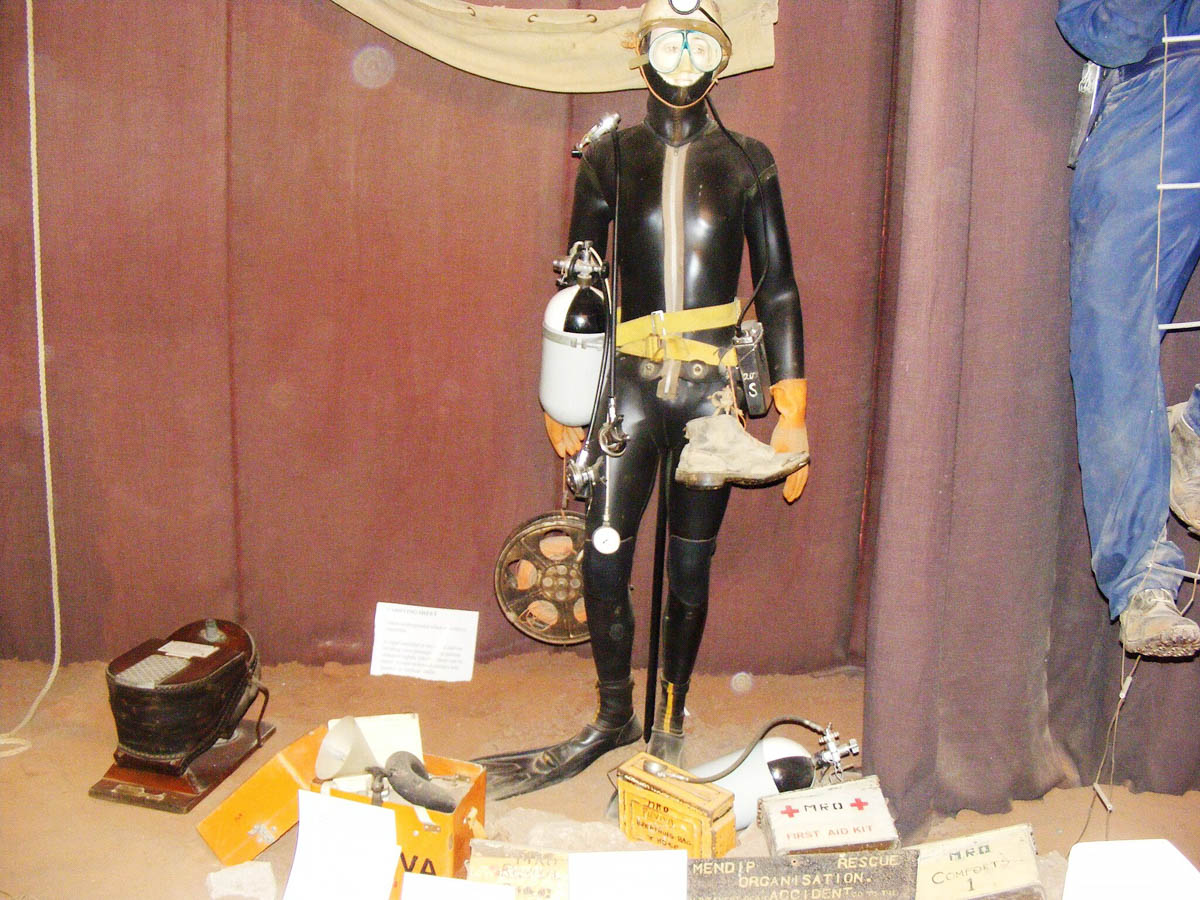
Rodw, Public domain, via Wikimedia Commons
Following our recent discussion on Why People Risk It All to Cave Dive, many readers asked who first dared to explore these submerged labyrinths, long before the technology and safety protocols we now take for granted. The history of cave diving is filled with innovation, courage, and tragedy. The sport was born not from thrill-seeking alone, but from curiosity and the desire to push the boundaries of human exploration.
From flooded British caves in the 1930s to the record-breaking depths of modern technical diving, the story of cave diving is inseparable from the individuals who refused to turn back when the light faded.
The Birth of Cave Diving: Balcombe, Sheppard, and Powell
Modern cave diving can trace its roots to Graham Balcombe, an engineer and explorer who became the driving force behind the early British expeditions in the Mendip Hills. Working with fellow adventurer Jack Sheppard, Balcombe co-founded the Cave Diving Group, which remains the world’s oldest continuing cave diving organisation.
In the 1930s, Balcombe and Sheppard made history at Wookey Hole, experimenting with modified diving suits and breathing apparatus to push through flooded passages no human had ever seen. Their 1935 dive at Wookey Hole was the first successful use of breathing equipment in a British cave. These early efforts, documented by the British Speleological Association, laid the groundwork for everything that followed.
Among them was Penelope “Mossy” Powell, a trailblazer who became one of the first women to cave dive. As Diver No. 2 during the historic 1935 Wookey Hole dive, Powell’s involvement broke both technical and social barriers. Her contribution, later chronicled on Wikipedia and in X-Ray Mag’s retrospective on Wookey Hole, reminds us that the origins of this sport were not confined to men in drysuits but to anyone bold enough to crawl into the unknown.
Their legacy continues each time a diver clips a reel line to the rock and disappears into darkness, chasing that same unyielding curiosity.
Sheck Exley: The Philosopher of the Depths
If Balcombe and Sheppard created the concept of cave diving, Sheck Exley defined its philosophy. Widely regarded as one of the greatest explorers of all time, Exley helped shape nearly every safety rule in the sport.
Through his writings, including Basic Cave Diving: A Blueprint for Survival and Caverns Measureless to Man, Exley taught generations of divers that survival depended on discipline, planning, and respect for the environment. He introduced essential procedures such as strict gas management, line continuity, and multiple light redundancy, principles that remain at the core of cave diver training today.
Exley was also a record-breaker. He became the first person to log over 1,000 safe cave dives and made numerous attempts at world depth records, constantly expanding the limits of what was thought possible. His fatal 1994 dive at Zacatón, Mexico, was both a tragedy and a testament to his lifelong pursuit of understanding the deep. His influence endures through the NSS-CDS and countless divers who still cite him as their inspiration.
William “Bill” Hogarth Main: The Systemiser
While Exley brought philosophy, Bill Hogarth Main brought order. His minimalist, highly efficient gear layout became known as the Hogarthian configuration, a system where every hose, clip, and bolt snap had a purpose.
This approach led to the Doing It Right (DIR) methodology, later popularised by the Woodville Karst Plain Project. Main’s focus on simplicity and consistency made cave diving safer and more efficient, allowing divers to operate as teams deep within complex systems.
The Hogarthian system remains the blueprint for technical diving setups worldwide, its principles of balance and redundancy mirrored in every modern twin-set and sidemount rig used today.
Paul Heinerth: Mapping the Unknown
In the 1970s and 1980s, Paul Heinerth emerged as one of the most prolific explorers of underwater caves. Working across Florida, Mexico, and the Bahamas, he mapped immense systems and took part in groundbreaking scientific research on groundwater and speleogenesis.
Heinerth’s career has been defined by methodical exploration and collaboration. He participated in NOAA’s Bermuda Deep Caves Project, where his deep technical expertise supported studies of subterranean biology and geology. His dives, often exceeding 300 feet, have helped scientists understand how these environments form and how life persists in total darkness.
To this day, Heinerth remains a quiet legend, not a record chaser but a meticulous explorer whose maps have illuminated the unseen corners of the planet.
Martyn Farr: The Chronicler
Welsh explorer Martyn Farr is both a cave diver and a historian of the discipline. His seminal work, The Darkness Beckons, chronicles the evolution of cave diving from its earliest experiments to modern exploration.
Farr’s expeditions span Europe, Asia, and the Americas, from the depths of UK systems to the submerged caves of Mexico and Iran. Known for both endurance and scholarship, he has combined firsthand experience with detailed research, ensuring that the achievements of those who came before him are never forgotten.
Through Farr’s lens, the history of cave diving becomes not only a chronicle of depth records but a story of persistence, ingenuity, and a shared love of discovery.
Legacy Beneath the Surface
From Balcombe’s early experiments in the cold waters of Somerset to the technical dives of Exley, Main, and Heinerth, cave diving has evolved through courage and obsession. What unites all these pioneers is not the pursuit of danger, but the drive to understand, to follow the line deeper, not for glory, but for the profound sense of peace found only where the world falls silent.
Each time a diver kneels at the entrance to a submerged tunnel and ties in their guideline, they continue a tradition begun nearly a century ago: one of respect, exploration, and awe for the unseen world beneath our feet.
Comments