




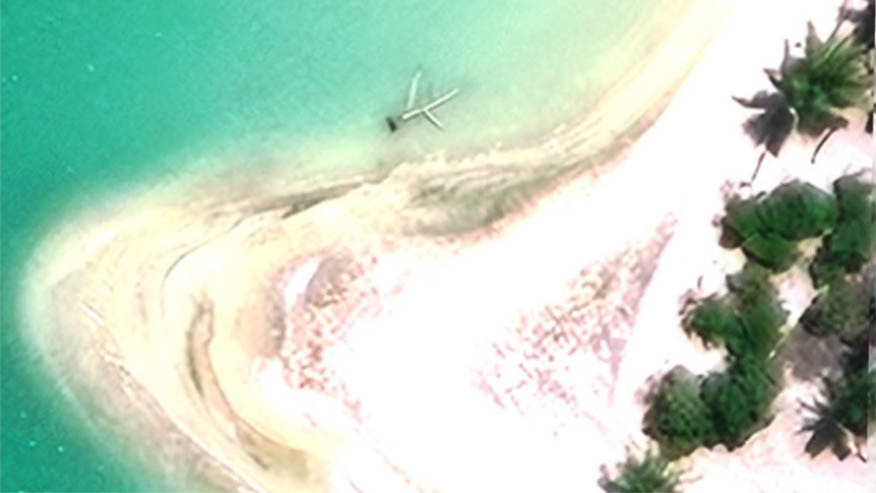

Almost 90 years after Amelia Earhart disappeared over the Pacific Ocean, an expedition is preparing to investigate a mysterious object beneath the shallow waters of a remote lagoon that researchers believe could potentially be part of her missing aircraft.
The Taraia Object Expedition is scheduled to depart from Tarawa, Kiribati, on 7 October 2026, bringing archaeologists and researchers to the uninhabited atoll of Nikumaroro in the Phoenix Islands.
At the centre of the expedition is an underwater anomaly known as the Taraia Object, lying close to the Taraia Peninsula on the northern side of Nikumaroro’s lagoon.
The expedition, involving the Archaeological Legacy Institute, Purdue Research Foundation and Purdue University, is intended to answer a deceptively simple question: what exactly is beneath the sediment?
Researchers are not claiming that the mystery has already been solved.
Instead, they plan to use a combination of remote sensing and underwater archaeological techniques to determine whether the object could be wreckage from Earhart’s Lockheed Electra 10-E, or something considerably less extraordinary.
A Mystery Beneath the Lagoon
Earhart and navigator Fred Noonan disappeared on 2 July 1937 while attempting to circumnavigate the globe.
Their intended destination was Howland Island, a tiny island in the central Pacific. Neither Earhart, Noonan nor their aircraft has ever been conclusively located.
One long-running theory proposes that the pair failed to find Howland Island and instead reached Nikumaroro, then known as Gardner Island, approximately 400 miles southeast of their intended destination.
The theory has been investigated extensively over several decades, but no evidence discovered so far has conclusively established that Earhart landed on Nikumaroro.
The latest search focuses on something different.
According to the Archaeological Legacy Institute, the Taraia Object is a visual anomaly in the lagoon immediately east of the Tatiman Passage, one of the connections between the lagoon and the surrounding ocean.
The object was initially noticed by Michael Ashmore while examining satellite imagery in 2020.
Researchers subsequently examined other imagery and say a feature at the same location can be seen in drone footage, earlier satellite images and potentially aerial photographs dating back to 1938.
The Archaeological Legacy Institute says the object became particularly visible following Tropical Cyclone Pam in 2015, possibly because sediment covering it had been disturbed.
That interpretation remains a hypothesis.
Taking the Search Underwater
The expedition is expected to rendezvous in Tarawa on 6 October before departing aboard the LC Marin Mainiku the following day.
The voyage to Nikumaroro is expected to take approximately six days.
Once there, the team faces the considerable logistical challenge of working on an uninhabited and isolated Pacific atoll.
According to Purdue University’s latest expedition update, the investigation will begin by documenting the site with video and still photography before conducting remote sensing surveys.
Magnetometers and sonar equipment will then be used to investigate the anomaly beneath the lagoon.
The team also intends to use underwater archaeological equipment to examine the buried object directly.
A hydraulic dredge will carefully remove sediment until enough of the object has been exposed for researchers to attempt an identification.
For the diving and marine archaeology community, it is this stage of the expedition that may prove particularly interesting.
The expedition team includes maritime archaeologists Michael Krivor and William Wilson of RECON Offshore, a Florida-based archaeological company with experience investigating submerged sites and aircraft.
The mission therefore sits at the intersection of historical research, underwater archaeology and remote marine exploration.
What Would Identify the Aircraft?
Simply finding metal beneath the sediment would not be enough.
Researchers will be looking for physical characteristics capable of distinguishing wreckage from Earhart’s Lockheed Electra from unrelated debris.
The Archaeological Legacy Institute says aluminium construction, structural shape and rivet patterns consistent with the Electra could potentially allow researchers to identify the object.
The objective of the 2026 expedition is identification rather than recovery.
If the object proves to be the aircraft, a considerably larger archaeological project would be required to expose, document and potentially recover the wreckage.
Organisers say that work could begin during a future expedition in 2027, with any eventual recovery potentially extending into 2028.
Previous Searches Have Come Up Empty
Claims surrounding the disappearance of Amelia Earhart have a long history of generating headlines, and previous promising discoveries have failed to provide a definitive answer.
Nikumaroro itself has been investigated repeatedly.
The International Group for Historic Aircraft Recovery, better known as TIGHAR, has conducted numerous expeditions to the island since 1989 and developed much of the research behind the theory that Earhart and Noonan reached the atoll.
In 2019, an expedition involving ocean explorer Robert Ballard and the Ocean Exploration Trust conducted an extensive marine search around Nikumaroro using remotely operated vehicles, sonar, autonomous systems, drones and divers.
It did not locate Earhart’s aircraft.
There is also disagreement over the significance of the Taraia Object itself.
TIGHAR executive director Ric Gillespie has publicly expressed scepticism that the anomaly represents aircraft wreckage, despite his organisation’s longstanding work on the broader Nikumaroro hypothesis.
That uncertainty is precisely why the forthcoming expedition matters.
Rather than attempting to identify the object from another satellite image, researchers intend to physically reach the site and examine what is actually there.
An Unusual Connection With Purdue
Purdue University’s involvement has a historical connection stretching back to Earhart herself.
Earhart joined Purdue in 1935 as a women’s career counsellor and adviser to the university’s Department of Aeronautics.
The Purdue Research Foundation also helped finance the Lockheed Electra used for her attempted round-the-world flight.
According to the university, Earhart intended the aircraft eventually to return to Purdue.
That history has given the university a particular interest in establishing whether the object beneath Nikumaroro’s lagoon could finally reveal what happened to the aircraft.
But expedition organisers acknowledge that it could just as easily establish what the object is not.
If the Taraia Object turns out to be natural material, debris or something unrelated to Earhart, documenting that finding would still eliminate another candidate from a mystery that has persisted since 1937.
Within weeks, researchers may finally be able to replace satellite images and speculation with direct observations from beneath the waters of Nikumaroro’s lagoon.
Comments