



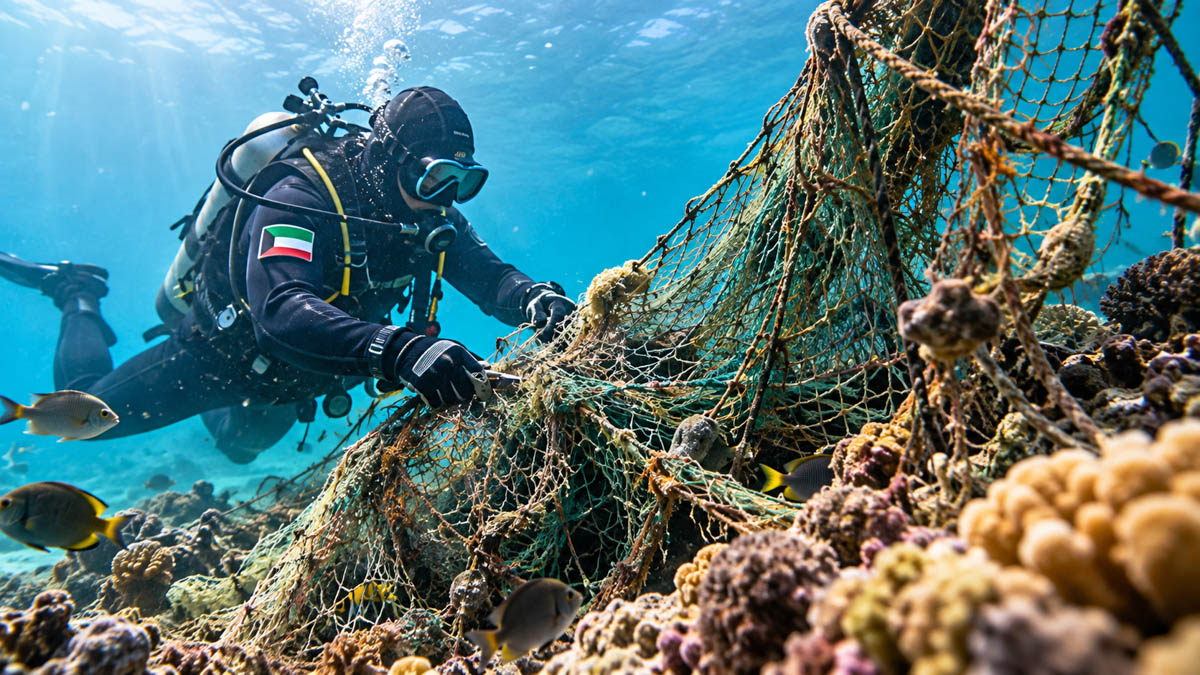
Volunteer divers in Kuwait have removed approximately a quarter-ton of abandoned fishing nets from a coral reef, freeing marine life caught in the gear and eliminating a potential hazard to divers and vessels.
The operation was carried out by the Kuwait Dive Team, part of the Environmental Voluntary Foundation, at the Arifjan marine area.
According to reporting from the Kuwait News Agency carried by Kuwait Times, the abandoned nets were recovered from a depth of approximately 12 metres and covered an area of around 30 square metres of reef.
Team leader Waleed Al-Fadhel said marine creatures trapped within the fishing gear were rescued during the operation.
Ghost Nets Threaten Coral And Marine Life
Lost or abandoned fishing equipment can continue catching animals long after fishermen have lost control of it, a process commonly known as ghost fishing.
The US National Oceanic and Atmospheric Administration describes derelict fishing gear as a persistent threat capable of trapping fish, crustaceans, marine mammals, sea turtles and seabirds while also damaging sensitive habitats including coral reefs and seagrass beds.
Research into the effects of ghost nets on coral reefs has also found that nets can break, shade and abrade coral colonies. NOAA researchers studying affected reefs in the Northwestern Hawaiian Islands found significantly less live coral at sites impacted by nets.
Al-Fadhel said the abandoned nets at Arifjan threatened both the reef and marine organisms living around it. Removing them also reduced the possibility of fishing gear becoming entangled with boat engines or otherwise creating a navigational hazard.
An Important Site For Kuwait’s Divers
Arifjan contains several types of coral reef and is visited by both divers and fishermen.
The site also contains a large iron shipwreck which Al-Fadhel said has been underwater for around 40 years.
The Kuwait Dive Team’s work at the site extends beyond removing abandoned fishing equipment. The volunteers have installed sustainable moorings intended to prevent boats and yachts from dropping anchors directly onto coral formations.
The team is also monitoring the condition of the reef and removing other marine debris.
Its parent organisation, the Environmental Voluntary Foundation, has a long history of marine environmental projects in Kuwait, with the Kuwait Dive Team undertaking volunteer conservation and salvage work since 1986.
Earlier in 2026, the team launched a large-scale campaign to clean and rehabilitate Kuwait Bay, targeting plastic waste, abandoned fishing nets, wooden debris and sunken vessels.
Scientific Coral Report Expected
The Arifjan operation may also provide further information about the condition of Kuwait’s reefs.
Al-Fadhel said the team intends to release a scientific report examining coral growth at the site in the coming days.
The Kuwait Dive Team said its wider programme will continue targeting abandoned fishing gear and other marine debris throughout Kuwait’s waters.
It has also urged divers, fishermen and other sea users who encounter abandoned or entangled fishing nets around coral reefs to report them to the Kuwait Dive Team, Kuwait Coast Guard or Environment Public Authority so they can be removed safely.
Comments