





The discovery of five villagers alive inside a flooded cave system in Laos has provided a surge of hope in one of the most technically challenging rescue operations seen in Southeast Asia since the 2018 Tham Luang cave rescue.
But while headlines have focused on the survival of the trapped men, cave divers involved in the mission are painting a picture of conditions so extreme that one experienced rescuer compared it to “diving in coffee.”

The five villagers were located alive after spending more than a week trapped underground in Xaysomboun province after heavy rain flooded the cave system and blocked their exit route. Rescue teams continue searching for two additional missing members of the group while preparing what may become the most dangerous phase of the mission, getting the survivors back out.

For divers, that extraction challenge is where this story becomes far more than another breaking news headline.
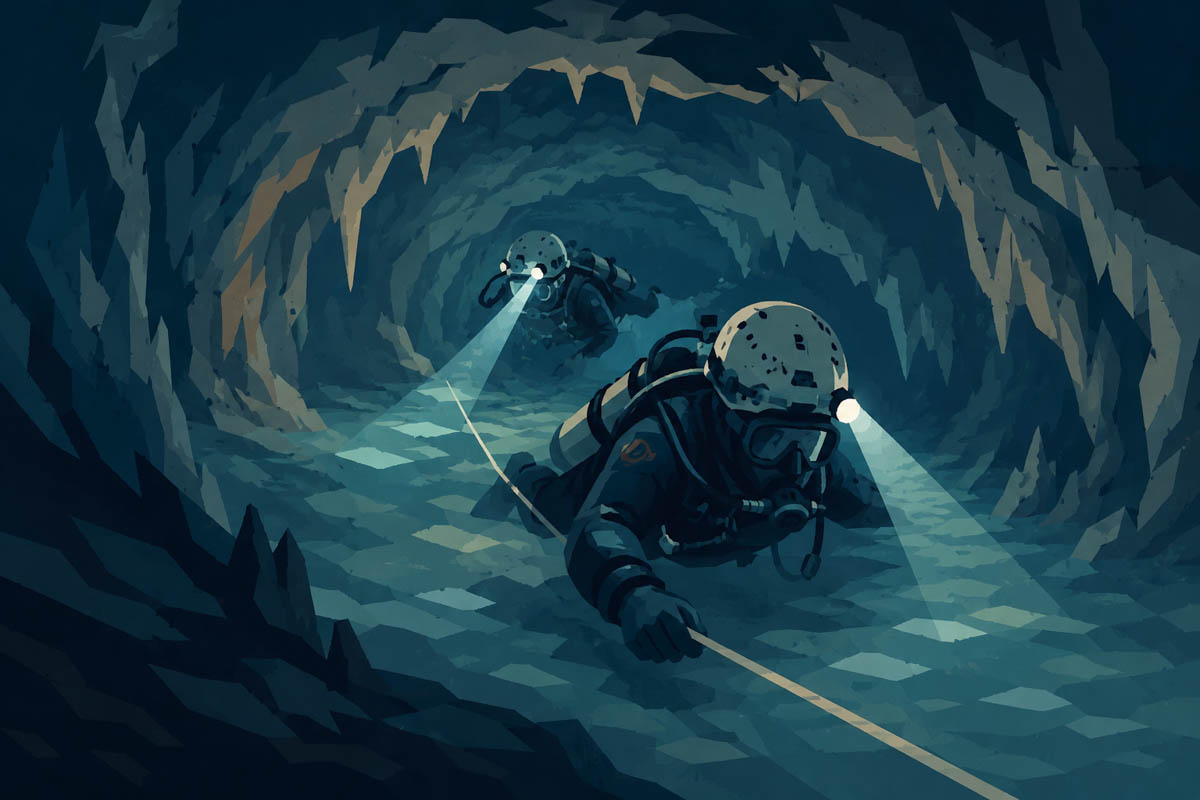
Australian cave diver Josh Richards, who joined the rescue effort, described visibility inside the flooded cave as being like “diving in coffee,” a phrase that instantly resonates with anyone who has experienced silty overhead environments.
Unlike open-water diving, where poor visibility is uncomfortable but manageable, visibility loss inside a cave can completely transform the risk profile of a dive.
Inside flooded cave systems, visibility is often destroyed by suspended sediment. Every fin kick, body movement, guideline contact, or surge of floodwater can stir up mud and clay from the cave floor. In severe conditions, divers lose all visual reference points and are forced to navigate entirely by touch.
That appears to be exactly what rescue teams are facing in Laos.
Reports from rescuers describe narrow flooded restrictions, unstable passages, strong sediment loads, and sections of cave where divers must squeeze through spaces barely large enough for a single person while carrying life-support equipment. Some passages are reported to be less than two feet wide.
Among the international rescue personnel are veteran cave divers Mikko Paasi and Norraseth “Nut” Palasri, both of whom were involved in the world-famous 2018 Tham Luang cave rescue in Thailand, bringing years of high-risk flooded cave rescue experience into the Laos operation. Their involvement has immediately drawn comparisons to the mission that captivated the world eight years ago.
Yet many cave divers would argue that finding trapped survivors is often only the beginning.
Locating the five villagers was a major breakthrough, but extraction through flooded cave restrictions presents an entirely different challenge. Divers must now contend with oxygen management, equipment logistics, physical exhaustion, rising water levels, unstable cave conditions, and the psychological realities of moving non-divers through an overhead environment.
According to multiple reports, rescuers are pumping water from the cave, establishing airflow systems, moving oxygen supplies underground, and creating staging points deeper inside the cave network to support the operation.
What makes cave rescue diving unique is that almost every safety layer available to recreational divers disappears.
There is no direct ascent to the surface. There is no immediate exit. Navigation depends entirely on guidelines. Equipment failures must be solved inside the cave. Even simple problems can escalate rapidly because the environment offers so little room for error.
The Laos rescue is also highlighting the small global community of cave divers repeatedly called upon when situations move beyond conventional rescue capabilities.
Many of these specialists spend years training in line navigation, gas planning, confined-space movement, emergency procedures, and low-visibility cave protocols. Their skills are rarely visible to the public until disasters like this suddenly place them at the centre of international attention.
The parallels with the Tham Luang rescue are impossible to ignore. In both cases, flash flooding transformed cave systems into underwater labyrinths. In both cases, specialist cave divers became the only realistic route to survival. And in both cases, the world has been reminded that some of diving’s most important work happens far from coral reefs, liveaboards, and recreational dive boats.
For the global diving community, the Laos mission is a powerful reminder of what cave diving expertise can achieve under the most extreme circumstances.
The discovery of five survivors has delivered hope. What happens next may prove even more challenging.
Comments