



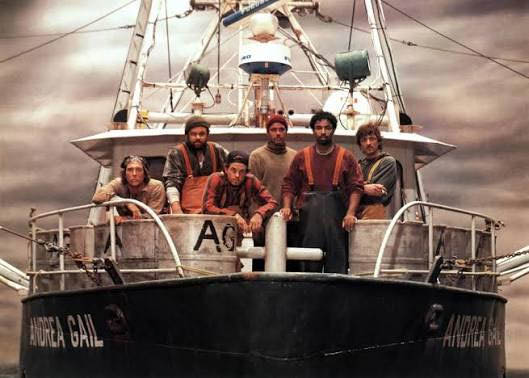

On September 20, 1991, the Andrea Gail set out from Gloucester Harbor for what would become its final journey, originally charting a course for the Grand Banks of Newfoundland. When the initial fishing proved unsuccessful, Captain Frank “Billy” Tyne Jr. made the strategic decision to sail further east toward the Flemish Cap. He hoped that these more remote waters would provide the productive haul the crew needed to make the trip profitable.
The tragic disappearance of the FV Andrea Gail remains one of the most chilling maritime mysteries of the late 20th century. A commercial sword-fishing boat based in Gloucester, Massachusetts, the vessel vanished in October 1991 while navigating the volatile waters of the North Atlantic.

Built in Panama City, Florida, in 1978, the Andrea Gail was a 72-foot commercial longliner owned by Robert Brown. Though her origins were in the South, her professional life was centered in Gloucester, Massachusetts. This historic fishing port served as her home base, where the crew would routinely unload their haul of swordfish before restocking the galley and refueling for the next trek into the Atlantic.

Communication with the Andrea Gail came to an end around 6:00 pm on the evening of October 28, 1991. In his final radio transmission, Captain Billy Tyne reached out to Linda Greenlaw, the captain of their sister ship, the Hannah Boden. At that time, Tyne reported their position as roughly 162 miles east of Sable Island. The conditions he described were already harrowing, with sustained winds hitting 80 knots and the ship battling swells of 30 feet. His final words over the radio—”She’s comin’ on, boys, and she’s comin’ on strong”—offered a grim acknowledgment of the intensifying storm that was about to overtake them.
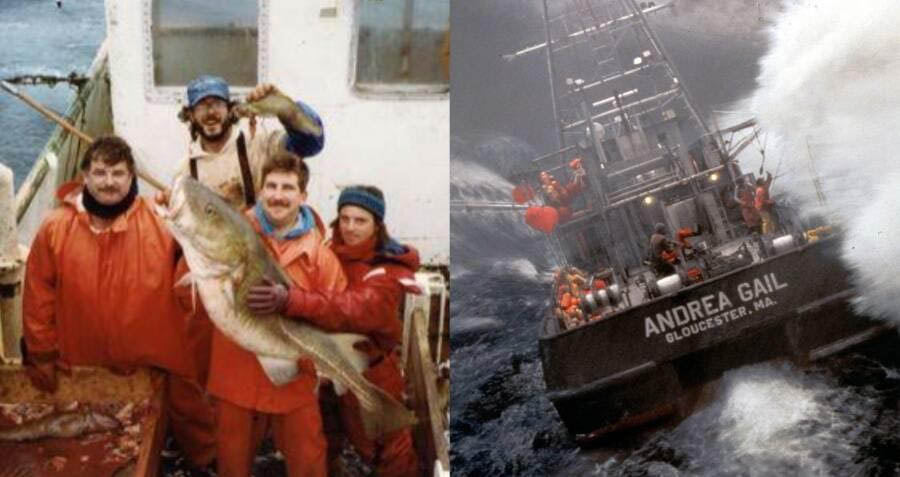
The true scale of the sea conditions following that final check-in remains a subject of some debate between anecdotal accounts and scientific records. While Sebastian Junger’s narrative of the event suggested the crew may have faced monstrous waves exceeding 100 feet, official buoy data in the immediate area initially peaked at a more modest 39 feet. However, broader data from the region paints a more terrifying picture; several sensors near the ship’s last known coordinates measured waves over 60 feet high between October 28 and 30. Most notably, a weather buoy stationed off the Nova Scotia coast documented a staggering wave height of 100.7 feet—a record-breaking measurement for the province’s waters that lends weight to the theory that the Andrea Gail was overwhelmed by truly historic seas.
The Andrea Gail was officially reported overdue on October 30, 1991, triggering a massive, multi-national search and rescue operation. This grueling effort utilized the combined resources of the New York Air National Guard’s 106th Rescue Wing, the United States Navy, and both the American and Canadian Coast Guards. Search teams scoured a staggering 186,000 square nautical miles of the North Atlantic, desperately seeking any sign of the missing trawler or its crew.
The first physical evidence of the ship’s fate appeared on November 6, 1991, when the vessel’s emergency position-indicating radio beacon (EPIRB) was found washed ashore on Sable Island, Nova Scotia. While these devices are engineered to automatically transmit a distress signal the moment they hit the water, this specific beacon failed to provide a location for the ship during the storm. Adding to the mystery, the Canadian Coast Guard personnel who recovered the device could not definitively confirm if the activation switch had been turned on or remained in the off position.
By November 9, 1991, authorities made the difficult decision to terminate the search, concluding that the chances of the crew surviving in the frigid, violent seas had dropped to near zero. Ultimately, the Andrea Gail and its six crew members were declared lost at sea. To this day, no remains have ever been recovered, leaving the final moments of the men to the silence of the Atlantic.
The story of Andrea Gail and her crew inspired Sebastian Junger’s 1997 book, The Perfect Storm, and a 2000 film of the same name. The sister ship of Andrea Gail, FV Lady Grace, was used during the filming of the movie.
Comments