



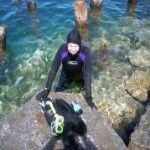

Although the J.C. Morrison has rested underwater in a fragmented state for more than 160 years, it continues to welcome visitors beneath the surface.
The J. C. Morrison was a side-wheel steamboat operated by the Ontario, Simcoe and Huron Railroad Company during the mid-1850s. On August 5, 1857, a fire broke out on board, causing the vessel to sink in shallow waters near what is now Centennial Beach in Barrie, Ontario. Today, the remains of the ship lie offshore and are a well-known destination for scuba divers.
The steamship Joseph Curran Morrison, more commonly known as the J. C. Morrison, was constructed for the Ontario, Simcoe and Huron Railroad Company. Confident in their success on land with a popular steam railway, the company aimed to extend that innovation onto Lake Simcoe. To bring this vision to life, they partnered with the Bell Ewart shipyards to design and build a new steam-powered vessel.

The Ontario, Simcoe and Huron Railroad Company commissioned Captain Hugh Chisholm, master of the steamer Woodman, along with a designer known as Mr. Porter, to plan the new vessel. Construction began in 1854 when the keel was laid, and the ship was named Joseph Curran Morrison in recognition of the railroad company’s president.
Several specialized firms contributed to the ship’s construction and outfitting. Jaques and Hay Furniture Company of Toronto supplied the interior furnishings, while Gartshore & Company engineered the 25-foot-high beam engine and boiler. The onboard silverware was produced by W. Adams & Sons. The vessel measured 150 feet in length with a 24-foot beam and had a gross tonnage of 150. Its 20-foot paddle wheels enabled speeds of up to 18 miles per hour (approximately 29 km/h). The J. C. Morrison was completed by June 30, 1855, at a total cost estimated between $18,000 and $20,000, an amount equivalent to about $698,000 today.
The launch of the J.C. Morrison on August 26, 1854, proved to be a chaotic spectacle for the roughly 5,000 onlookers gathered at the Belle Ewart waterfront. Although the ceremony was officiated by the wife of the vessel’s namesake, Joseph Morrison, the event nearly ended in failure when the hull seized up halfway down the slipway. In a desperate attempt to dislodge the stuck steamer, the company deployed another ship, the Morning, to haul it into Lake Simcoe. The operation was fraught with tension, involving a snapped tow line and a frantic manual effort by a crew of men who used a felled tree as a makeshift lever to finally heave the massive vessel into the water.
Beginning its service in the summer of 1855, the J.C. Morrison embarked on its inaugural journey on June 30 under the leadership of Captain Fellows. The steamer functioned as a vital link for the region, ferrying mail, freight, and travelers across Lake Simcoe to various ports, including Orillia and Beaverton, before returning to Belle Ewart to sync with departing steam trains. Its refined interior, which featured luxurious velvet seating and elegant stained-glass windows, offered a level of sophistication that captivated the public. This popularity, combined with the vessel’s impressive speed, led to the introduction of evening excursions commanded by Captain Bell. These sought-after night cruises cost roughly $3 at the time—an amount equivalent to approximately $150 in modern currency—solidifying the ship’s reputation as a premier mode of local transport and leisure.
Despite its popularity, the J.C. Morrison was plagued by significant design flaws and embarrassing operational failures throughout its service. The vessel was notoriously difficult to maneuver due to a rigid rudder and a top-heavy construction that made it vulnerable to being blown off course, leading to several collisions with smaller sailboats. Perhaps the most humiliating incident occurred on August 11, 1855, when the steamer ran aground at the Atherley Narrows while carrying a capacity crowd. Because the ship lacked sufficient sleeping quarters for such a large group, stranded travelers were forced to spend the night in the dining areas and lounges. It was not until the next day that the smaller steamer Morning arrived to rescue the weary passengers and complete their journey.
On the morning of August 4, 1857, Captain Bell authorized the J.C. Morrison to begin its standard transit from Belle Ewart at 10:00 a.m. The day’s journey proceeded without incident, concluding at 7:00 p.m. when the vessel moored at Allandale Station in preparation for an early departure the following day. After confirming the ship was secure, the Captain permitted the passengers to disembark at 7:30 p.m. and left the vessel himself to coordinate details for an upcoming excursion with a local committee. Returning to the docks at 11:30 p.m., Bell retired to his quarters, observing that the ship appeared entirely still and that he was seemingly the last person awake on board.
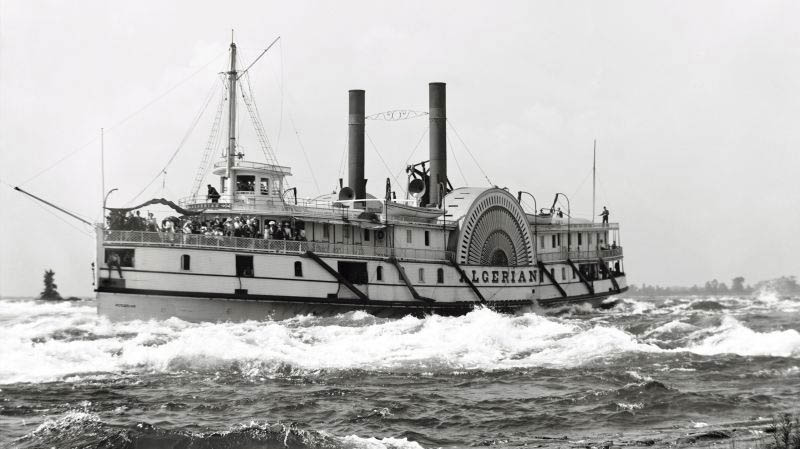
The destruction of the J.C. Morrison began in the early hours of August 5, 1857, while the vessel lay moored at Allandale Station with passengers asleep on board. Around 12:30 a.m., a fireman discovered flames erupting from the boiler area and immediately raised the alarm, prompting a dramatic rescue effort led by Captain Bell. Still in his nightclothes, Bell personally ensured every traveler evacuated—including a young woman who struggled to escape the rapidly spreading fire—nearly losing his own life in the process. To prevent the blaze from spreading to local infrastructure, firefighters cut the ship loose, allowing it to drift into the lake. Driven by a light breeze, the inferno floated toward the wharves of Barrie, illuminating the shoreline with such intensity that nearby buildings were clearly visible in the glow. After burning for ninety minutes, the steamer finally sank beneath the surface with a thunderous hiss.
The aftermath was a scene of total financial and personal devastation, as the fire consumed almost everything on board. Only a small amount of currency and a few ledgers were salvaged by the ship’s purser before the vessel went down. Families like the Rolfes and Sutherlands lost significant wealth, including hundreds of dollars in cash and a gold watch valued at nearly $4,800 in today’s currency, leaving them dependent on the charity of others for basic clothing. Captain Bell also suffered the loss of his own timepiece and critical business papers. Ultimately, the cause of the fire remained a mystery, and the meager $1,000 insurance payout—roughly $36,700 today—covered only a small fraction of the total wreckage.
Shortly after the J.C. Morrison sank, an unidentified boat club shifted the ship’s paddle wheels into deeper water to prevent them from damaging their own vessels. One of these wheels resurfaced near the original wreck site in 1997, though the circumstances of its return remain a mystery, leading to speculation that the club may have eventually been compelled to move it back. Although plans were made to salvage the entire wreck as early as September 1857, the operation never materialized for unknown reasons. The ship remained a visible landmark above the waterline until at least May 1858. Eventually, in October 1860, Captain Charles Fortin successfully retrieved the ship’s boiler for use in a new vessel, the Emily May. That ship was later abandoned in 1883 and now lies decaying near the Belle Ewart coast.
The loss of the steamer also forced a change in plans for a major social event scheduled for August 22, 1857. A group of 200 guests had intended to sail to Orillia on the J.C. Morrison, but the company was forced to substitute the steamer Morning instead. Despite the change in vessels, the celebration continued with a high level of fanfare, featuring festive railway transport to the docks, live musical performances, and a scenic tour of Lake Couchiching highlighted by numerous celebratory toasts.
The remains of the J.C. Morrison were rediscovered in 1974 by two divers from Innisfil, who found the vessel separated into three primary sections: the bow, the midsection, and a relatively well-preserved stern. To confirm the identity of the wreckage, various items were retrieved, including pottery, glassware produced by W. Adams & Sons, and a flintlock pistol. Many of these artifacts are now exhibited at the Simcoe County Museum, though some items, such as a tobacco pipe, were left at the underwater site. Today, the location serves as a popular training ground for novice scuba divers in Simcoe County, seeing approximately 50 visits annually.
As of May 2025, several structural elements of the steamer are still visible on the lakebed, including the engine, a paddle wheel, and the aft keel. The wreckage has evolved into a thriving artificial reef, drawing divers who wish to see the local wildlife, such as crayfish and smallmouth bass. However, the site is also heavily impacted by invasive zebra mussels and algae, which have nearly covered the entire structure. The ship’s historical significance has been memorialized on land as well; in 1979, a commemorative dollar coin was issued to mark the 125th anniversary of the vessel’s launch, featuring an engraving of the J.C. Morrison and serving as legal tender for a limited time.
Comments