




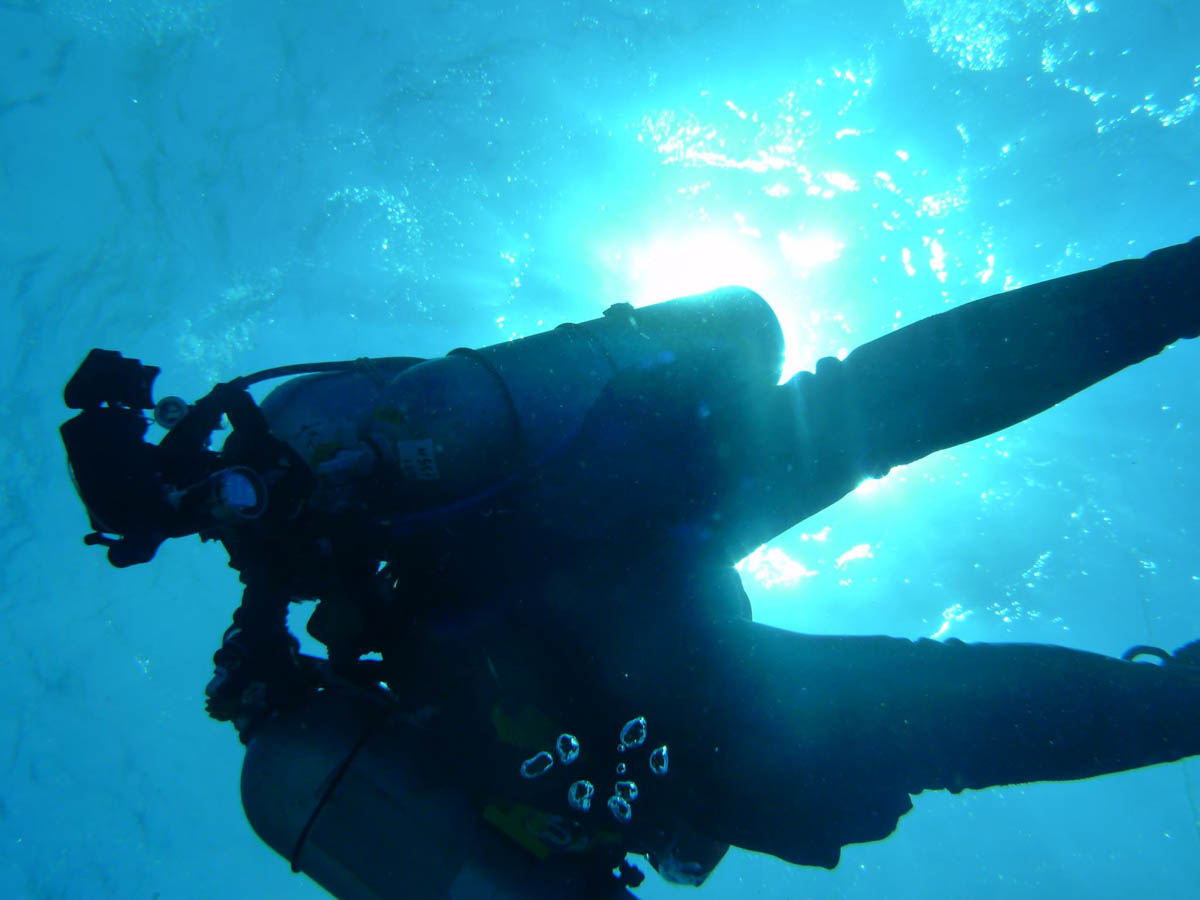

For many divers, the first encounter with rebreathers comes wrapped in an appealing phrase: recreational rebreather diving. It suggests quieter dives, longer bottom times, less gas to carry and access to advanced technology without leaving the familiar comfort zone of recreational training.
But is that phrase genuinely helpful, or does it risk oversimplifying something far more complex?
This is not an argument against rebreathers. Quite the opposite. Rebreathers are remarkable tools that have transformed underwater exploration, photography, scientific research and wreck diving. The real question is whether calling any form of rebreather diving “recreational” helps divers make informed decisions about training, risk and progression.

What “recreational” usually means in diving
For most divers, recreational scuba is defined less by equipment and more by boundaries. Shallow to moderate depths, limited or no decompression obligations, straightforward gas planning and relatively simple failure modes. If something goes wrong, the solutions are usually immediate and intuitive, ascend, switch to an alternate air source, end the dive.
That mental model is deeply ingrained from entry-level training onward. It shapes how divers assess risk and how they interpret course labels and marketing language.
Why rebreathers change the equation
A rebreather is not simply a different way of carrying gas. It fundamentally changes how breathing gas is managed underwater. Instead of continuously supplying fresh gas and venting exhaled gas into the water, a rebreather recycles the breathing loop, adds oxygen as needed and relies on chemical scrubbers to remove carbon dioxide.
That design brings enormous benefits, but also introduces new considerations. Oxygen levels must be actively managed. Carbon dioxide removal depends on correct packing, monitoring and time limits. Sensors, electronics or mechanical systems must function correctly, and when they do not, the consequences can develop faster than many open-circuit divers expect.
None of this makes rebreathers unsafe by definition, but it does mean they are less forgiving of complacency and misunderstanding.
Where the term “recreational rebreather” comes from
Training agencies did not invent the term casually. Organisations such as PADI, BSAC, SSI, RAID, NAUI and CMAS all offer structured rebreather training pathways designed to introduce divers to closed-circuit systems within carefully defined limits.
Entry-level rebreather courses typically restrict depth, limit decompression exposure and focus heavily on procedures, drills and unit-specific familiarity. In that narrow sense, the diving being taught sits within a recreational envelope, even though the equipment itself is more complex.
As divers progress, those same agencies clearly distinguish between introductory rebreather training and advanced courses that include staged decompression, deeper depths or the use of helium-based gas mixes. At that point, the diving is unambiguously technical, regardless of what equipment is being used.
Why the label can still mislead
The potential problem is not the training itself, but how the word “recreational” is interpreted by divers.
To an experienced instructor, “recreational rebreather” means limited depth, conservative profiles and strict adherence to procedures. To a newly qualified diver, it can sound like a reassurance that rebreather diving carries risks similar to ordinary open-circuit fun diving.
That gap in interpretation matters. Rebreathers demand a higher level of pre-dive preparation, in-water discipline and post-dive awareness, even on shallow dives. Skipping checks, rushing assembly or relying on assumptions rather than procedures carries greater consequences than it would on open circuit.
Where trimix draws a clear line
Once helium is introduced to manage narcosis at depth, any remaining ambiguity disappears. Trimix diving, whether on open circuit or a rebreather, involves complex planning, multiple contingencies and staged decompression. All major agencies treat trimix training as technical diving, and rightly so.
At that stage, the word recreational no longer serves any useful purpose. The equipment may be familiar, but the dive objectives, risks and required mindset have fundamentally changed.
So, is it really an oxymoron?
Not entirely, but it is an imperfect shorthand.
There is a form of rebreather diving that sits within recreational limits when it is properly trained, conservatively planned and rigorously executed. Entry-level rebreather courses exist to introduce divers to the technology safely, not to blur the line between casual and advanced diving.
The danger lies in assuming that because something is described as recreational, it is simple, intuitive or forgiving. Rebreathers are none of those things, even when used shallow.
What divers should take away from this
If you are considering rebreather training, focus less on the label and more on the reality of what is being taught. Ask about depth limits, decompression exposure, bailout requirements and how much time is spent on failure management. Understand that moving to a rebreather is not a shortcut, it is a commitment to a more procedural style of diving.
Rebreathers open extraordinary opportunities underwater. They reward preparation, discipline and continuous learning. Whether you call that recreational or technical matters far less than approaching it with the respect it deserves.
Comments