






Patrick Vincent Coleman (13 March 1872 – 6 December 1917) worked as a train dispatcher for the Canadian Government Railways (previously the Intercolonial Railway of Canada). He lost his life in the Halifax Explosion, but not before sending a crucial warning to an approaching passenger train, instructing it to halt before entering the danger zone. His actions have made him one of the most celebrated heroes of the disaster.
Around 8:45 a.m., the French munitions ship SS Mont-Blanc, loaded with high explosives, collided with the Norwegian vessel SS Imo. Moments after the impact, Mont-Blanc caught fire, prompting its crew to abandon ship. With the tide nearly still, the burning vessel drifted toward Pier 6 and grounded there within minutes. A sailor—reportedly sent by a naval officer—rushed ashore to alert Coleman and Lovett about the dangerous cargo on board.
On the morning of 6 December 1917, 45-year-old Patrick Coleman was on duty at the Richmond station with Chief Clerk William Lovett. The station sat in the middle of the busy rail yards near the base of Richmond Street, only a few hundred feet from Pier 6. From this location, they managed train movements along the main rail line leading into Halifax. The route followed the western edge of Bedford Basin, stretching from Rockingham Station down to the North Street passenger terminal, about a mile south of Richmond Station. Coleman was a seasoned dispatcher, known for having been praised a few years earlier for his role in stopping a runaway train safely.

Read The Scuba News Article on Halifax explosion’s toll in 1917 only surpassed by WW2 atomic bombs
Meanwhile, the overnight express Train No. 10 from Saint John, New Brunswick, carrying close to 300 passengers, was scheduled to reach Halifax at 8:55 a.m. Before evacuating the office, Lovett contacted CGR terminal agent Henry Dustan to warn him that a burning, explosives-laden ship was heading toward the pier. After this message was sent, both men were believed to have left the depot. Coleman, however, returned to the telegraph room and continued transmitting urgent warnings up the line as far as Truro, instructing inbound trains to halt. One widely accepted version of his Morse transmission reads as follows:
“”Hold up the train. Ammunition ship afire in harbour making for Pier 6 and will explode. Guess this will be my last message. Good-bye, boys.””” Patrick Vincent Coleman

The warnings sent over the telegraph appear to have been effective: Train No. 10 was brought to a stop just before the blast. It was held at Rockingham Station, along the western edge of Bedford Basin, roughly 6.4 km (4 mi) from Halifax’s main terminal. After the explosion, Coleman’s message—along with subsequent transmissions from railway staff who reached Rockingham—carried news of the catastrophe across Canada. The railway acted quickly, organizing emergency assistance and dispatching a dozen relief trains loaded with firefighters and medical personnel from communities in Nova Scotia and New Brunswick on the same day. Additional support arrived two days later from other parts of Canada and from the United States, including significant aid from Boston. Although Lovett had managed to leave the station beforehand, both he and Coleman were killed in the blast.
There is ongoing debate among historians about whether Coleman’s first warning directly caused No. 10 to be stopped. However, some evidence supports this possibility. Conductor Gillespie told the Moncton Transcript that even though his train was running on schedule, “his train was held for fifteen minutes by the dispatcher at Rockingham,” suggesting the message may indeed have played a role.
Vince Coleman has been featured prominently in Canadian popular history. He was the focus of a Heritage Minute and appeared as a key character in the CBC miniseries Shattered City: The Halifax Explosion. However, both the Heritage Minute and other retellings include several inaccuracies. They often depict Coleman warning people in the immediate area around the depot, when in fact the Richmond Station was surrounded mainly by freight yards, not nearby crowds. These sources also significantly inflate the number of passengers on the Saint John train, claiming there were 700 onboard, although the four-car overnight train could carry no more than about 300. The wording of his telegraph warning is also altered in dramatized versions.
Coleman’s telegraph key, along with his watch and pen, are preserved in the Halifax Explosion exhibit at the Maritime Museum of the Atlantic.
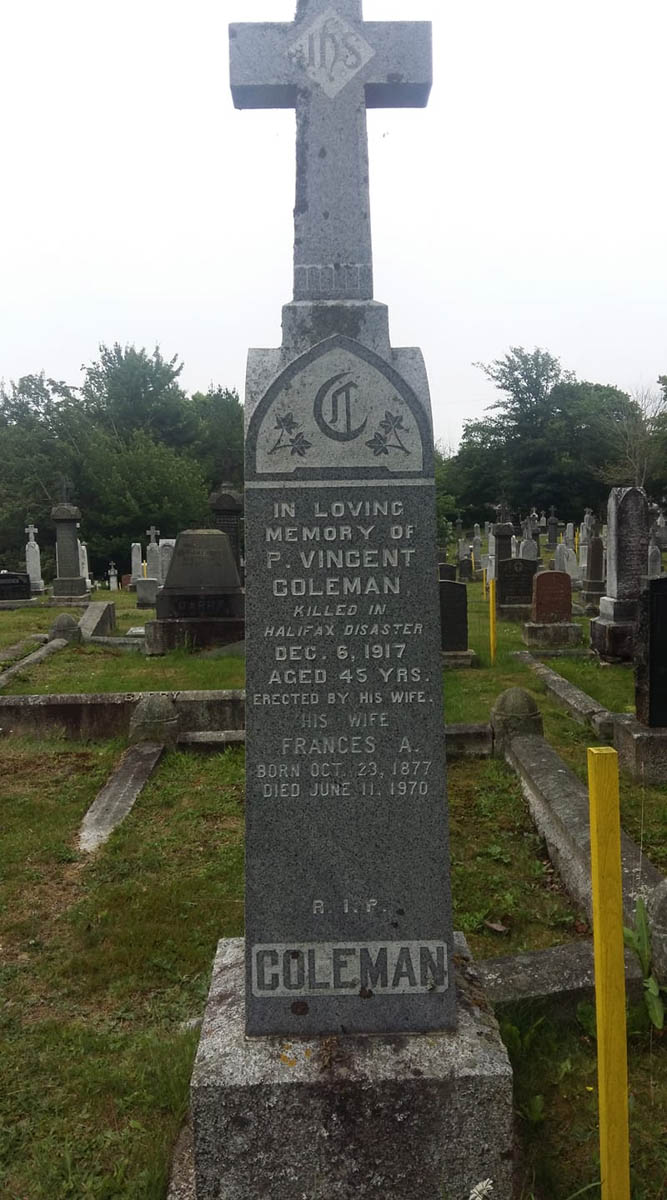
He is buried in Mount Olivet Cemetery in Halifax, near the intersection of Mumford Road and Joseph Howe Drive. His legacy is reflected across the city: a street in the Clayton Park area bears his name, and in 2007 part of Albert Street near his former home was renamed Vincent Street. A condominium on Bayer’s Road, close to Mount Olivet Cemetery, also carries his name—The Vincent Coleman—as a tribute.
Coleman’s wife, Frances (1877–1970), outlived him, though she and the youngest of their four children were badly hurt in the explosion.
Coleman’s contributions were further recognized when he was inducted into the Canadian Railway Hall of Fame in 2004. In 2017, residents voted to name a Halifax harbour ferry the Vincent Coleman. The vessel was formally dedicated and entered service on 14 March 2018.
Comments