



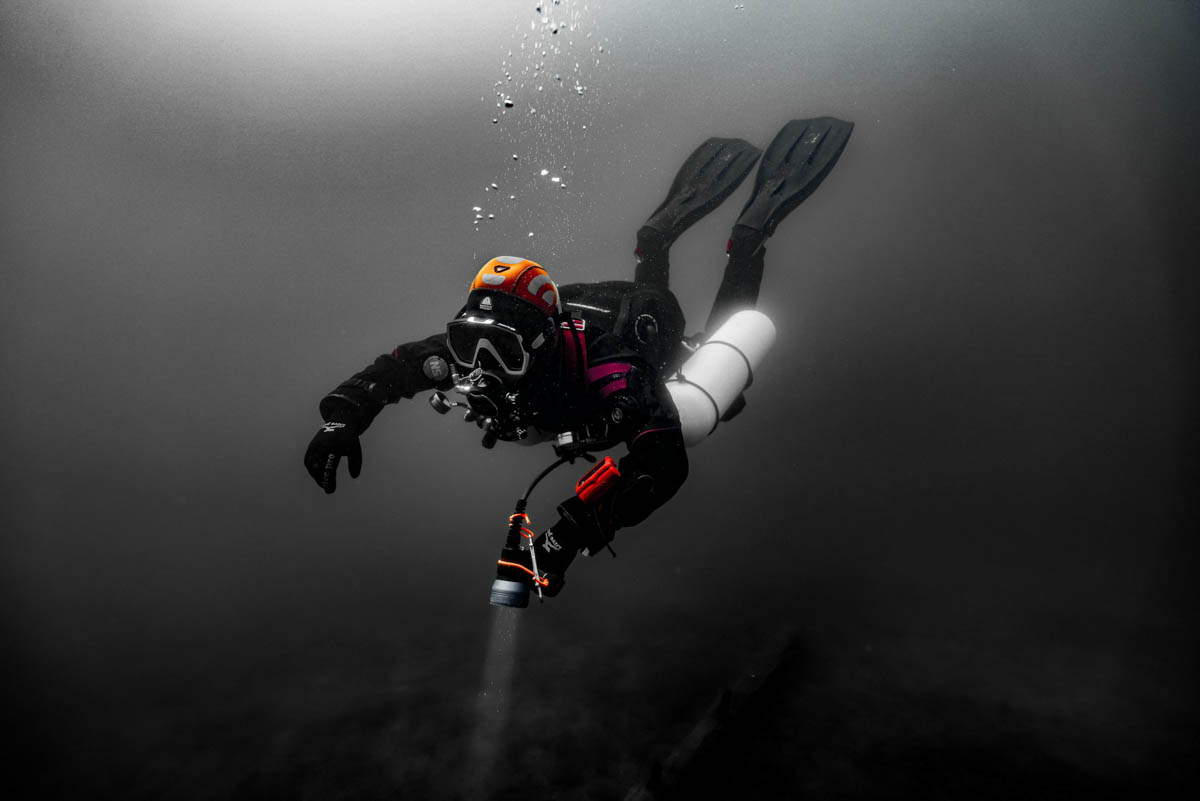

A Quiet Path in a Shared Sport
Diving alone has always lived in the grey space between independence and risk. Recreational training built its foundation on the buddy system, yet some of the most skilled divers in the water prefer to move through the ocean with quiet focus and full ownership of every decision. To understand why, you have to look deeper than simple debate and explore the psychology, preparation, and discipline that define the solo diving mindset.

How Solo Diving Evolved Into a Recognised Discipline
The history is more nuanced than many divers realise. Before recreational agencies formalised training standards, early divers often relied entirely on themselves. Over time the buddy system became the default safety model, taught everywhere from beginner programmes to advanced recreational courses. Even so, a growing group of experienced divers continued to advocate for structured self reliance, supported by training and redundant equipment. Several agencies now teach this formally, including the widely respected Self Reliant Diver programme from PADI and the Solo Diver curriculum from SDI, both designed to reduce risk for divers who choose to operate independently.
Local rules vary from country to country, which means solo divers must always check the legal position before planning a dive. Some regions accept self reliant diving without restriction, while others limit or prohibit it. Most recreational environments leave the final decision to the diver, but the responsibility is absolute when you choose to go alone.

Why Some Divers Choose to Go Alone
The motivations are highly personal. Many photographers and videographers prefer to work without distraction, particularly when waiting for wildlife behaviour or soft light. Other divers pursue independence because they trust their own procedures more than an unknown buddy on a holiday boat. Sometimes the choice is practical, especially in remote locations where matching experience levels is difficult. What is consistent is that solo diving is rarely the habit of novices. It is usually the deliberate choice of divers who understand not only what can go wrong, but how quickly a small distraction can escalate.
Understanding the Risk and the Reality
Statistics are challenging to interpret because many fatalities labelled as solo began as buddy dives that ended in separation. Even so, multiple incident analyses show that divers are frequently alone at the moment a problem becomes fatal. Experience levels also matter. A significant proportion of recorded fatalities involve divers with limited experience or poor preparation rather than divers trained in self reliance. This is one of the reasons agencies stress that solo diving is not a shortcut and should never be attempted until competence, comfort, and calm decision making are fully established.
The Real Solo Diver Mindset
The solo diver’s mindset is built on attention, humility, and preparation. Solo divers monitor everything. They treat instrument checks as non negotiable, remain aware of depth, gas, and environmental changes, and avoid dives where external factors could overpower planning. There is no space for complacency. They accept responsibility from the moment they enter the water, and they plan contingencies rather than depending on the optimism that a buddy will solve a problem. Conservative dive profiles are the norm, especially when working within no decompression limits, mild currents, and familiar terrain. The rhythm is slow, steady, and deliberate.
Training That Builds Self Reliance
Training adds a second layer of security. A structured programme gives divers a framework for problem solving and teaches them to evaluate dives based on gas requirements, bailout procedures, and their own psychological readiness. Courses like the Self Reliant Diver or SDI Solo Diver emphasise skill assessments, emergency drills, and redundant equipment management. Their purpose is not to encourage divers to abandon the buddy system, but to ensure that anyone who chooses this path does so with competence rather than misplaced confidence.
Redundancy and Equipment That Solo Divers Trust
Equipment choice is another defining part of the mindset. Redundancy is the golden rule. That means a completely independent breathing gas supply, such as a properly configured pony cylinder or bailout system, supported by a separate second stage, a backup depth and time device, and reliable surface signalling gear like a DSMB, whistle, or mirror. Many solo divers carry an alternate method of BCD inflation and keep cutting tools within immediate reach. Redundancy only works if it is practiced. Switching to backup regulators, deploying emergency equipment, and solving minor failures should be familiar muscle memory long before the first independent descent.
Planning With a Different Kind of Responsibility
Planning takes on a different tone when you remove the safety net of a buddy. Solo divers create personal emergency plans that include surface contacts, estimated dive times, and precise turnaround points. They leave copies with a trusted person on shore, evaluate the conditions with conservative limits, and are honest about fatigue or distraction. Psychological readiness is central. If concentration is not perfect, the dive does not happen. Simple decisions like postponed dives are often the ultimate expression of self reliance.
Where Solo Diving Has No Place
Some dives should never be attempted alone. Overhead environments, penetration wrecks, and decompression dives belong to trained teams or divers with professional support. Strong currents, extreme cold, poor visibility, or remote sites also demand greater risk controls. Solo divers acknowledge these limits because their mindset is built on realism, not bravado.
Autonomy With Respect for the Ocean
For those who choose the path, solo diving can be peaceful and intensely rewarding. It sharpens awareness, deepens respect for the environment, and strengthens personal discipline. It also carries consequences that cannot be shared. The solo diver’s mindset is therefore not about isolation, but about responsibility. It is built on calm preparation, strong skills, honest self evaluation, and equipment that is chosen and maintained with care.
Solo diving is autonomy with humility. If you feel drawn toward it, take formal training first, practise until confidence is earned, carry the right redundancy, and move slowly into simple conditions that you know well. The ocean will always reward preparation.
Comments






1 Comment
I started diving in ex. Yugoslavia Navy 1984. Now, I am I** CMAS and representative of Croatian diving Assotiation in CMAS Scientific comitee. I started solo diving in 1991. Still doing that, let say 60% of my dives are solo diving – sometimes in (marine) caves, zero visibility, hard work and deco dives. I always triple check all my stuff and prepare scenario(s) exiting in an emergency. And still kicking……