




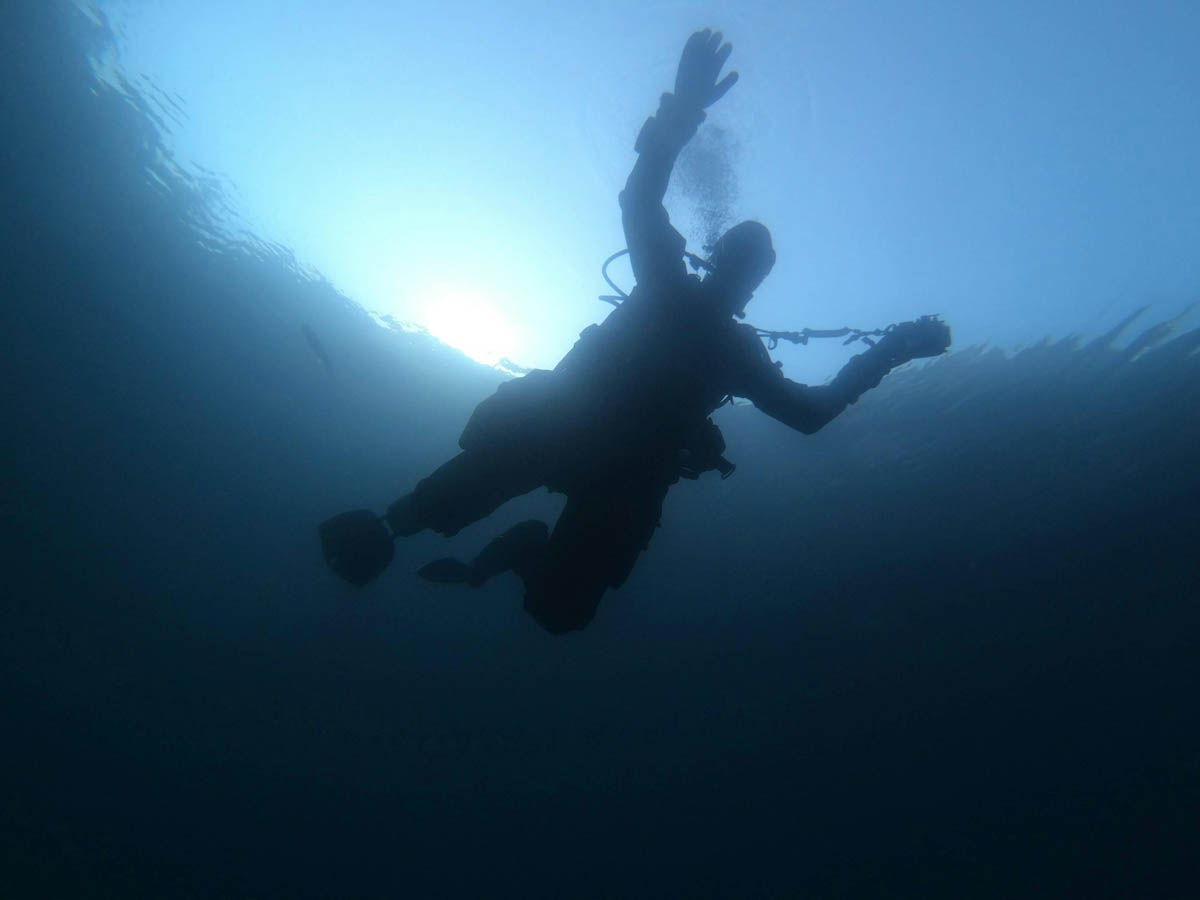

The recent death of a British diver following a solo dive off Gili Air has reignited one of scuba diving’s most polarising questions.
Should divers ever dive alone?
For decades, the answer was simple. No. The buddy system was considered fundamental to survival underwater. But modern training, evolving diver behaviour, and hard realities beneath the surface have blurred that line.

Today, solo diving sits in a controversial middle ground, no longer taboo, but far from universally accepted.
From Rule to Risk-Managed Choice
Training agencies have not ignored the shift. Instead, they have adapted to it.
Courses like the PADI Self-Reliant Diver program, the SDI Solo Diver certification, and SSI’s Independent Diving pathway acknowledge a reality many divers already know.
Divers are not always truly diving as a pair.
These programmes do not encourage casual solo diving. They are built around redundancy, discipline, and self-rescue, requiring significant experience before even being considered. According to the PADI Pros blog discussion on self-reliant diving, the focus is not independence for its own sake, but preparation for scenarios where a diver may effectively be alone.
Why Divers Choose to Go Solo
Among experienced divers, the reasons for solo diving are rarely reckless. More often, they are practical.
Freedom is a major factor. Without a buddy, there is no compromise on dive time, air consumption, or objective. Photographers and videographers in particular often operate independently in practice, even when paired.
There is also a less comfortable truth.
Not all buddies improve safety.
Poor communication, mismatched experience levels, or complacency can introduce risk rather than reduce it. The concept of the buddy system, while essential in training, does not always translate perfectly in real-world conditions.
For some divers, self-reliance becomes the safer option, not the riskier one.
What Divers Are Saying
Across Reddit and diving forums, the conversation is candid and often divided.
One diver described self-reliant training as:
“the most useful course I’ve done… it makes you more aware and forces you to plan properly”
Others point out a practical barrier. Many dive operators will only permit solo diving with formal certification, reinforcing that this is not an informal or casual activity.
At the same time, strong opposition remains.
A consistent theme across social media is that solo diving increases exposure to risk in an already unforgiving environment, particularly when attempted without proper training or redundant systems.
The Reality of Risk
This is where the debate sharpens.
Diving alone removes the single biggest safety layer in recreational scuba.
There is no immediate assistance in the event of:
- Gas supply issues
- Equipment failure
- Medical emergencies
- Disorientation or entanglement
The risks are not theoretical. They are immediate and absolute.
That is why structured solo diving requires:
- Redundant gas supply
- Backup systems
- Advanced planning
- Strict personal limits
Without these, solo diving moves from controlled discipline into dangerous territory.
The Grey Area Most Divers Already Occupy
There is an uncomfortable truth at the centre of this discussion.
Many divers are already effectively diving solo.
Buddies become separated. Objectives differ. Visibility drops. Attention narrows.
In these moments, the idea of a reliable, immediate backup disappears.
This raises a critical question.
If your buddy cannot reach you when it matters, are you really diving as a pair?
Where the Industry Stands
Despite the rise of solo and self-reliant training, the buddy system remains the foundation of recreational diving.
Agencies continue to promote it as best practice.
Even within self-reliant courses, the message is consistent. Solo diving is a specialised discipline, not a replacement for standard diving practices. The PADI Pros perspective on solo diving risk and responsibility reinforces that it is suitable only for experienced divers who accept full responsibility for their safety.
Many dive operators still prohibit solo diving entirely.
The Real Question Isn’t Solo vs Buddy
The debate is often framed as a binary choice.
It shouldn’t be.
The real issue is not whether a diver is alone. It is whether they are capable of surviving without assistance if they are.
That distinction matters.
Because whether planned or accidental, every diver will face moments underwater where they are, in practical terms, on their own.
The Takeaway
Solo diving is not inherently reckless. But it is not forgiving either.
Done properly, it is structured, disciplined, and deliberate.
Done poorly, it removes the last margin for error.
The recent incident has not just reignited debate. It has exposed a deeper truth within diving.
Safety is not defined by whether you have a buddy.
It is defined by whether you are prepared when that buddy is no longer there.
Comments






1 Comment
A statement often given by solo divers is, ‘they’re better off solo than diving with a buddy who increases the overall risk’ (due to the things mentioned above in the article). Overall, I can see why this statement is made. I believe that an effective dive team is better than a solo diver who is better off solo than diving with an ineffective team. With this all in mind though, why don’t divers who have a poor experience with a buddy put more effort into developing their buddy rather than accepting the increased risk of diving solo? We talk about solo divers not being complacent but, by definition, not putting effort into debriefing and developing their buddies is, in itself, complacent behaviour. Solo divers also often state that they accept the risks of diving solo. This implies that they’re aware the risk is increased but I would argue that we don’t really manage risk in diving, we manage uncertainties. I.e. it won’t happen to us. Until it does. And then it is often the families left with no answers and, if they have no body, they also have no closure and no life insurance. So should we accept the risk of diving solo? Or put more effort into developing our team mates?