




The Ultimate Reality Check
Nobody’s watching you down there.

Every Open Water class has that moment. We’re talking about depth limits and I say, “When you finish open water, you’ll be certified to 60 feet.” And somebody, usually with a grin on their face, asks:
“So what happens if I go to 61?”

They’re trying to be funny. Maybe a little clever. At least they think they are.
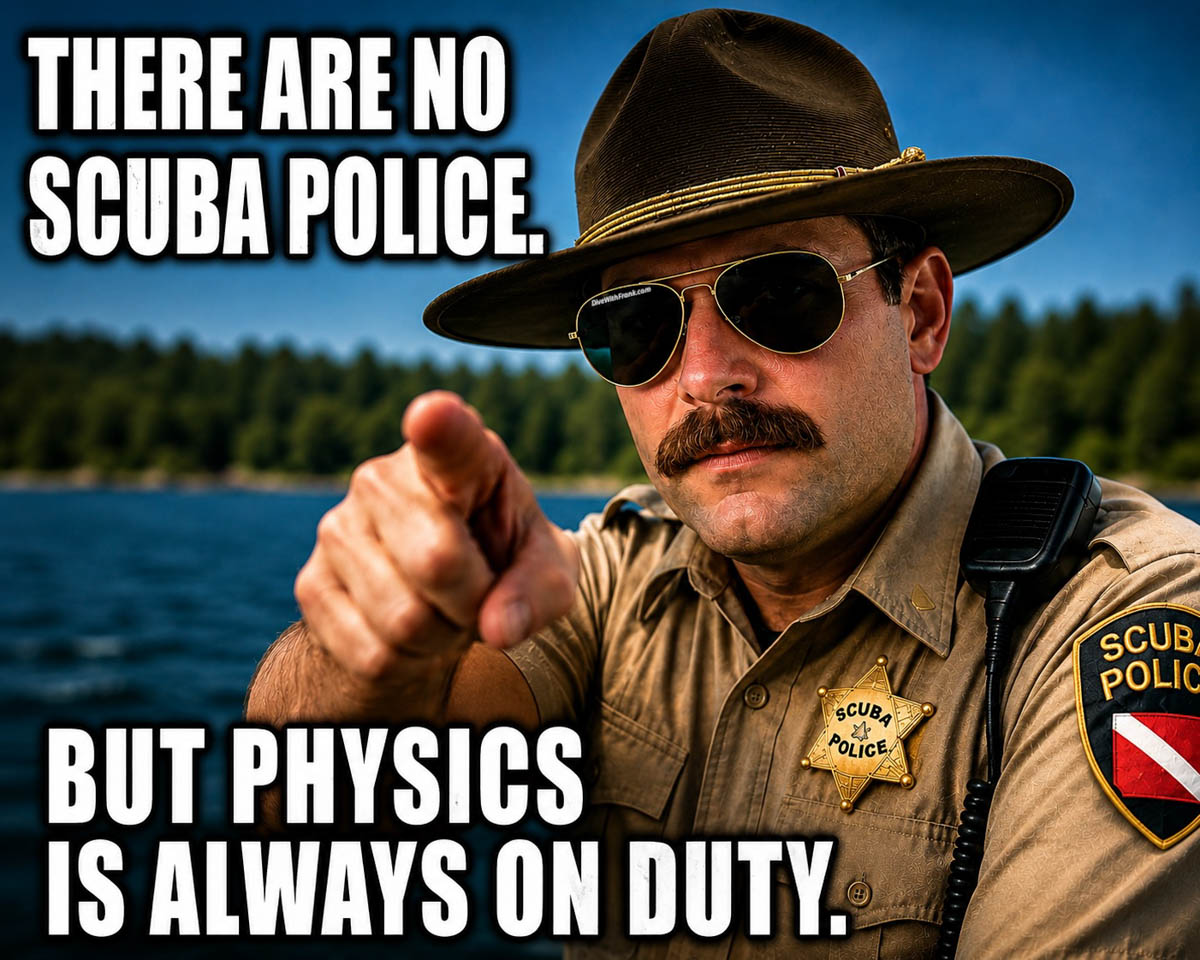
My answer is always the same: “There are no scuba police.”
Everybody laughs. But hidden inside that joke is one of the most important realities in recreational diving.
Nobody Is Going to Stop You
There’s no underwater enforcement agency. No reef ranger hiding behind a coral head waiting to write you a ticket. Nobody is going to physically stop you from stretching your limits, ignoring conditions, skipping a check, or making questionable decisions because “it’ll probably be fine.”
Once you hit the water, it’s basically you, your buddy, and your judgment. That’s the system.
And that freedom is part of what makes diving incredible. Scuba still operates heavily on personal responsibility. You are trusted to make smart decisions. You are trusted to understand your own limits. You are trusted to not do dumb things that put yourself or other people at risk. Most of the time, that works really well.
You Can Get Away With It… Until You Can’t
This is where people get themselves into trouble. You can make bad decisions in diving for a surprisingly long time before anything bad actually happens. That’s dangerous. Because human beings are really good at confusing luck with skill, familiarity with mastery, and survival with competence.
You skip something once. Nothing happens. So your brain quietly starts rewriting the rules:
- “Maybe this isn’t actually important.”
- “Everybody overreacts.”
- “I’ve done this before.”
That’s how complacency sneaks in. Not all at once. Just a tiny little shortcut here and there until eventually your standards start drifting. And because nothing went wrong immediately, people assume they’ve discovered some deeper truth the rest of us missed. They haven’t. They’ve just been lucky. So far.
Physics Does Not Care About Your Confidence
One of the hardest things to explain to newer divers is that the ocean doesn’t grade on effort. Physics does not care if you’re confident, if you watched YouTube videos, if your buddy said it was okay, or if you’ve “done this before.”
Pressure is pressure. Gas is gas. Your body responds the way it responds. That’s it.
You can absolutely ignore good diving practices for a while and still come home smiling with great photos and a fun story. Until the day conditions line up differently. Until stress stacks up. Until task loading kicks in. Until one small issue snowballs into three. And underwater, little problems have a nasty habit of becoming big problems quickly. Not because diving is evil. Not because the ocean is angry.
Just because physics is always on duty.
The Rules Weren’t Invented to Ruin Your Fun
I don’t make the rules. Your instructor didn’t make the rules. Safe diving practices exist because thousands and thousands of divers collectively learned what works and what doesn’t over decades. Sometimes through experience. Sometimes through accidents. Sometimes through tragedy.
Every “annoying” little procedure you learned in class exists because at some point somebody discovered why it mattered. Usually the hard way.
That’s worth remembering the next time somebody starts acting like dive limits were invented just to ruin their fun. You’re not being controlled. You’re benefiting from generations of people figuring this stuff out before you ever put a regulator in your mouth. That’s a pretty good deal if you think about it.
BWRAF: Why Real Experts Never Skip the Pre-Dive Safety Check
Take the pre-dive safety check. BWRAF.
Back before Bruce Willis got sick, I used to jokingly tell students it stood for: “Bruce Willis Ruins All Films.” Which: a) was funny, b) wasn’t true, and c) was somehow easier to remember and sounded more manly.
But joke or not, I’ve always taken the actual check seriously. A lot of divers eventually start treating BWRAF like a formality. I don’t. I do a BWRAF every single time I gear up. Every dive. No exceptions.
I’m fast now. It takes seconds. But I still do it because it catches problems regularly. About one out of every twenty times, I find something that would have turned into an annoyance underwater. And every once in a while? I find something serious.
Like somebody trying to be helpful and shutting off my air without telling me. That’s not hypothetical. That actually happened.
That’s why experienced divers keep doing basic things. Not because we’re obsessed with rules. Not because we enjoy checklists. Because simple mistakes underwater can matter a whole lot more than they do on land.
Personal Responsibility vs. Industry Regulation in Recreational Scuba
People sometimes imagine scuba safety as this giant structure full of oversight and enforcement. It really isn’t. The reason recreational scuba is as safe as it is comes down mostly to culture. Most divers genuinely care about doing things correctly, improving their skills, watching out for their buddies, staying within reasonable limits, and coming home safely.
And yes, there are absolutely people who ignore all of that. I’ve seen them. Every instructor who’s been around long enough has. Some people cut corners constantly. Some people treat diving like they’re immune to consequences. Some people mistake confidence for competence. And some of them get away with it for years. But the system still works because enough divers take safety seriously enough to keep the culture healthy. That matters more than people realize.
Open Water certification is not the finish line. It’s barely the starting point. The goal isn’t to become the deepest diver the fastest. The goal isn’t to impress people. The goal is to build experience slowly enough that your judgment keeps pace with your confidence.
Comfortable. Calm. Competent. That’s the sweet spot. This is a marathon, not a sprint. Nobody hands out trophies for becoming overconfident early.
Building Judgment Over Confidence: Why the Long Game Matters
On the human side of things, I genuinely want my divers safe. I want people enjoying this sport twenty years from now. I want them traveling, exploring, seeing cool things underwater, and building confidence over time instead of becoming another avoidable accident story.
But there’s also a practical side to this. If recreational divers as a group suddenly started acting recklessly and getting hurt in huge numbers, the industry would absolutely see pressure for more regulation and oversight. That’s reality. A lot of the freedom divers currently enjoy exists because the community, overall, does a pretty good job policing itself culturally. Not perfectly. But well enough.
There are no scuba police. Nobody is coming to save you from bad judgment underwater. That responsibility belongs to you. And that’s probably how it should be.
Because good divers aren’t created by fear of punishment. They’re created by discipline, awareness, humility, and experience.
As I tell my kids:
Make good choices.
Comments