

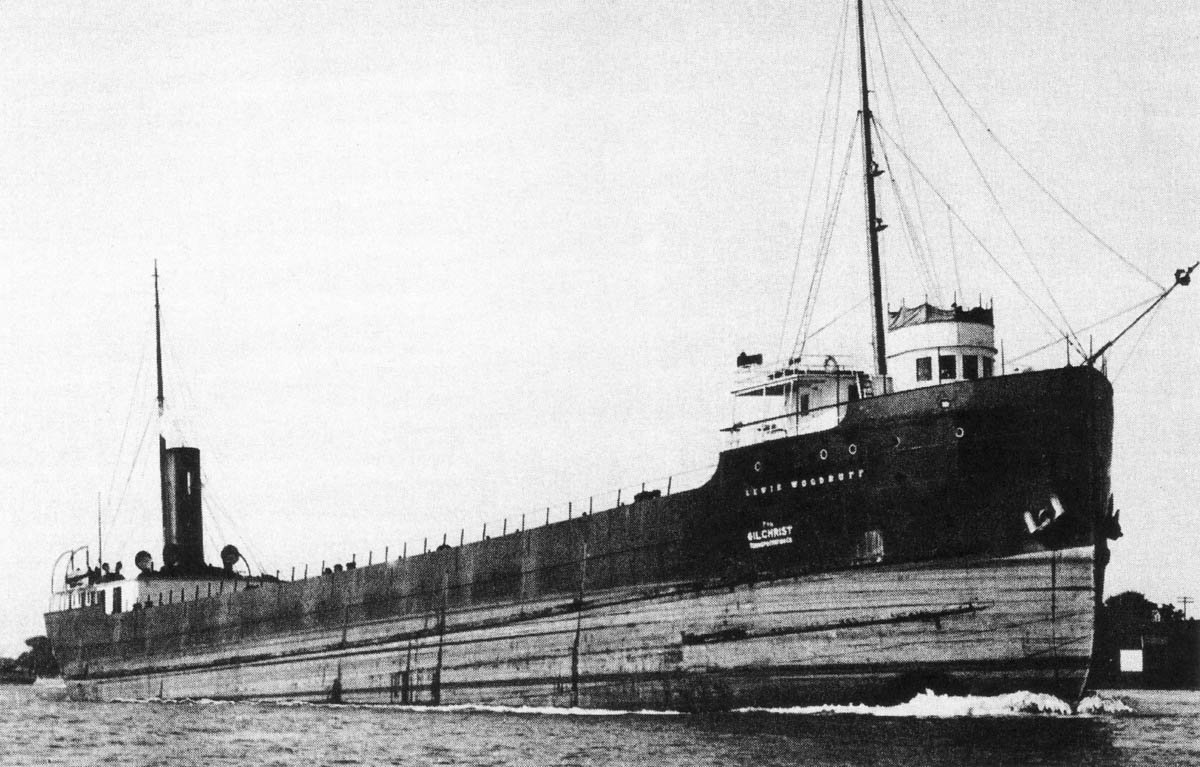
The SS Argus was a lake freighter built in 1903 as the Lewis Woodruff by the American Ship Building Company in Lorain, Ohio. Originally operated by Cleveland’s Gilchrist Transportation Company, the vessel changed hands in 1913, three years after Gilchrist went into receivership, when Pickands Mather & Company’s Interlake Steamship Company purchased her at auction and rechristened her Argus. Throughout her decade-long career on the Great Lakes, the freighter suffered a history of multiple accidents.
Her final voyage began on November 9, 1913, when Captain Paul Gutch navigated the Argus into Lake Huron. She was heading upbound toward Chicago, Illinois, carrying a shipment of coal that had been loaded in both Sandusky, Ohio, and Buffalo, New York. Upon venturing into open water, the ship ran directly into massive waves and blinding snowfall driven by the most devastating storm to ever hit the Great Lakes. The severe seas eventually overwhelmed the struggling vessel later that day, causing her to founder and killing every member of the crew. Uniquely among the major shipwrecks of that storm, the sinking of the Argus was the only loss directly witnessed by sailors aboard another passing ship.
Decades later, in 1972, searchers located the wreck resting inverted roughly 13 miles (20.9 km) north of Point Aux Barques, bearing visible damage along her stern.
Between the early 1870s and the mid-1880s, Great Lakes shipbuilders began adopting iron construction on a significantly broader scale. This evolution accelerated in 1884 with the introduction of the region’s first steel-hulled freighters, making metal a standard building material across regional shipyards by the 1890s. During this transition, technological innovations like pneumatic riveting guns and overhead gantry cranes drastically improved shipyard efficiency and worker output. Driven by these manufacturing advances alongside a steep decline in steel costs, the physical dimensions of lake freighters expanded rapidly through the late 19th and early 20th centuries.

Final Voyage
Commanded by Captain Paul Gutch, the freighter Argus departed Sandusky, Ohio, on November 4, 1913, carrying 5,000 long tons of soft coal bound for Buffalo. Upon reaching Buffalo on November 7, she loaded an additional 2,000 long tons of cargo before setting out late that evening for Chicago, Illinois. As the ship pressed westward the following day, deteriorating weather across Lake Erie brought thick snowfall that severely hampered visibility. She reached the Detroit River by nightfall, navigating the Livingstone Channel and passing Detroit at 5:40 PM on November 8 before clearing the St. Clair River and entering Lake Huron early on November 9.
Out on the open lake, the Argus collided with the violent fury of the most devastating storm in Great Lakes history, encountering blinding snow, sea smoke, and massive seas. Sustained winds roared at 60 mph, gusting up to 90 mph off Harbor Beach, Michigan. Because Lake Huron’s geography aligned with the northwesterly winds and offered minimal surface friction, the gale gathered strength unchecked, whipping up waves estimated by mariners to exceed 35 feet.
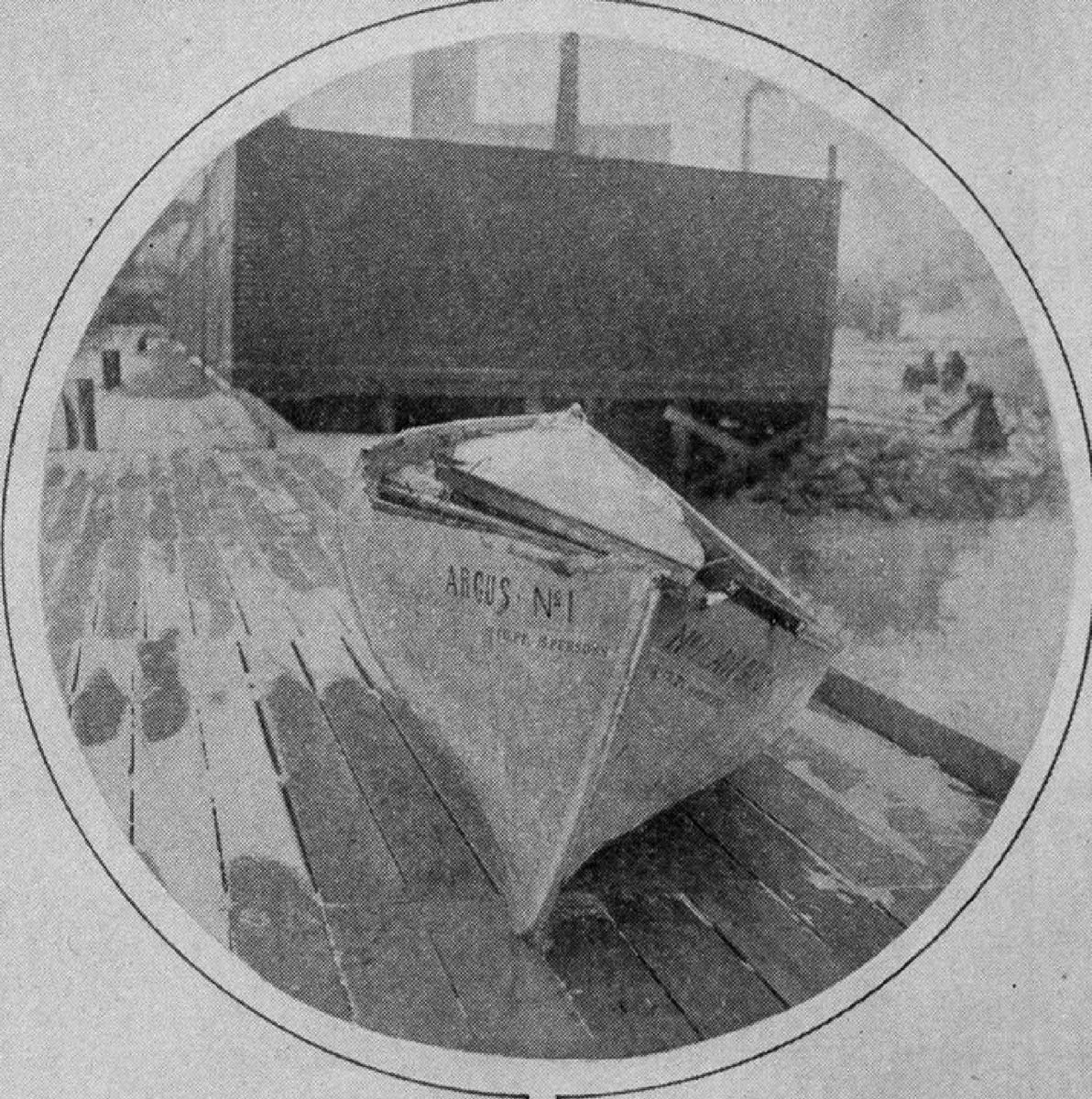

Late that afternoon, the downbound freighter George C. Crawford, having turned back to seek shelter in lower Lake Huron, crossed paths with the struggling vessel. Her master, Captain Walter C. Iler, observed the Argus wallowing helplessly as she failed to steer clear of the wave troughs. Positioned with her bow and stern balanced atop separate wave crests, the unsupported center of the hull buckled under the structural strain. Iler later recalled seeing the ship swing into a trough, crumple like an eggshell, and vanish beneath the water, making the Argus the only vessel whose sinking during the storm was directly witnessed by survivors. All 28 crew members lost their lives in the disaster.
The November 1913 gale claimed a total of twelve vessels, two-thirds of which foundered on Lake Huron alone. Among these losses, the destruction of the Argus represented a $200,000 financial blow to her owners (equivalent to roughly $4.66 million in 2024), contributing to an aggregate storm toll of over $3 million in vessel damage across the region (over $71 million in 2024). In the days following the disaster, debris and the remains of the Argus crew washed up along the southeastern Canadian coastline of Lake Huron, prompting the Lake Carriers Association to advertise a $25 bounty (about $582 in 2024) for every victim’s body recovered.
In 1972, diver Richard T. “Dick” Race discovered the wreck of the Argus approximately 13 miles (20.9 km) north of Point Aux Barques while searching for the missing bow of the freighter Daniel J. Morrell. Resting upside down in depths ranging from 220 to 250 feet (67.1 to 76.2 m), she became the first 1913 storm victim to be located in the modern era.
The ship exhibits distinct damage around her stern. Maritime historian Robert McGreevy suggested that shifting coal cargo initially caused the vessel to capsize, after which she likely drifted inverted for a prolonged period. During this time, her stern repeatedly struck the lake floor in the rough seas, a phenomenon seen in other inverted 1913 wrecks like the Charles S. Price, Isaac M. Scott, and John A. McGean, leaving the hulls, in McGreevy’s words, “twisted and distorted like a tube of toothpaste.”