

A 19-year-old South African swimmer has completed an extraordinary series of open-water challenges to highlight the need for shark protection. But months after conservationists were promised further discussions, questions remain over the government’s response.
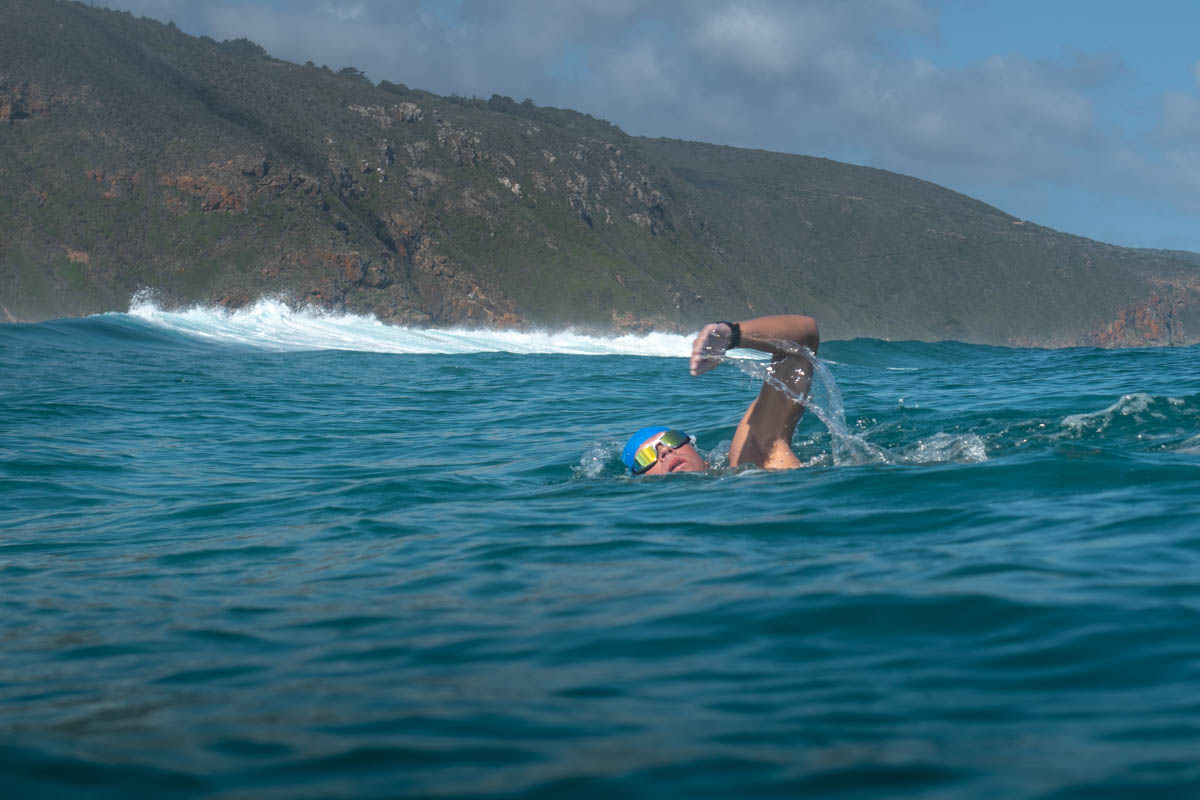
When Kane Johnstone entered the water off Mossel Bay for the third and final stage of Project DEEP, he was completing more than another demanding endurance swim.
The 19-year-old South African was finishing a journey that had taken him approximately 49 kilometres along some of the Western Cape’s most challenging coastline, drawing attention to a proposed conservation measure intended to protect important shark habitat from targeted commercial fishing.
The physical challenge is now complete. The conservation campaign that inspired it is not.
Earth Legacy Foundation, the organisation working alongside Johnstone, is still seeking meaningful engagement with South Africa’s Department of Forestry, Fisheries and the Environment (DFFE) over a proposed Shark Catch Exclusion Zone (SCEZ) for Mossel Bay.
Correspondence shared with The Scuba News outlines months of discussions, proposed meetings and subsequent attempts to obtain clarification over which government department is responsible for progressing the proposal.
The Scuba News also contacted DFFE directly on 8 October and followed up on 12 October, requesting clarification of the proposal’s status, the outstanding stakeholder meeting and any anticipated timetable for further engagement.
At the time of writing, no response had been received to those enquiries.
Three Swims Along the Coastline
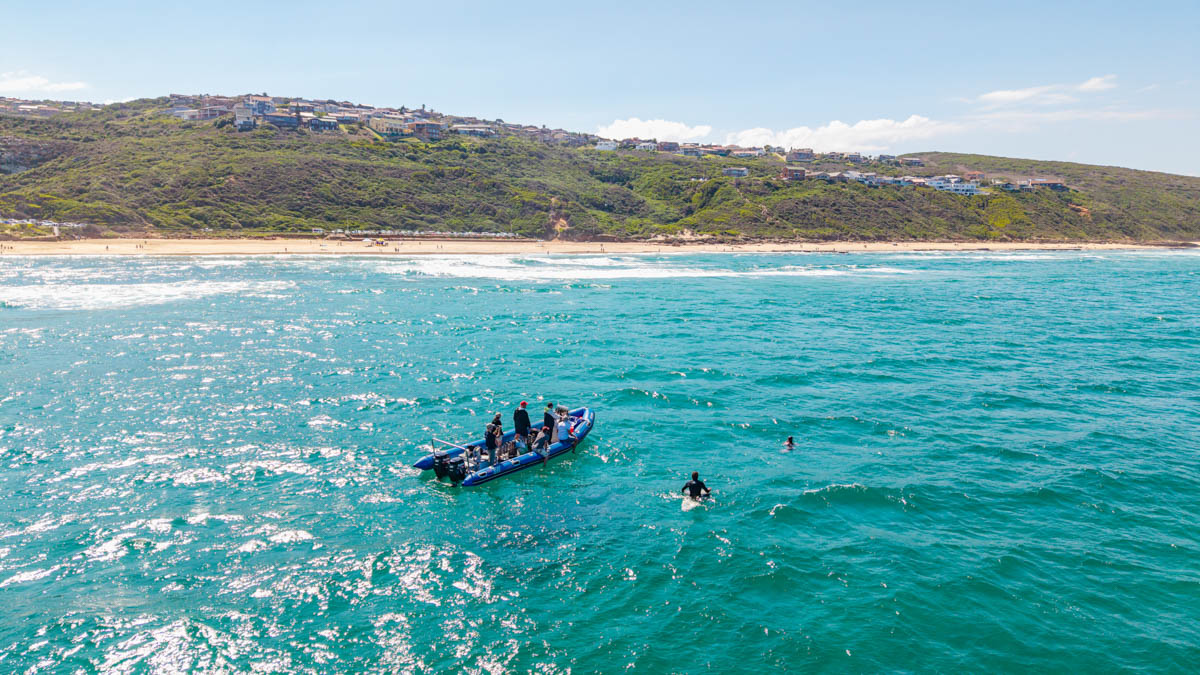
Project DEEP began on 19 February 2026, when Johnstone undertook an approximately 22-kilometre crossing from Mossel Bay’s The Point to Glentana.
The swim lasted around nine and a half hours and was intended to draw attention to the ecological importance of a coastline historically associated with significant shark activity.
During the crossing, Johnstone reported seeing no sharks, rays or fish.
Although an observation made during a single swim cannot establish the condition of an entire marine ecosystem, it became an important part of the campaign’s message about changes that local conservationists believe are taking place in Mossel Bay.
The second swim followed on 4 April, covering approximately 14.2 kilometres from Fransmanshoek to Dana Bay.
That route was selected to trace another section of the coastline associated with the proposed exclusion zone, giving the public a more tangible sense of the area campaigners want protected.
The third swim took place on 19 September, following a route of approximately 13 kilometres from Dana Bay’s First Beach to The Point.
Its exposed coastline, cold water and challenging sea conditions presented another substantial endurance test.
During the final crossing, Johnstone also encountered a southern right whale. The incident was subsequently reported by the Mossel Bay Advertiser, providing an unexpected wildlife encounter during a campaign focused on marine conservation.
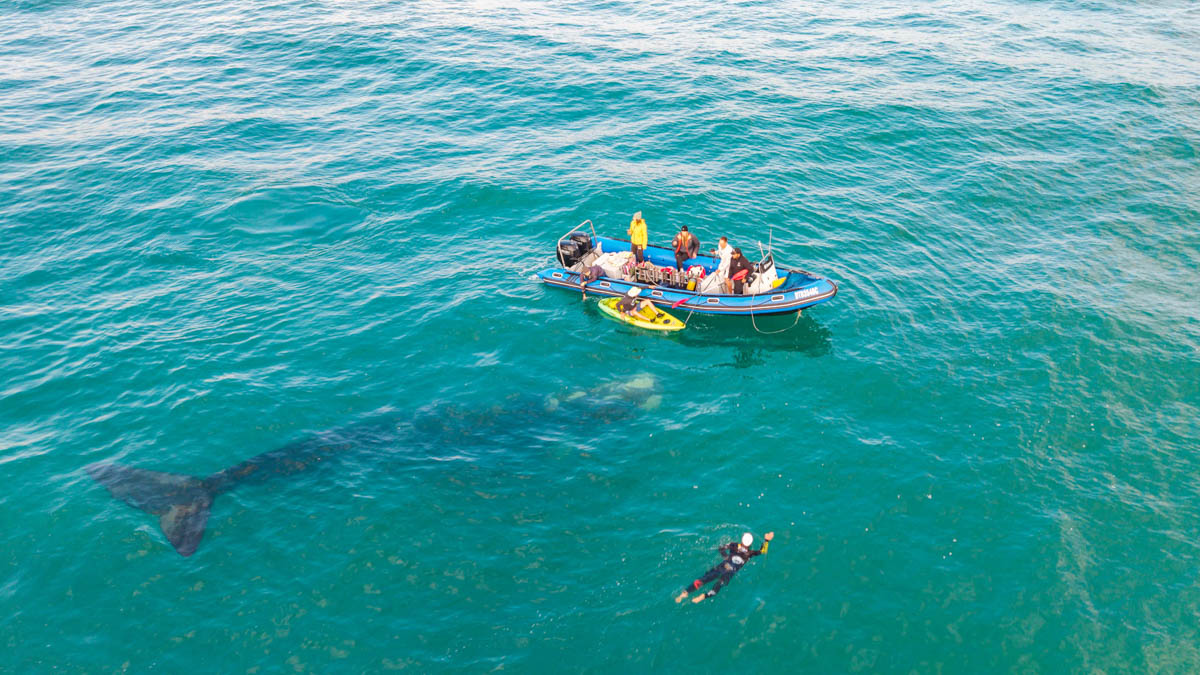
The three swims brought Johnstone back to the point where his project began.
Together, they covered approximately 49 kilometres.
The final swim also carried personal significance. Johnstone dedicated it to young conservation advocate Alba Overbeeke and to the memory of his friend Robin Skeates, who died in 2024.
But while the endurance component has ended, the campaign’s central objective remains unresolved.
What Is the Proposed Shark Catch Exclusion Zone?
The Mossel Bay Shark Catch Exclusion Zone proposal seeks to introduce geographically targeted restrictions on commercial shark fishing in areas considered important for shark aggregation, research and marine tourism.
Earth Legacy Foundation argues that these restrictions could reduce fishing pressure in key habitats while allowing commercial fishing activities to continue outside the designated areas.
The foundation’s concern centres particularly on the overlap between areas used by sharks, marine researchers and tourism operators, and those where demersal shark longline fishing is permitted.
Mossel Bay has a longstanding association with shark research and tourism, including the observation of white sharks and bronze whaler sharks.
Campaigners are concerned about reported changes in local shark sightings and believe that spatial protection could help safeguard the area’s ecological and economic value.
Those concerns warrant serious examination, but they also require a distinction between observations, scientific evidence and the effects of particular fishing activities.
A reduction in sightings does not, on its own, establish why sharks may be less visible in a particular area. Changes in distribution, environmental conditions, prey availability and fishing pressure can all be relevant to a scientific assessment.
South Africa already uses fisheries restrictions and spatial management measures in certain marine areas. Its published 2026 demersal shark fishing permit conditions contain provisions governing where longline fishing may take place.
The Mossel Bay proposal would require consideration of its ecological justification, geographical boundaries, enforcement arrangements and potential effects on licensed fishing operations.
These are questions for a formal assessment and engagement process involving government, scientists, fishers and other affected stakeholders.
What Happened to the Government Discussions?
The history of the campaign’s engagement with DFFE has become a significant part of the story.
In correspondence supplied directly to The Scuba News, Earth Legacy Foundation project director Esther Jacobs described an initial positive response from the department in 2025.
According to Jacobs, campaign representatives attended a meeting with the then minister and other conservation stakeholders on 18 December 2025, where they received verbal indications of support.
She subsequently sent four follow-up emails seeking progress but said she received no substantive reply until after Johnstone’s first swim in February 2026 had attracted media attention.
Following that swim, Jacobs said Mbulelo Dopolo, then identified to her as Director of Oceans and Coasts, contacted her and indicated that departmental representatives would arrange a meeting.
The prospect of government engagement was publicly highlighted by Earth Legacy Foundation in February, when it announced that a departmental delegation was expected to visit Mossel Bay.
According to Jacobs, officials subsequently circulated possible dates for a stakeholder meeting in April.
However, she said participants were later informed that a mutually suitable date could not be established and that alternative dates would be proposed.
The meeting did not take place.
Jacobs told The Scuba News that, after she followed up again, Dopolo advised that responsibility for the matter lay with Fisheries rather than Oceans and Coasts.
She then sent three further follow-up emails to Fisheries, copying other departmental representatives.
She said the only subsequent clarification concerned a change in departmental personnel and the appointment of an acting director.
Her most recent follow-up before contacting The Scuba News was sent on 28 August.
This account is based on correspondence and information provided by Jacobs. The Scuba News has not independently examined the complete underlying departmental email chain.
It is also important to distinguish between a delay in stakeholder discussions and a formal decision on the proposal. The absence of a meeting does not establish that the proposal has been rejected or abandoned.
Earth Legacy Foundation’s published campaign information continues to describe the proposal as under review, involving both Fisheries Management and Oceans and Coasts.
Questions That Remain Unanswered
The Scuba News approached DFFE directly on 8 October seeking clarification of the proposed zone’s current status and the department responsible for handling it.
We also asked whether a formal assessment had been undertaken of the proposal’s conservation and fisheries implications, why the anticipated stakeholder discussions had not progressed, and whether a timetable existed for further engagement or a decision.
A follow-up enquiry was sent on 12 October, requesting a response by 15 October.
No response had been received by publication.
Consequently, we cannot independently establish the department’s current internal assessment of the proposal, whether further stakeholder meetings are being arranged, or when a decision might be expected.
Any substantive response subsequently received from DFFE will be reflected in an update to this article.
The unanswered questions matter not only to campaign organisers but also to the wider discussion about how South Africa balances shark conservation, commercial fishing and the economic interests of its coastal communities.
From an Endurance Challenge to a Conservation Decision
Project DEEP has succeeded in making an otherwise technical fisheries-management proposal visible to a wider audience.
Three demanding swims have carried the campaign along the coastline it seeks to protect, while also drawing public attention to the importance of sharks in marine ecosystems.
Yet endurance swimming cannot resolve the scientific, economic and regulatory questions involved in creating a new fisheries exclusion zone.
Those questions ultimately require evidence, consultation and a transparent decision-making process.
For Earth Legacy Foundation, the immediate objective is to reopen constructive discussions with the authorities and establish what happens next.
For Johnstone, the physical journey has reached its conclusion.
For Mossel Bay’s proposed shark protection zone, the next meaningful milestone will not be another swim.
It will be clarity over whether, and how, the proposal can progress.
