




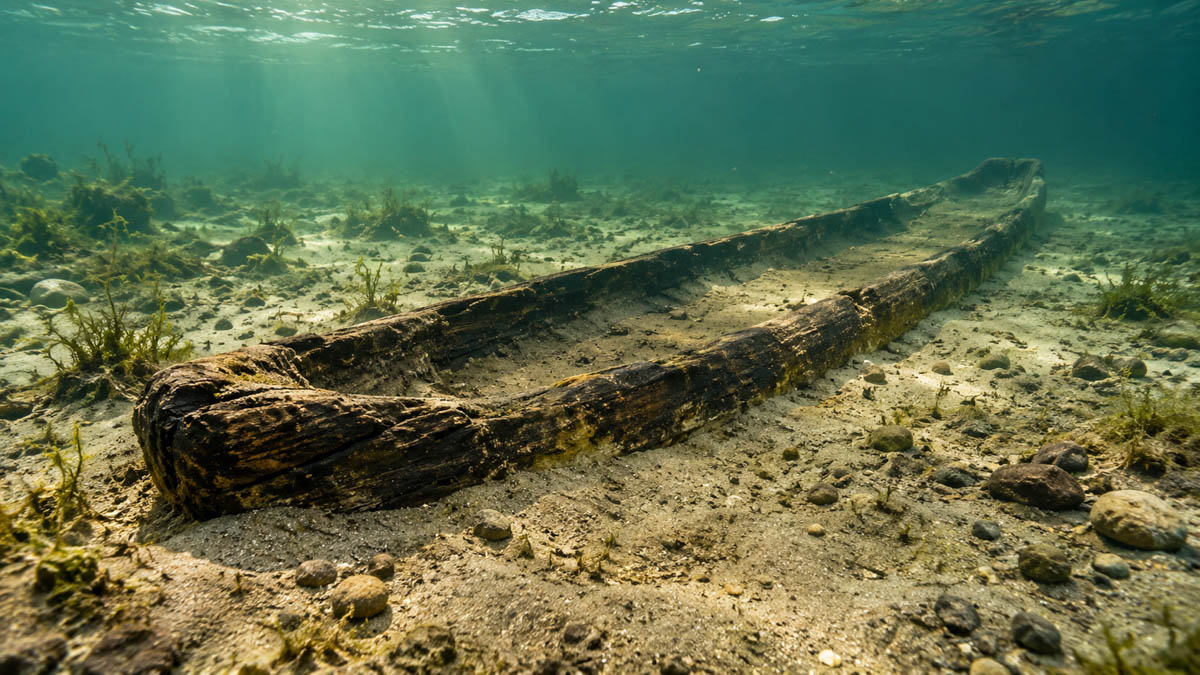

A recreational scuba diver searching a Wisconsin lake for old bottles has discovered an Indigenous dugout canoe dating back approximately 1,000 years.
Mark Schachtner made the discovery while diving in Pewaukee Lake in southeastern Wisconsin in early May 2026. The approximately 17-foot-long canoe was found around 15 feet beneath the surface and partially filled with sediment.
Schachtner, from Beaver Dam, has been diving for around a decade and regularly explores southeastern Wisconsin lakes with the Four Seasons Dive Club. He frequently searches lake beds for old embossed glass bottles, but his discovery in Pewaukee Lake proved considerably older.

According to Wisconsin Public Radio, Schachtner recognised that the object might be an ancient dugout canoe, in part because he had previously worked with Wisconsin Historical Society maritime archaeologist Tamara Thomsen.
Within days, Thomsen joined Schachtner at the site to document the discovery. Measurements, photographs and video were taken, while wood samples were collected for analysis.
Radiocarbon Dating Places Canoe Around AD 1000
Analysis by Michael Wiemann at the US Department of Agriculture’s Forest Products Laboratory identified the canoe as being made from white oak.
Subsequent radiocarbon dating by Beta Analytic found a 70% probability that the vessel was in use between AD 992 and 1049.
That places the canoe within Wisconsin’s Late Woodland period, roughly a millennium before Schachtner encountered it on the lake bed.
Researchers have also identified evidence of how the vessel was constructed.
Char marks remain visible on the bottom of the canoe, while scraping marks are consistent with the wood having been shaped using stone tools or shells. Fire could be used during dugout construction to help hollow and shape a large tree trunk.
Canoe May Have Been Deliberately Sunk
The position and condition of the canoe have also provided archaeologists with clues about why it ended up beneath Pewaukee Lake.
Rather than simply having been lost, Thomsen believes its appearance is consistent with a canoe that was deliberately cached underwater.
Indigenous communities could sink dugout canoes and allow them to fill with sediment before returning in a later season, excavating them from the lake bed, allowing them to dry sufficiently and putting them back into use.
The practice provided a practical way of storing substantial wooden vessels close to the waterways where they were needed.
Jon Greendeer, president of the Ho-Chunk Nation, told Wisconsin Public Radio that the discovery lies within Ho-Chunk territory and expressed excitement about the find.
The canoe may also have served purposes beyond simply carrying people. Such vessels could transport equipment including fishing nets and weights associated with harvesting food.
Wisconsin’s Remarkable Collection of Ancient Canoes
The Pewaukee Lake discovery forms part of a much larger archaeological record beneath Wisconsin’s waters.
State archaeologists and volunteers have examined 88 of approximately 130 known dugout canoes discovered on lake beds or held in collections across Wisconsin.
Some are considerably older than the Pewaukee canoe.
Sixteen ancient dugout canoes have been discovered in Lake Mendota at Madison, including one dating back approximately 5,200 years. That vessel is regarded as the oldest known boat discovered in the Great Lakes region.
The newly documented Pewaukee canoe is also not the first ancient vessel reported from the lake. Historical newspaper research has identified another canoe that was discovered and removed during the 1930s.
Together, the finds provide physical evidence of the long relationship between Indigenous communities and Wisconsin’s lakes and waterways.
Ancient Vessel Will Remain Beneath the Lake
Unlike two ancient Lake Mendota canoes that have undergone extensive conservation treatment after recovery, there are currently no plans to raise the Pewaukee vessel.
The Wisconsin Historical Society has been consulting Native Nations about the discovery, including representatives associated with the Ho-Chunk Nation and Bad River Band of Lake Superior Chippewa.
Native Nations have indicated that they want the canoe to remain where it is out of respect for their ancestors.
Keeping it submerged also helps preserve the ancient wood. Removing waterlogged archaeological timber without extensive conservation can cause rapid deterioration as it dries.
The archaeological site is protected under Wisconsin law, and divers are prohibited from removing artefacts.
For Schachtner, the discovery began as an ordinary recreational dive looking for old bottles.
Instead, lying beneath approximately 15 feet of water was a vessel created by people navigating the same Wisconsin lake around a thousand years earlier.
Comments