




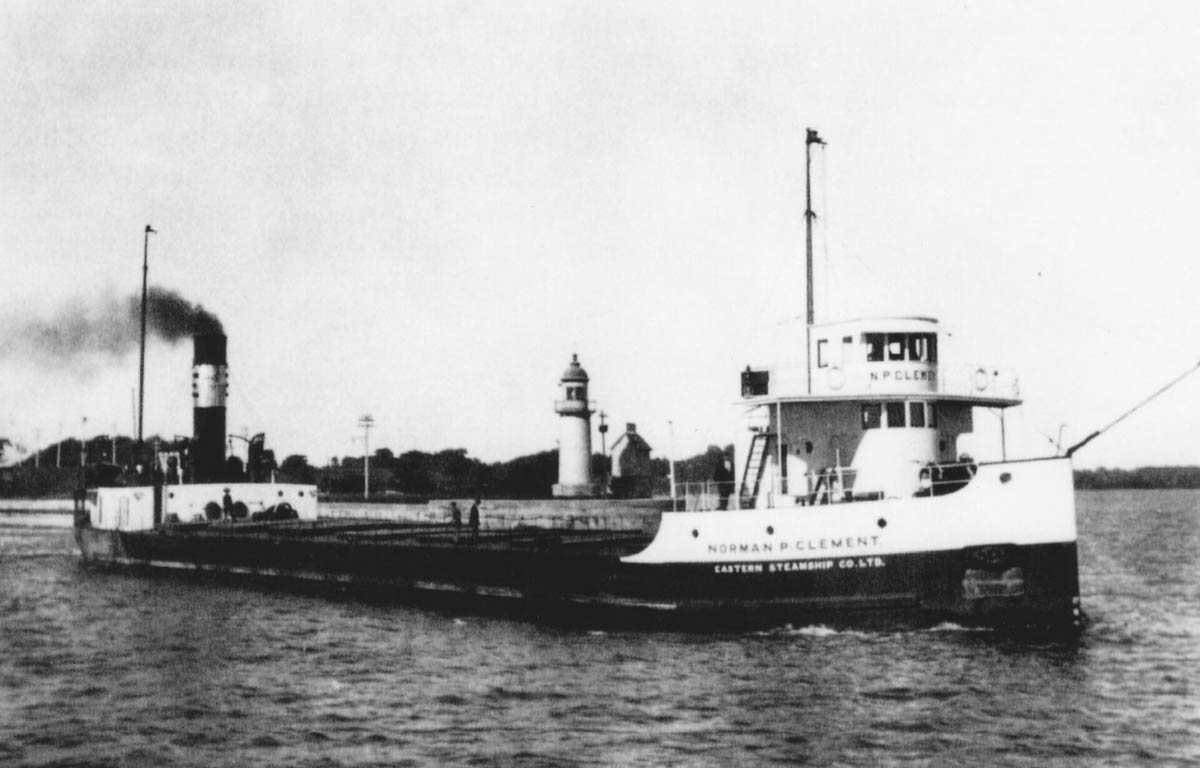

The Norman P. Clement was a historic Great Lakes vessel that had a long career as a bulk carrier before its dramatic, explosive end as a chemical tanker in 1968.

Here is the history, specifications, and eventual fate of the ship:
Ship Specifications
- Built: 1923 (launched January 1924) by J. Samuel White & Co. in Cowes, Isle of Wight, England.
- Dimensions: 261 feet total length, 43-foot beam, and 20-foot depth.
- Design: It was built as a “canaller”—a class of ship designed specifically with dimensions that allowed it to fit through the locks of the old St. Lawrence and Welland canals before the modern Seaway was built.
- Namesake: Named after Norman Parsons Clement (1885–1951), a prominent banker from Buffalo, New York.
History and Career
The Norman P. Clement spent the first few decades of its life as a standard steel bulk freighter moving cargo across the Great Lakes.

- 1924–1936: Operated by Eastern Steamship Ltd. of Port Colborne, Ontario.
- 1936–1960: Sold to Upper Lakes & St. Lawrence Transportation Co. (later Upper Lakes Shipping Ltd.) of Toronto.
- The Seaway Shift: When the modern St. Lawrence Seaway opened in 1959, it allowed much larger ships to traverse the lakes. This rendered smaller “canallers” like the Clement obsolete for standard bulk cargo almost overnight, and she sat idle for the 1960 and 1961 seasons.
- The Chemical Conversion: In 1961, the ship found a second life. It was sold to Tank Truck Transport Ltd. and converted into a sulphuric acid tanker by installing seven specialized storage tanks into her hold. She was later transferred to Chembarge Ltd. in 1966.
The 1968 Disaster
The ship’s career came to a sudden end in October 1968 due to a series of unfortunate events.
- The Grounding: On October 7, 1968, the Clement ran aground in Byng Inlet on the north shore of Georgian Bay, damaging her hull.
- The Explosion: She was refloated and towed to the Collingwood Shipyards in Collingwood, Ontario, for drydock repairs. On October 16, 1968, as shipyard workers were preparing to cut into the vessel and add a neutralizing agent to the tanks, a massive gas explosion ripped through the ship.
- The Aftermath: The blast rocked the entire town of Collingwood, shattering windows and throwing heavy deck plating into the air. Amazingly, no one was killed, though 11 men (eight shipyard workers and three crew members) were injured, suffering severe burns exacerbated by spilling acid.
Final Disposition
The explosion completely tore the ship apart internally, rendering her a total loss. Because of the lingering hazard of the acid and the structural instability of the hull, the decision was made to dispose of her.
On October 23, 1968, the Norman P. Clement was towed out into the deep waters of Georgian Bay and scuttled (intentionally sunk) off Christian Island, where she still rests today in roughly 350 feet of water.
Comments