


Affiliate Disclosure: Some content on The Scuba News may include affiliate links. Find out how this supports our work.
Every diver remembers the big stuff.
The regulator gets serviced. The dive computer gets charged. The wetsuit gets packed. Yet it’s often the small accessories that determine whether a dive goes smoothly or turns into a frustrating story back at the dock.
Ask any experienced diver and they’ll tell you the same thing. A missing O-ring can cancel a dive. A forgotten DSMB can become a safety issue. A lost fin strap can end a dive trip before it begins.
The good news is that most of these problems are easy to prevent. Here are some of the most commonly forgotten scuba accessories and why they deserve a permanent place in your dive bag.
A Save-a-Dive Kit Can Rescue an Entire Trip
If there’s one item that belongs in every diver’s gear bag, it’s a save-a-dive kit.
Most equipment issues aren’t catastrophic failures. More often, they’re small annoyances such as a damaged mouthpiece, a missing regulator O-ring, or a broken fin strap. Unfortunately, even a minor problem can mean sitting out a dive if replacement parts aren’t available.
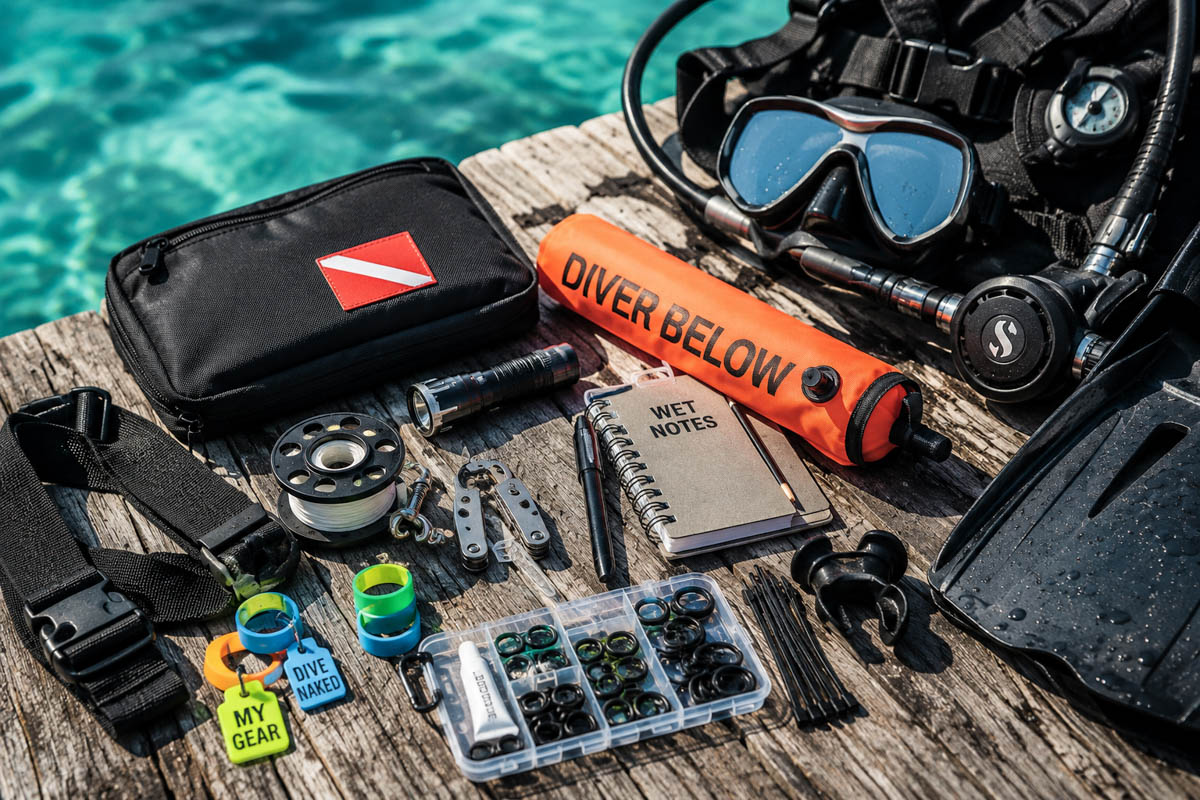
A well-stocked save-a-dive kit typically contains spare O-rings, mouthpieces, cable ties, silicone grease, fin straps, mask straps and a small multi-tool. These items take up almost no room in your luggage, yet they can save hundreds or even thousands of dollars in lost diving opportunities during a liveaboard or overseas dive trip.
Many experienced divers also keep a backup set of regulator O-rings separate from their main repair kit because they’re among the most common points of failure.
A DSMB Is No Longer Optional
A delayed surface marker buoy (DSMB) has become one of the most important safety accessories a recreational diver can carry.
Whether you’re drift diving in Cozumel, exploring offshore wrecks in Florida, or diving from a liveaboard in the Red Sea, a DSMB helps boat crews identify your position during ascent and once you’re back on the surface.
Many divers still think of DSMBs as advanced equipment, but that perception is changing rapidly. Today, many instructors and dive operators encourage divers to carry one on every boat dive.
The best DSMBs are compact, highly visible and easy to deploy, making them one of the simplest safety upgrades you can add to your kit.
Don’t Forget the Finger Spool
A DSMB is only as useful as your ability to deploy it properly.
That’s why every DSMB should be paired with a finger spool or compact reel.
A spool allows controlled deployment during ascent and can also be useful for navigation, search patterns and marking underwater locations. Lightweight and inexpensive, it is one of those accessories that many divers don’t think about until they need one.
Because finger spools are small and easy to pack, there’s little reason not to carry one on every dive trip.
Wet Notes Solve Problems Hand Signals Can’t
Hand signals work for most situations, but they aren’t always enough.
That’s where wet notes come in.
Underwater photographers use them to coordinate shots. Instructors use them during training exercises. Scientific divers use them to record observations and survey data. Recreational divers often find them invaluable when communicating detailed navigation plans or complex information underwater.
A simple notebook may not seem exciting, but many divers who start carrying wet notes quickly wonder how they managed without them.
Gear Retractors Protect Expensive Equipment
Every diver has seen a pressure gauge dragging across a reef or a torch dangling beneath a diver’s BCD.
These situations aren’t just inconvenient. They can damage the environment and increase the risk of losing expensive equipment.
Using gear retractors keeps essential accessories secure while ensuring they’re always within reach when needed.
They’re particularly useful for dive lights, compasses, cameras, pointers and pressure gauges. For underwater photographers, a quality retractor often pays for itself the first time it prevents a camera accessory from disappearing into the depths.
Equipment Markers Make Travel Easier
After a few days aboard a busy liveaboard, everyone’s black fins, black regulators and black BCDs start looking remarkably similar.
That’s where equipment markers become surprisingly useful.
They help identify your gear quickly, reduce confusion on crowded dive decks and make it far less likely that another diver accidentally walks away with your equipment.
While not the most glamorous accessory on this list, they are among the most practical, particularly for divers who travel frequently.
A Foldable Snorkel Is Worth the Space
Many experienced divers stop carrying a snorkel.
Then comes the unexpected surface swim.
A compact foldable snorkel weighs almost nothing, takes up very little room and can make a significant difference when conditions change unexpectedly.
Whether you’re swimming back to a shore entry point or waiting for pickup after a drift dive, having a snorkel available can conserve energy and improve comfort.
It’s one of those items that often gets left at home right up until the moment it’s needed.
Reef Hooks Have Their Place
Most divers won’t need a reef hook on every trip.
However, if you’re heading to destinations known for strong currents, carrying a reef hook can dramatically improve your experience.
When used responsibly and in accordance with local environmental guidelines, reef hooks allow divers to maintain position while observing schooling fish, sharks and other pelagic species in high-current environments.
Destinations such as Palau, Indonesia and parts of the Maldives are particularly well known for dives where reef hooks can be useful.
The Smallest Accessories Often Have the Biggest Impact
The most expensive piece of gear in your dive bag isn’t always the most important.
A DSMB can improve your safety. A save-a-dive kit can rescue an entire trip. A spool, slate or retractor can solve problems before they become frustrations.
The next time you’re preparing for a dive holiday, spend a few minutes thinking about the accessories that don’t usually make the packing list. They may not be glamorous, but they’re often the items that make the difference between a good dive and a great one.
And when that missing O-ring, broken fin strap or unexpected current eventually appears, you’ll be glad you packed them.
