


A discussion of whirling disease, what it means for Alberta’s fish populations and what anglers and other recreational users can do to help prevent its spread.
Whirling disease is a devastating infection driven by the complex biological requirements of the parasite Myxobolus cerebralis. This organism relies on a dual-host life cycle to propagate, beginning with its definitive host, the Tubifex tubifex or sludge worm. While inhabiting these sediment-dwelling worms, the parasite matures into an infectious, spore-like stage called a triactinomyxon (TAM). Once these TAMs are released into the surrounding freshwater, they seek out and penetrate the skin of their intermediate hosts—juvenile fish belonging to the Salmonidae family, such as trout and salmon.
Once the parasite successfully infiltrates a fish, it specifically attacks the cartilage and skeletal structures. This internal damage manifests in severe physical and behavioral symptoms, most notably skeletal deformities like misshapen heads or twisted spines. Because the infection compromises the fish’s equilibrium and inner ear, it triggers a distinctive “whirling” swimming pattern that leaves the animal unable to feed properly and highly vulnerable to predators. For juvenile fish, whose skeletons are still developing from soft cartilage, the infection is particularly aggressive and often proves fatal, leading to high mortality rates within affected populations.

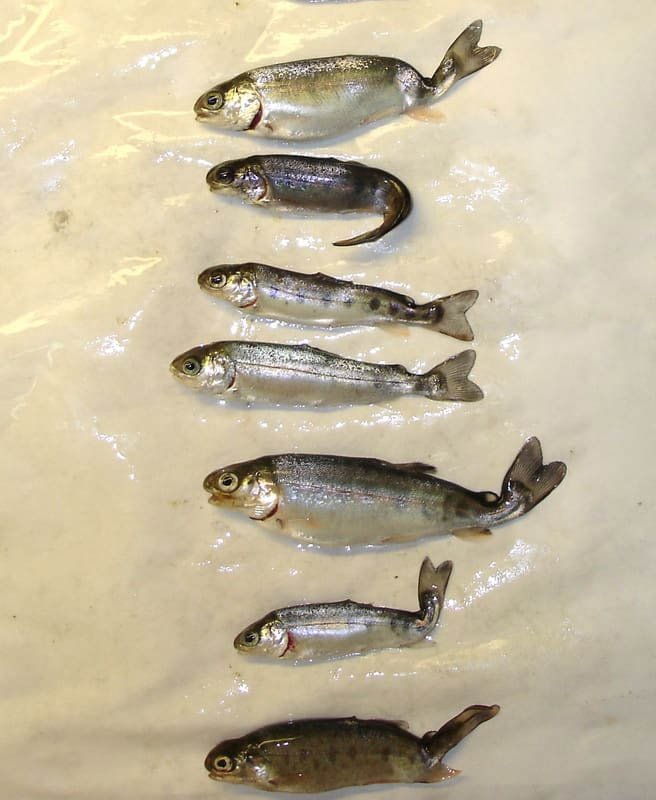
Fish that have been infected with whirling disease may show symptoms such as:
- Spinal deformity
- Skull deformity (shortening of mandible, indentations on top of head)
- Dark or black colour in the tail
- Swimming in circles (whirling)
Some infected fish, however, may not exhibit any signs of the disease.

Whether you are a professional working in aquatic environments or an outdoor enthusiast enjoying water-based recreation, your actions are vital in preventing the transmission of whirling disease. By practicing proper equipment sanitation and being mindful of how you move between different waterbodies, you can play a key role in protecting vulnerable fish populations from this parasite.
The transmission of whirling disease does not occur through direct contact between fish; instead, the Myxobolus cerebralis parasite relies on environmental movement and ingestion to spread. Infection typically happens when the parasite’s free-floating spores encounter a fish or when a salmonid consumes a carrier sludge worm. These spores are remarkably hardy, capable of surviving for years in moist environments. They can endure extreme conditions, such as temperatures as low as -20°C, and remain infectious in mud for several months. Furthermore, the spores can pass through the digestive tracts of various animals unharmed and easily cling to recreational or industrial water equipment.
Human and Natural Transmission
While the disease moves naturally through flowing water and migrating fish, human activity is a primary driver of its spread into new territories. People often unknowingly transport the parasite by moving the following items:
- Biological Matter: Both living and dead infected fish, as well as carrier worms.
- Environmental Elements: Contaminated water, mud, sediment, or aquatic vegetation.
- Gear: Equipment used for fishing, swimming, and various water sports.
Additionally, wildlife plays a role in the parasite’s expansion. Animals that eat infected fish or drink contaminated water can introduce the parasite to new locations by physically displacing fish remains or by releasing viable spores through their droppings.
Everyone, including anglers, boaters and recreational water users can help stop the spread of whirling disease by following these best practices:
- Never move live or dead fish, or fish parts from one waterbody to another (this is illegal in Alberta).
- Use fish cleaning stations where available or put fish parts in the garbage. Never dispose of fish, or any fish parts, back into the water they were captured or into your kitchen garburator when home.
- It is illegal to use live fish as bait. The use of worms or leeches as bait should be avoided as well.
To safeguard our aquatic ecosystems, all water users—including boaters and anglers—must adopt specific preventative measures. Preventing the spread of whirling disease is largely a matter of containment, and following these best practices is essential:
Bait Precautions
- Avoid Live Bait: Using live fish as bait is strictly prohibited by law. (In Ontario, Alberta, Quebec and Saskatchewan) To further minimize risk, it is also recommended to avoid using worms or leeches, which can act as carriers for the parasite.
Before moving a boat or any equipment (such as hip waders, life jackets, kayaks, etc.) between water bodies, be sure to:
- clean your watercraft or any equipment that has been in contact with water
- drain water from the watercraft and equipment onto dry land before leaving the shore
- dry your watercraft and equipment completely between trips
These practices should be completed before leaving any waterbody, not just in the infected areas of Alberta.
The massive $25,000 fine highlights just how seriously Parks Canada takes the protection of its pristine waters. The strict “Clean, Drain, Dry” protocol serves as the primary line of defense against incredibly destructive aquatic invasive species, such as whirling disease and zebra mussels, which can permanently devastate vulnerable ecosystems like Lake Louise.
By adhering to these guidelines, you help ensure that local trout and salmon populations remain healthy for future generations.
Comments