



A major new European research project is highlighting what many divers have long felt intuitively, that time underwater may have measurable benefits for mental well-being.
Released during European Mental Health Week 2026, the initial findings from the One Health Underwater project suggest that regular scuba diving could positively influence the psychological health of young adults through a combination of physical activity, controlled breathing, social connection, and immersion in nature.

The international initiative, funded through Erasmus+ and led by FFESSM, DAN Europe, and HE2B, surveyed 1,669 divers aged between 18 and 29 across six languages using one of the most comprehensive diving-related questionnaires ever deployed. The study included 176 questions built around validated scientific mental health scales.

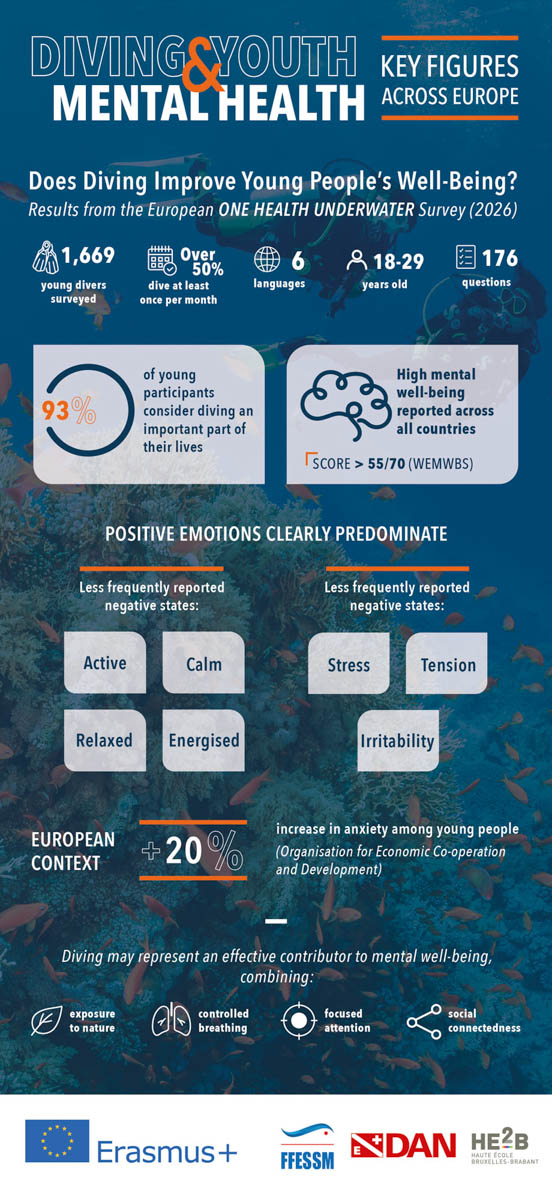
Researchers focused primarily on active divers rather than occasional participants. More than half of respondents reported diving at least once per month, with 77% practising scuba diving and a further 21% combining scuba diving with freediving.
The findings arrive against a backdrop of worsening mental health indicators among young people across Europe, including rising anxiety levels, sleep disorders, irritability, and depressive episodes. However, according to the project’s preliminary results, the divers surveyed displayed notably strong levels of psychological well-being.

Participants recorded Warwick-Edinburgh Mental Well-being Scale (WEMWBS) scores above 55 out of 70 on average. More than 80% said they regularly felt joyful, relaxed, mentally clear, and open to new experiences. Mood-profile analysis also showed positive emotional states significantly outweighed negative ones, with over 90% describing themselves as active and 86% identifying as calm and attentive. Indicators linked to tension and irritability remained comparatively low.
Another notable finding was the importance diving appeared to hold in participants’ lives. According to the survey, 93% viewed diving as a meaningful activity, suggesting the benefits may stem not from occasional recreation but from long-term lifestyle integration.
Researchers believe several core elements of diving may contribute to these outcomes, including controlled breathing, sustained concentration, self-confidence, emotional regulation, teamwork with a dive buddy, and exposure to natural environments.
“Diving offers a unique setting where physical activity, mindfulness, and emotional regulation come together,” said Professor Costantino Balestra, Vice President of Research & Education at DAN Europe.
Dr Frédéric Di Meglio, President of FFESSM, added that diving “contributes to mental well-being by engaging the parasympathetic nervous system, which helps the body relax and heal.”
The organisations behind the project believe the findings could eventually position scuba diving as a recognised wellness and public-health tool, particularly for younger generations and potentially vulnerable groups.
The research is now moving into a new phase. This summer, a monitored diving camp will take place at a UCPA centre in France using longitudinal research methods. Participants will undergo repeated assessments through questionnaires and salivary biomarker analysis, allowing researchers to track physiological and psychological changes over time.
Future stages of the project aim to integrate diving into supervised and inclusive health programmes designed for vulnerable youth, while also developing educational resources for policymakers, professionals, and the wider public. The long-term ambition is to establish scuba diving as a credible complementary approach to mental well-being, while also encouraging resilience, environmental awareness, and active citizenship among younger generations.
The One Health Underwater initiative is part of a broader Erasmus+ effort focused on combining sport, environmental engagement, and social inclusion to improve youth mental health across Europe.
Additional information about the organisations involved can be found through DAN Europe and HE2B Research.
Comments