





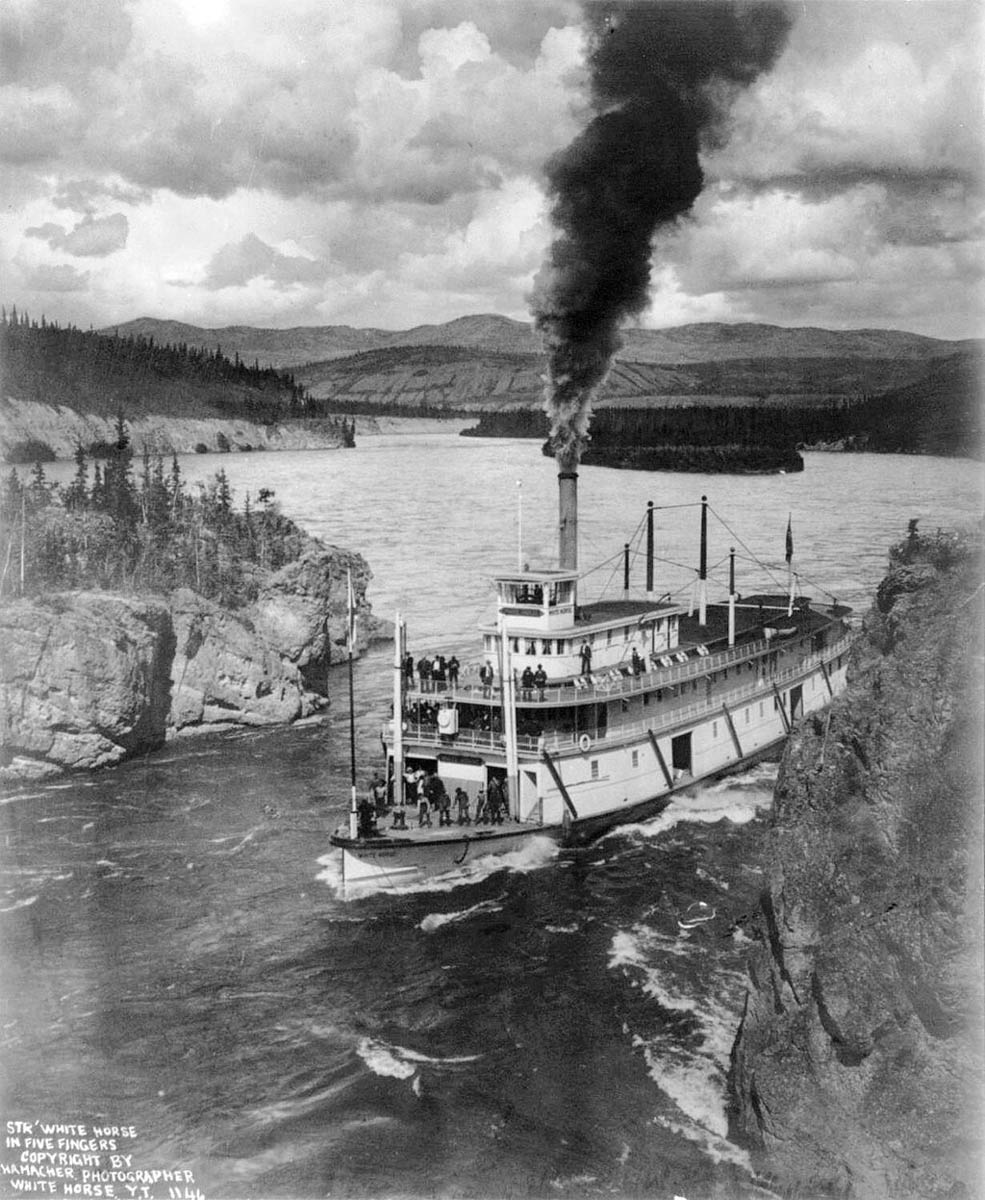

Steamboats on the Yukon River were vital to the growth and settlement of Alaska and the Yukon. The rugged mountains and vast distances made travel to the interior difficult, but the broad Yukon River offered a practical transportation route. The earliest steam vessels to operate on the lower Yukon appeared around 1866 or 1867, serving the Collins Overland Telegraph project, including a small steamer known as the Wilder. Since the river’s mouth lies far to the west near St. Michael, a voyage from coastal cities such as Seattle or San Francisco to reach it stretched roughly 4,000 miles (about 6,400 kilometers).
The Alaska Commercial Company operated several steamboats that helped open up the North. Among them were the Yukon, a screw-propelled vessel launched in 1869, and the St. Michael, a sternwheeler introduced in 1879. Gradually, these riverboats made travel and trade along the Yukon River more accessible. The Portus B. Weare began operating on the river after 1892, further expanding transportation routes. By 1897, seven steamers were in service on the Yukon, and that number had grown to thirty by 1899.
By 1900, the White Pass & Yukon Route had finished building its railway connecting Skagway, Alaska, with Whitehorse in the Yukon. The following year, the company expanded into steamboat operations to link the rail line with communities along the Yukon River. Starting in 1901, White Pass became the primary—almost exclusive—provider of transportation on the Upper Yukon River between Whitehorse and Dawson City. Its network also extended to Tagish Lake and Atlin Lake, which form part of the river’s headwaters.


Eric A. Hegg – Eric A. Hegg Photographs: Public Domain @ Wikipedia
In 1914, the White Pass & Yukon Route expanded further by acquiring the Northern Navigation Company, which at the time was the largest steamboat operator on the lower Yukon River, running routes between Dawson City, Tanana, and St. Michael. It was also the leading carrier on the Tanana and Chena Rivers, serving towns such as Tanana, Nenana, and Fairbanks. The Northern Navigation Company itself had been created through a series of earlier mergers involving the river divisions of the Alaska Commercial Company, Alaska Exploration Company, Seattle–Yukon Transportation Company, Empire Transportation Company, and North American Transportation & Trading Company.
Between 1914 and 1921, at the height of its operations, White Pass managed a network covering more than 2,000 miles (3,200 kilometers) of waterways and held an almost complete monopoly over passenger and freight transport in the area. Over time, the company owned 88 steamboats—some newly built, but most acquired through its takeovers of other major Yukon River operators.
The White Pass & Yukon Route operated its riverboats under two separate subsidiaries, depending on where they ran. Vessels serving the upper Yukon River were registered in Canada and managed by the British Yukon Navigation Company, while those running on the lower Yukon were registered in the United States and operated by the American Yukon Navigation Company.
Starting in 1922, competition from the Alaskan Engineering Commission—later reorganized as The Alaska Railroad in 1923—greatly reduced White Pass operations on both the lower Yukon and the Tanana/Chena Rivers. Once the railroad reached Nenana that year, White Pass scaled back its river routes to run only between Dawson City and Tanana on the lower Yukon, and between Tanana and Nenana on the Tanana River.
After the reorganization, the Alaska Railroad began running its own commercial riverboats from 1923 until 1953, maintaining service between Nenana and Tanana on the Tanana River and between Tanana and Marshall, Alaska, on the lower Yukon River. Passenger transport by river was discontinued after the 1949 season. From 1923 to 1949, the Northern Commercial Company provided connecting passenger service between Marshall and St. Michael with the small gasoline-powered vessel Agulleit (U.S.A. #214487), a 45-foot, 16-gross-ton screw-propelled boat.
When the Alaska Railroad ended its freight river operations in 1954, it leased its riverboats and equipment to the Yutana Barge Line, later selling them outright to the company in 1980. White Pass itself had already stopped regular river service after the 1941 season, driven out by highway competition—specifically, the completion of the North Klondike Highway (Whitehorse to Dawson City) and the Atlin Road in the early 1950s.
Today, only one of the old White Pass vessels, the diesel-powered Yukon Rose, is still in operation. Another former company boat, the gasoline-powered Loon, is under consideration for restoration.
The Nenana was the final steamboat to operate regularly on the Lower Yukon River, completing its last season in 1954. On the Upper Yukon River, the Klondike (Klondike II) was the last vessel in regular service, making its final trip on July 4, 1955.
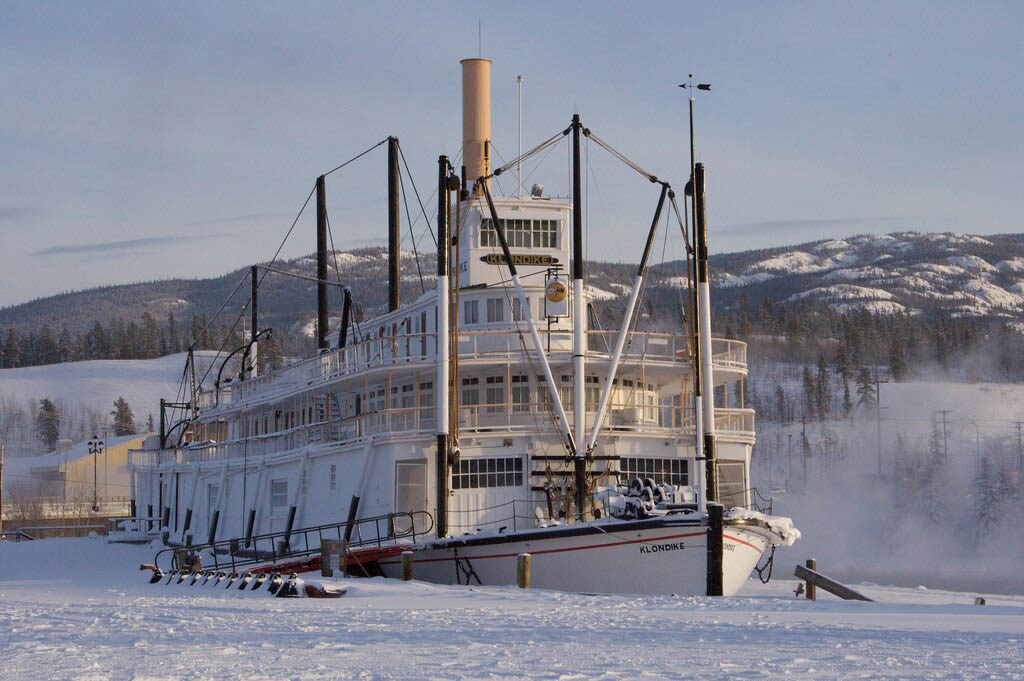

The Keno holds the distinction of being the last commercial steamboat to travel the Yukon River under its own power. Its final voyage, from Whitehorse to Dawson City between August 26 and 29, 1960, was an equipment transfer to relocate the vessel for preservation and display in Dawson City.
Today, the Keno, Klondike II, and Nenana have all been preserved and serve as museum ships, commemorating the era of Yukon River steamboats.
Comments