




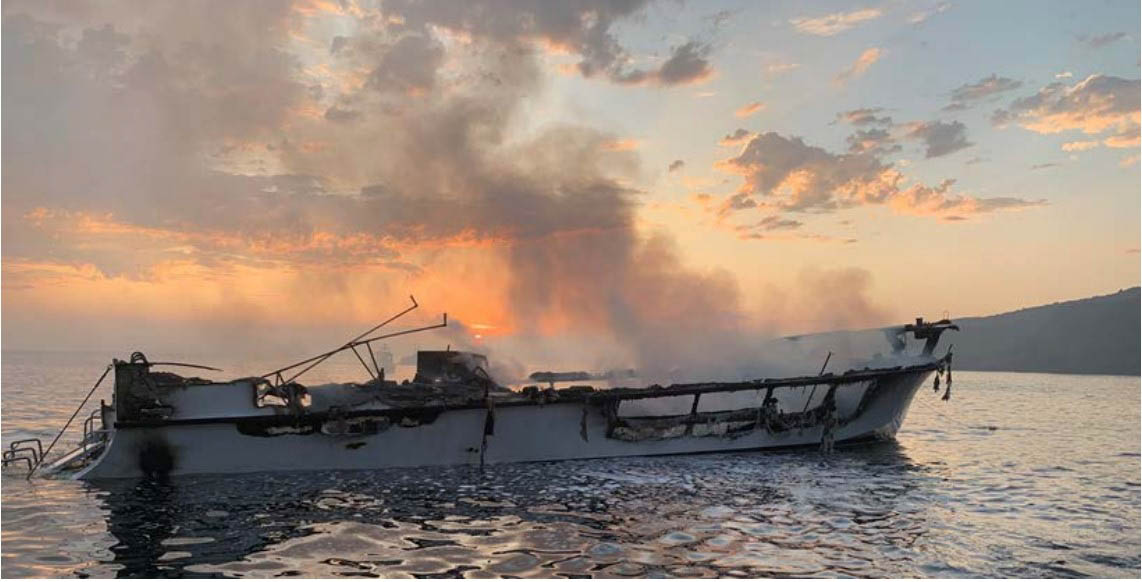

A critical new chapter has unfolded in one of the most significant legal cases in modern diving history, and this time, the outcome leaves little room for further delay.
A U.S. federal appeals court has refused to rehear the case of Conception dive boat captain Jerry Boylan, effectively closing the door on his final attempt to overturn his conviction in the 2019 disaster that claimed 34 lives.
This latest ruling, issued this week by the Ninth Circuit Court of Appeals, marks a decisive turning point. While Boylan’s conviction had already been upheld in March, this new development confirms that the court will not revisit the case, bringing the appellate process to an end.

A Legal Road Now Near Its End
The court’s decision relates specifically to a petition for rehearing, a follow-up legal move after Boylan’s original appeal was rejected earlier this year.
According to reporting from the Los Angeles Times coverage, a three-judge panel denied the request, and no judge called for a wider review by the full court, effectively shutting down further appeal options at this level.
For Boylan, who has remained free pending the outcome of his appeals, the consequences are immediate and tangible. With this latest denial, he could now be ordered to begin serving his four-year federal prison sentence in the near future.
Revisiting the Case That Changed Dive Safety
The ruling stems from the catastrophic fire aboard the Conception liveaboard in September 2019, widely regarded as the deadliest maritime disaster in modern California history.
Thirty-three passengers and one crew member were trapped in a below-deck bunkroom as flames spread rapidly through the vessel in the early hours of the morning.
Prosecutors successfully argued that Boylan failed in fundamental duties of care, including:
- Not assigning a required overnight roving watch
- Failing to conduct adequate fire safety training
- Leaving a poorly prepared crew unable to respond effectively
These failures formed the basis of his conviction for seaman’s manslaughter, a charge that hinges on negligence rather than intent.
The Legal Argument That Failed
At the heart of Boylan’s appeal was a challenge to how the jury was instructed.
His legal team argued that the court allowed conviction based on “misconduct,” which they claimed set too low a bar compared to “gross negligence.”
However, the appeals court rejected that interpretation, reaffirming that the law does not require gross negligence, and that the evidence against Boylan was, in the court’s words, overwhelming.
This week’s refusal to rehear the case confirms that position is now firmly established.
What Happens Next
With the rehearing denied, Boylan’s legal avenues are now extremely limited.
The only remaining option would be a petition to the U.S. Supreme Court, a step that is rarely successful and not guaranteed to delay enforcement of the sentence.
For families of the victims, the latest ruling represents a long-awaited moment of accountability. Some have expressed relief that, after years of legal proceedings, the case is finally reaching a conclusion.
Previous Coverage from The Scuba News
The Scuba News has followed this case closely as it progressed through the courts. You can explore earlier reporting, including the original appeal decision and industry reaction, here:
👉 Conception case coverage on The Scuba News
Why This Still Matters for Divers
Beyond the courtroom, this week’s decision reinforces a message that continues to shape the global dive industry:
Accountability at the highest level of vessel operation is no longer negotiable.
The Conception tragedy has already led to regulatory changes, particularly around:
- Mandatory overnight watchkeeping
- Fire detection and escape systems
- Crew training standards
This final legal step strengthens the precedent that captains can and will be held criminally responsible for failures in safety oversight.
For divers, operators, and liveaboard businesses worldwide, that message is now clearer than ever.
Comments