




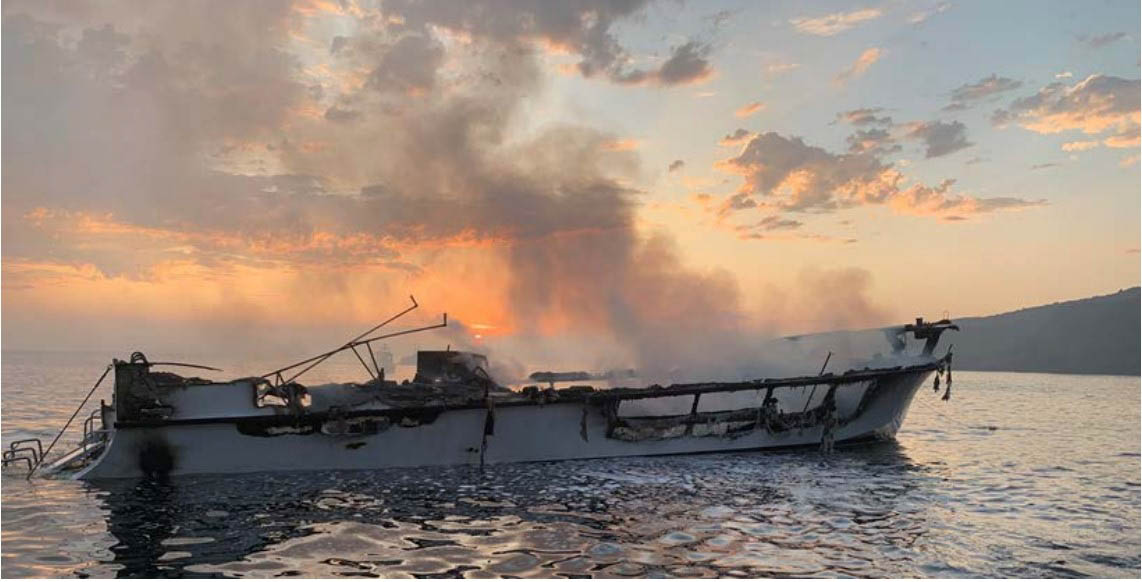

A US federal appeals court has upheld the criminal conviction of the captain of the dive boat Conception, confirming the manslaughter verdict linked to the 2019 fire that killed 34 people on a California dive trip.
The ruling from the Ninth Circuit Court of Appeals means former captain Jerry Boylan must serve the four-year federal prison sentence imposed in 2024 after a jury found him guilty of misconduct or neglect of a ship officer, a charge commonly referred to as “seaman’s manslaughter.”
The decision closes one of the final major legal challenges stemming from the tragedy, which remains the deadliest maritime disaster involving recreational divers in modern US history.

Appeal rejected after years of legal proceedings
According to reporting from the Los Angeles Times and other legal news outlets, the appeals court ruled that the jury’s verdict should stand and rejected arguments from Boylan’s legal team that the trial judge had used incorrect legal instructions when defining negligence for the jury.
In its opinion, the panel said the evidence presented during the trial was “overwhelming,” affirming that the captain failed to meet basic safety responsibilities aboard the vessel.
Boylan, who had served as a captain for decades before the incident, was convicted in 2023 and sentenced the following year, but had remained free while the appeal worked its way through the courts.
With the appeal now denied, the sentence is expected to move forward.
The 2019 Conception dive boat fire
The Conception was a 75-foot dive vessel operating multi-day scuba charters off the California coast. In the early hours of 2 September 2019, the boat was anchored near Santa Cruz Island in the Channel Islands when a fire broke out shortly after 3 a.m.
Thirty-three passengers and one crew member were sleeping in a bunkroom below deck and became trapped by the rapidly spreading fire. All 34 died, primarily from smoke inhalation.
Five crew members, including the captain, escaped by jumping into the water after issuing a distress call.
Investigators later found that the required overnight roving watch, a basic maritime safety practice intended to detect hazards such as fire, had not been maintained.
Prosecutors argued during the trial that the lack of watchkeeping, inadequate crew training, and failures in emergency response played a critical role in the scale of the disaster.
A case closely followed by the diving community
The tragedy sent shockwaves through the global diving community and prompted widespread debate about dive vessel safety, overnight watchkeeping, and emergency escape routes.
When the guilty verdict was first delivered in 2023, The Scuba News reported that Boylan faced up to 10 years in prison after being found guilty of criminal negligence in connection with the deaths aboard the vessel.
Later coverage in December 2025 examined the appeal process, explaining how the case could shape legal accountability for dive vessel operators and captains worldwide.
With the appellate ruling now confirming the conviction, the legal phase of the case has moved significantly closer to conclusion.
Why the ruling matters for divers
Beyond the courtroom, the Conception disaster has had a lasting impact on dive operations and safety discussions throughout the industry.
Investigations into the fire highlighted concerns including overnight watch procedures, emergency escape design on small passenger vessels, and crew preparedness during onboard fires.
For divers, particularly those joining multi-day liveaboard trips, the case has reinforced a broader industry message: safety culture on dive vessels is not optional, and responsibility ultimately rests with the vessel’s command.
As courts continue to examine the events of that night, the Conception tragedy remains a stark reminder of how quickly conditions aboard a dive boat can change, and how critical preparedness is when they do.
Comments