




For decades, the USS Oriskany has ruled the Gulf of Mexico’s depths as one of the most iconic artificial reefs in the world. Known affectionately as “The Great Carrier Reef,” the 888-foot aircraft carrier was sunk in 2006 off Pensacola, Florida, transforming from a Cold War relic into a thriving marine ecosystem.
Now, another American legend is preparing for a similar fate. The SS United States, once the fastest passenger liner on Earth, is undergoing its final preparations in Alabama before being towed into Gulf waters to become what could be the world’s largest artificial reef. The question captivating divers and historians alike is simple: can the SS United States rival the Oriskany?

U.S. Navy, Public domain, via Wikimedia Commons
The Benchmark: USS Oriskany
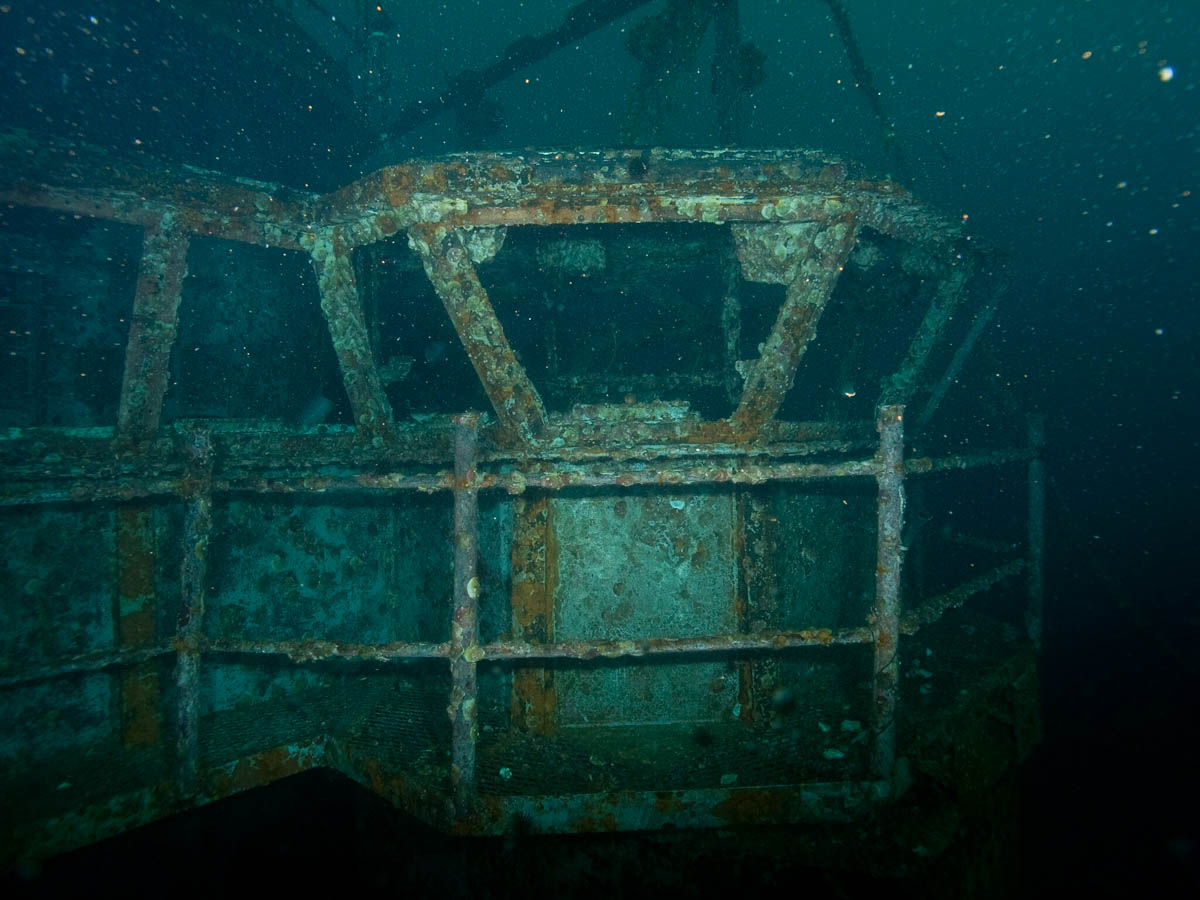
When the USS Oriskany was scuttled twenty-two miles off Pensacola, few could have imagined the scale of its impact. The ship rests with its flight deck around 145 feet deep, the island superstructure rising to within 80 feet of the surface. It quickly became a magnet for marine life and a pilgrimage site for advanced divers.
According to NOAA, the Oriskany’s massive structure has created a vertical ecosystem that attracts everything from amberjack and grouper to sea turtles and whale sharks. Its presence transformed local tourism, generating millions of dollars annually for dive operators and coastal businesses. For wreck divers, it set the gold standard in scale, accessibility, and adventure.

Brian W. Schaller, FAL, via Wikimedia Commons
The Challenger: SS United States
The SS United States was never built for war. Designed by naval architect William Francis Gibbs, she launched in 1952 as the ultimate expression of American postwar engineering, 990 feet of speed, luxury, and power. Capable of crossing the Atlantic in just over three days, she remains the fastest ocean liner ever built.
Today, the ship sits stripped and silent in Mobile, Alabama, under the care of Okaloosa County. The county purchased the vessel for approximately 10.1 million dollars with the goal of sinking it as an artificial reef roughly twenty nautical miles south of Destin-Fort Walton Beach. Once deployed, her 990-foot hull would eclipse the Oriskany’s 888-foot length, potentially earning her the title of largest artificial reef in the world.
According to Fox10 News, crews have already removed fuel from 120 tanks, cleared the upper decks, stripped wiring, and dismantled her funnels. Environmental remediation continues to ensure the structure is clean and safe before deployment.

U.S. Navy photo by Photographer's Mate 2nd Class Jeffrey P. Kraus, Public domain, via Wikimedia Commons
A Tale of Two Reefs
While the Oriskany and the United States share similar fates, they are fundamentally different in design and purpose. The Oriskany’s military structure – thick, vertical, and compartmentalized – creates an ideal habitat for pelagic species and a complex dive experience suited to technical divers.
The SS United States, on the other hand, has a sleeker, lighter hull built for speed rather than strength. Her streamlined form will influence how she settles on the seabed, how water circulates through her remains, and how coral and marine life will colonize the metal surfaces over time. Environmental engineers are studying how her thinner structure will weather in the Gulf, ensuring stability and longevity before the final descent.
From a diver’s perspective, accessibility may become the defining difference. Plans suggest that the upper decks of the SS United States could rest around 60 feet below the surface, well within reach of advanced recreational divers. This would make her far more accessible than the Oriskany, whose deeper profile appeals mainly to technical divers trained in advanced decompression procedures.
Gareth Richards, CC BY-SA 3.0, via Wikimedia Commons
Economic and Environmental Impact
The Oriskany transformed Pensacola’s dive industry overnight. Charter boats, hotels, and dive shops experienced a sustained economic surge as divers from around the world came to explore the towering wreck. The SS United States could bring a similar wave of opportunity to the Destin-Fort Walton Beach region, already a popular destination for anglers and snorkelers.
Okaloosa County’s reef program has emphasized not just tourism but long-term environmental benefits. Artificial reefs help relieve pressure on natural coral systems, providing habitats for reef fish and improving biodiversity. If properly executed, the project could represent a model for how historical preservation and marine conservation can coexist.
Cultural Symbolism and Legacy
Beyond engineering and ecology, there is deep symbolism in the United States’ final voyage. The ship that once embodied American pride and speed will soon serve a new purpose – as a living monument to sustainability, transformation, and marine renewal.
Meanwhile, the Oriskany continues to age gracefully beneath the Gulf, covered in corals and life, a thriving community of color and history. If the United States succeeds in following that example, it may not just rival the Oriskany but redefine what it means to give history a second life beneath the waves.
A Rivalry Beneath the Surface
So, can the SS United States truly rival the Oriskany? In length and ambition, perhaps yes. In legacy and living proof, only time and the sea will decide.
For now, divers watch with anticipation. One ship rests quietly in her coral-covered glory; the other stands poised to make history once again, not by crossing the Atlantic, but by sinking into it.
Comments






_near_Midway_Atoll_1967.jpg)


