


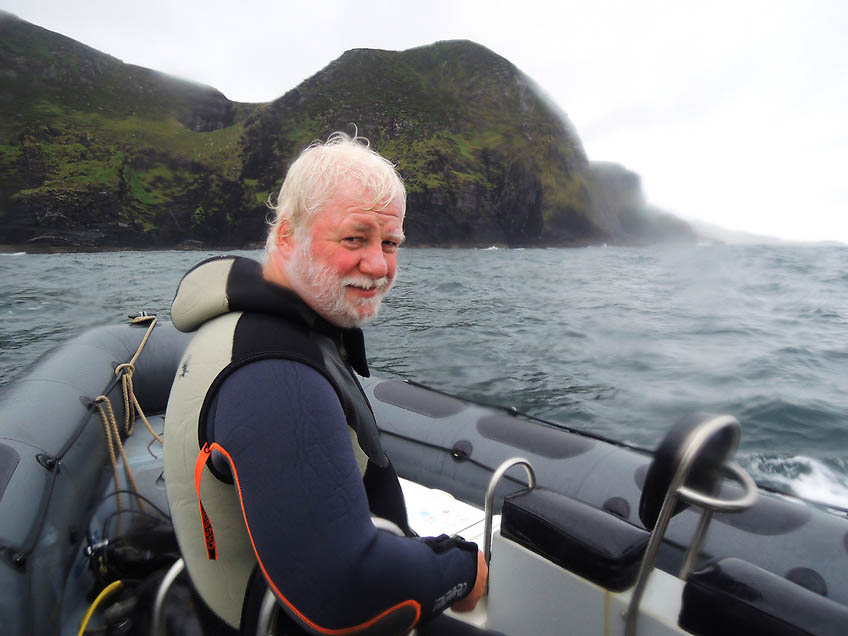
Tributes have been paid to Brian Stone, one of Ireland’s most influential underwater photography pioneers, following his death at the age of 67.
A diving instructor, photographer and assistant professor at Dublin City University (DCU), Stone helped shape Ireland’s underwater photography community while combining his enthusiasm for the marine environment with scientific research, technology and education.
His legacy reaches across diving clubs, university research programmes, underwater archaeology and the many divers who benefited from his encouragement and expertise.
A Lasting Influence on Irish Diving
Stone was instrumental in developing underwater photography within Diving Ireland, the national governing body formerly known as the Irish Underwater Council.
When the organisation began establishing an underwater photography course in 2009, he helped develop the teaching materials and practical instruction, later contributing improvements as digital photography technology evolved.
In 2013, he established an underwater photography exhibition that became a fixture of Ireland’s diving community.
Rather than creating another photography competition, Stone wanted an exhibition that would encourage participation and allow divers to see their underwater images professionally printed and displayed.
That inclusive approach became one of the exhibition’s defining characteristics, and the initiative continued to travel around Ireland more than a decade after its introduction.
According to Afloat’s tribute to Stone, Sarah Staunton, President of Diving Ireland, described him as a pioneer who helped shape the country’s underwater photography community.
She also highlighted his generosity, friendship and willingness to share his knowledge with divers throughout Ireland.
Building a New Generation of Divers
Stone’s contribution to diving education extended to Dublin City University, where he helped establish the DCU Sub Aqua Club approximately 25 years ago.
He was closely involved in acquiring equipment, organising training and creating the foundations that allowed the club to develop.
Former club members remember him not simply as an instructor but as someone who encouraged others to become confident, independent divers and eventually instructors and leaders themselves.
His approach to teaching reflected a wider philosophy that valued patience, curiosity and the experience of observing the underwater environment.
That philosophy also influenced his photography. Rather than treating every dive as a search for dramatic subjects, he encouraged divers to slow down, observe carefully and appreciate the marine life around them.
Where Underwater Photography Met Marine Science
Stone’s professional career at Dublin City University brought together computer science, image analysis and marine research.
His work included developing technologies capable of automatically collecting and analysing images of fish, seals and cetaceans.
Through projects involving the Marine & Environmental Sensing Hub and the Insight Centre for Data Analytics, he contributed to collaborative research supporting marine biodiversity monitoring and environmental science.
The work brought together expertise from DCU, the Marine Institute and other research organisations, demonstrating how imaging technology could help scientists better understand marine ecosystems.
Professor Fiona Regan, director of the DCU Water Institute, remembered his enthusiasm for combining engineering, software and image analysis to address practical challenges in marine science.
His involvement with students was an important part of that work, including the development of a fish-identification system.
An Important Contribution to Underwater Archaeology
Stone also used his diving and photographic expertise to support the documentation of historic shipwrecks.
He participated in underwater archaeological surveys of the Tayleur, which sank in Dublin Bay in 1854, working alongside marine archaeologist Eoghan Kieran and a team of licensed divers.
The project produced photographic and video documentation for the State and helped inform standards for diving expeditions involving protected historic wreck sites in Irish waters.
His photographs also contributed to the Shipwreck Inventory of Ireland, connecting his technical skills with the preservation of Ireland’s maritime heritage.
A Photographer Who Inspired Others
Stone’s underwater photography took him well beyond Irish waters, including expeditions to the Caribbean, the Azores and the Red Sea.
His subjects ranged from small marine organisms and coastal habitats to sharks and other large marine animals.
He was also a longstanding participant in Ireland’s recreational diving community, including involvement with the Curragh and Dalkey sub-aqua clubs.
His photography remains part of a permanent installation at Valentia Lighthouse in County Kerry, where images of marine life help visitors appreciate the diversity of the underwater world.
Further examples of his work are due to feature in an exhibition celebrating the 25th anniversary of DCU Sub Aqua Club, scheduled for 12–23 October 2026 at the university library.
The Valentia Lighthouse photographic installation is also scheduled to remain accessible during the lighthouse’s visitor season, which closes on 1 November before reopening in March 2027.
A Legacy Beyond the Photographs
For those who knew him, Stone’s legacy was about considerably more than technical expertise or photographic achievement.
Friends, colleagues and former students have remembered his kindness, humour, curiosity and enthusiasm for helping others discover new interests.
His influence can be seen in the divers he trained, the photographers he encouraged, the scientific projects he supported and the underwater images that continue to introduce people to Ireland’s marine environment.
At a time when underwater photography has become more accessible than ever, Brian Stone’s contribution is a reminder that the greatest influence of a photographer is not always found in an individual image.
Sometimes it is found in the people they inspire to pick up a camera, enter the water and see the underwater world differently.
