


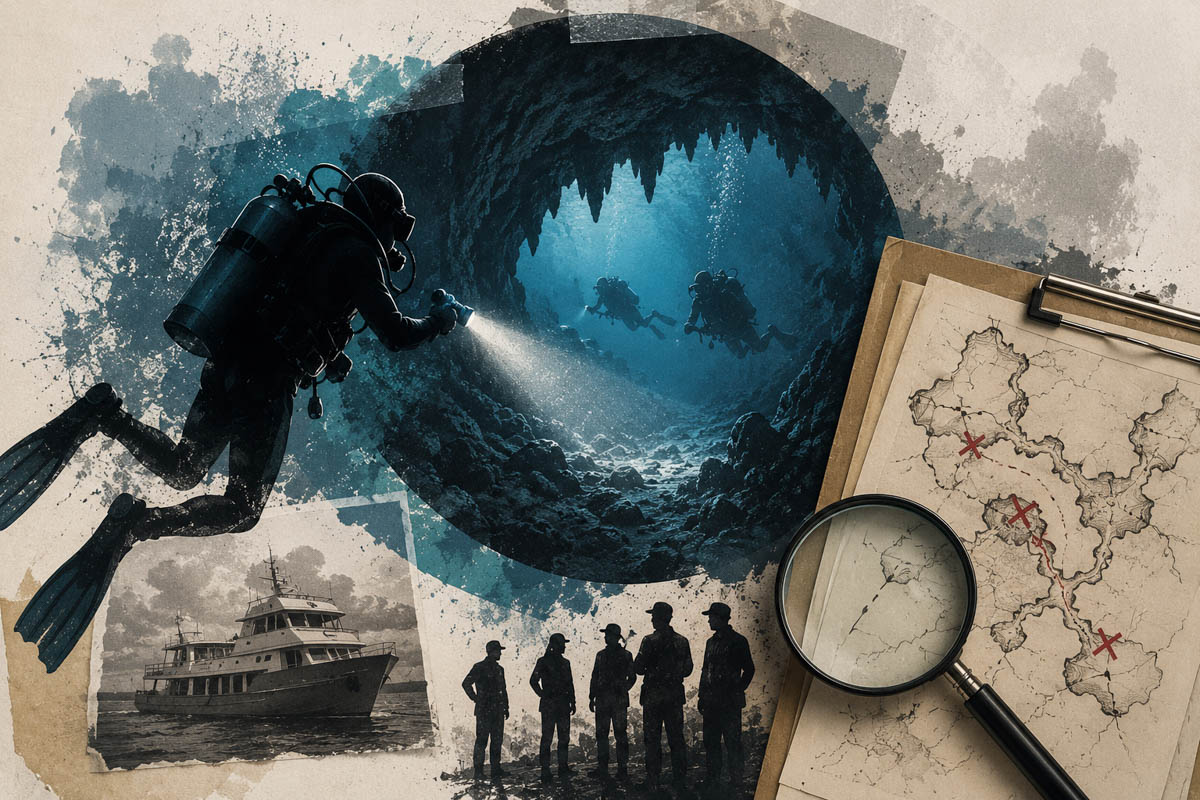
New forensic findings have established the medical cause of death of five Italian divers who lost their lives in an underwater cave in the Maldives in May, although investigators are still working to determine why the group was unable to return to the surface.
The five divers who died during an underwater cave dive in the Maldives on 14 May 2026 succumbed to anoxia, a complete lack of oxygen, according to forensic findings reported by Italian media on 4 October.
The findings represent an important development in the investigation into one of the most serious diving tragedies in the Maldives in recent years.
According to Italian news agency LaPresse, the expert report commissioned by prosecutors in Busto Arsizio concluded that the divers had apparently remained underwater beyond the duration supported by their breathing gas supplies.
However, while the medical cause of death has now been identified, the circumstances that prevented the divers from leaving the cave remain under investigation.
Five Lives Lost in Vaavu Atoll
The tragedy occurred on 14 May during a dive into an underwater cave system in Vaavu Atoll, near Alimathaa.
The five Italian victims were:
- Monica Montefalcone, an ecology professor at the University of Genoa.
- Giorgia Sommacal, Montefalcone’s daughter.
- Muriel Oddenino, a researcher.
- Federico Gualtieri, a recent marine biology graduate.
- Gianluca Benedetti, a diving guide and boat captain.
The group had been diving from the liveaboard vessel Duke of York when they failed to return to the surface.
Their disappearance prompted an extensive search and recovery operation involving Maldivian authorities and specialist international divers.
The operation itself claimed another life when Maldivian military diver Mohamed Mahudhee died following a search dive. His death was investigated separately.
Three specialist Finnish cave divers subsequently assisted with the recovery of the four victims whose bodies remained deep inside the cave.
According to Associated Press reporting at the time, the bodies were located in the innermost chamber at a depth of approximately 60 metres.
Autopsies Establish Cause of Death
The autopsies were conducted on 25 and 26 May at Gallarate Hospital in northern Italy, following the repatriation of the victims.
The forensic findings were subsequently submitted to prosecutors.
According to Italian public broadcaster Rai News, the examinations identified anoxia as the cause of death.
Toxicological testing reportedly found no abnormalities suggesting that poisoning or exposure to harmful substances caused the fatalities.
The examinations also found no injuries consistent with a shark attack or other significant physical trauma.
The findings support the conclusion that the divers exhausted their available breathing gas while underwater.
However, they do not establish what caused the group to remain inside the cave long enough for their supplies to run out.
Why Could the Divers Not Escape?
This remains the central unanswered question.
One possibility being considered is that the divers became disorientated within the submerged cave system.
Underwater caves present particular challenges because divers cannot make a direct ascent to the surface. Exiting requires navigating back through an overhead environment, potentially involving narrow passages, reduced visibility and complicated routes.
At significant depth, breathing gas consumption also increases considerably, reducing the time available from a given gas supply.
Nevertheless, there has been no definitive finding that disorientation caused this tragedy.
Investigators must establish the sequence of events before drawing conclusions about what prevented the divers from returning safely.
Dive Computers and Cameras May Hold Important Evidence
The investigation is expected to examine information from the divers’ equipment, including their dive computers, cylinders, underwater cameras and other instruments.
These records may help investigators reconstruct the group’s depth profiles, the duration of the dive and their movements before the tragedy.
The analysis may also clarify whether the breathing gas supplies and equipment were appropriate for the dive being undertaken.
According to Corriere della Sera, investigators are examining operational decisions, equipment suitability and the authorisations associated with the dive.
The findings from the forensic examinations will need to be considered alongside this additional evidence.
Investigation Continues in Italy
The Rome Public Prosecutor’s Office is overseeing an investigation into possible negligent homicide.
The autopsy examinations were arranged through prosecutors in Busto Arsizio, where the victims’ remains were examined after their return to Italy.
The investigation must now determine whether any actions, omissions or decisions contributed to the deaths and whether the tragedy could have been prevented.
The University of Genoa previously stated that the fatal dive was undertaken privately and was not part of its official scientific research programme.
Questions concerning the dive’s planning, authorisation and equipment have formed part of the wider investigation.
No conclusion concerning criminal responsibility should be drawn from the autopsy findings alone.
A Tragedy Still Awaiting Answers
The confirmation of anoxia establishes how the five Italian divers died, but it does not yet explain why they became unable to escape the underwater cave.
For their families, the diving community and those involved in the recovery operation, the outstanding investigation remains significant.
The next important development will be the assessment of the recovered equipment and any further conclusions reached by Italian prosecutors.
Until then, the precise sequence of events inside the cave remains unresolved.
