




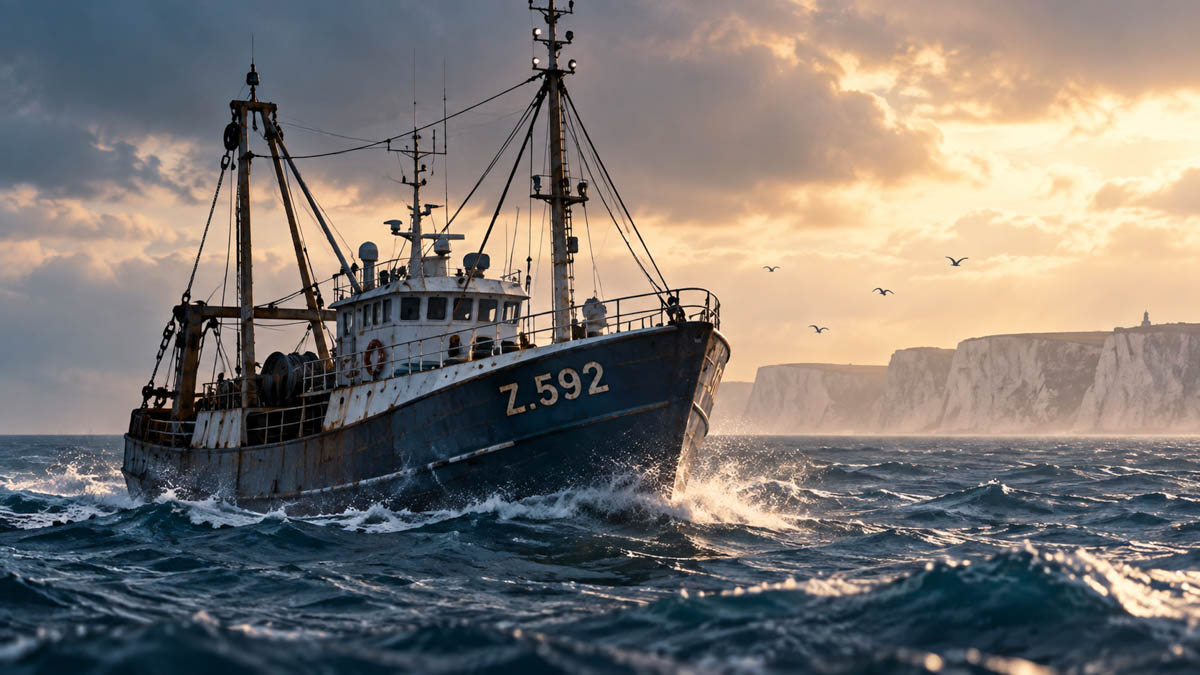

A fishing vessel that disappeared with five people aboard more than 46 years ago has finally been identified on the seabed in the Dover Strait following an investigation involving maritime researchers and British wreck divers.
The wreck has been confirmed as Z.592 Hosanna, a Belgian fishing vessel that disappeared in February 1980. The identification followed years of historical research and two investigation dives carried out by Mutiny Diving from Dover.
The first dive took place on 10 August 2026. Divers returned on 24 September with the specific objective of establishing whether the unidentified wreck was Hosanna.
Evidence gathered during that second investigation provided the confirmation researchers had been seeking for more than four decades.
Five People Disappeared With Hosanna
Hosanna was a 25-metre Belgian fishing vessel built in Zeebrugge in 1965.
Historical vessel records held by the Flanders Marine Institute (VLIZ) document Z.592 Hosanna as a steel fishing vessel operating from Belgium.
She operated as Z.592 Hosanna and was associated with Belgian company De Pax, with Germain Ackx serving as skipper. During the 1970s, the vessel also became associated with supplying the offshore radio ship Mi Amigo.
Hosanna’s circumstances changed shortly before her disappearance.
She had run aground in July 1979 and was subsequently declared unseaworthy. On 29 January 1980, she was sold to British company Minerva Fisheries Ltd and transferred to the British flag, receiving the Guernsey fishing registration GU5200.
Less than three weeks later, she disappeared.
Hosanna left Plymouth on 14 February 1980 bound towards the Netherlands.
Five people were aboard: skipper Germain Ackx, his son Piet Ackx, Hector Snauwaert, Pieter Guijt and Guijt’s 14-year-old nephew Pieter Albertus Guijt.
A ship-to-shore telephone connection involving Ackx was attempted at 21:28 UTC on 15 February, but the call was not completed.
The following morning, a liferaft associated with Hosanna was discovered near the Goodwin Sands.
A search followed, but neither the vessel nor the five people aboard were found.
Contemporary coverage of the disappearance survives in the February 1980 archive of Belgian fishing publication Het Visserijblad, preserved by VLIZ.
A 46-Year Maritime Mystery
Without a confirmed wreck, theories surrounding Hosanna’s disappearance multiplied.
Over the following decades, there were claims that the vessel had survived and been sighted as far away as Spain, Morocco and Greece. Other theories suggested smuggling or a deliberate disappearance.
Another persistent claim linked Hosanna with the British bulk carrier Derbyshire and suggested the fishing vessel had been run down.
The identification of the wreck has now resolved one major part of the mystery.
Hosanna did not secretly continue elsewhere. She sank in the Dover Strait.
Exactly what caused her loss remains unresolved.
Researchers Narrow The Search
The modern investigation brought together Dutch and British expertise.
Cees Meeldijk, chairman of Stichting Onderzoek Maritieme Vermisten, worked on the case alongside a Dutch television production team documenting the investigation for the second series of Op zee gebleven, a programme produced for Dutch public broadcaster EO.
Historical records and archival research increasingly pointed towards the Dover Strait.
That eventually brought the investigation to British wreck researcher Mark Lewis and Mutiny Diving.
Rather than discovering a previously unknown wreck, the researchers identified an existing unidentified fishing-vessel wreck as a strong candidate for Hosanna.
The next step required divers to investigate what remained on the seabed.
Diving The Unidentified Wreck
According to Mutiny Diving’s detailed account of the investigation, the first dive took place on 10 August 2026.
The wreck lies at technical-diving depths, with its working deck at approximately 47 metres and the surrounding seabed reaching around 52 metres.
Divers found that the wheelhouse was no longer standing, removing one of the most obvious places to search for identifying features.
However, the wreck still contained potentially valuable evidence.
Divers located a lamp and obtained video footage from areas associated with the former wheelhouse, accommodation and living spaces.
Reviewing that footage strengthened the possibility that the wreck could be Hosanna and provided investigators with specific areas to examine during a return dive.
Divers Return For Confirmation
On 24 September, Mutiny Diving returned to the site aboard the Dover-based dive vessel Maverick.
This time, the objective was clear: establish whether the wreck really was Hosanna.
Members of the Guijt family were in Dover as the investigation reached its conclusion.
Divers concentrated on areas identified during the August dive and gathered further evidence from the wreck.
In an account published by Dutch fishing-industry publication Visserij.nl, Stichting Onderzoek Maritieme Vermisten chairman Cees Meeldijk said investigators were able to compare a winch visible underwater with historical photographs of Hosanna.
Equipment recovered during the investigation reportedly included radio equipment carrying an Oostende reference.
The underwater evidence, vessel characteristics, location and historical research came together.
The unidentified wreck was Z.592 Hosanna.
Five Crew Finally Have A Known Resting Place
For the families, the identification carries significance far beyond adding another name to a wreck chart.
Germain Ackx, Piet Ackx, Hector Snauwaert, Pieter Guijt and Pieter Albertus Guijt disappeared with the vessel in 1980.
The VissersNamenMonument Scheveningen archive preserves historical material relating to the disappearance and the people who were lost.
Members of the Guijt family were able to visit the wreck site following the identification and lay flowers on the water.
The wreck itself is substantially filled with sand and silt and cannot safely be entered. It remains the final resting place of the five people aboard.
For wreck divers, the investigation also demonstrates how modern diving can contribute to maritime historical research.
There was no single obvious ship’s bell or surviving name across the bow that immediately provided the answer.
Instead, Hosanna’s identity emerged through archival research, historical navigation information, wreck dimensions and construction, surviving fishing equipment, electronics, underwater imagery and observations gathered during two separate dives.
The August dive established that investigators could be looking at Hosanna.
The September dive provided the evidence needed to confirm it.
One Mystery Remains
Identifying Hosanna answers the question of where the vessel ended her final voyage, but it does not yet establish why she sank.
Researchers continue to investigate what happened during Hosanna’s final hours.
The persistent theory that she was struck by another vessel has not been conclusively established, and Mutiny Diving notes that available timelines raise questions about previous claims specifically linking the loss with Derbyshire.
Further investigation of the wreck may yet provide additional evidence.
The wider search and identification are also being documented for the second series of Op zee gebleven, currently scheduled for broadcast by EO in 2027.
For now, one part of a mystery that endured for more than 46 years has finally been resolved.
Hosanna once again has a position on the chart.
Comments