


U.S. Coast Guard divers have completed a series of underwater operations around Kauaʻi as crews worked to restore safe access to harbors damaged by Hurricane Lowell.
Divers from Regional Dive Locker Pacific carried out 14 dives in waters off Kauaʻi, repairing, repositioning and re-establishing aids to navigation affected by the storm. The operation formed part of a wider Coast Guard response between September 9 and 15 that helped reopen critical maritime routes around the Hawaiian Islands.
The work around Kauaʻi involved Coast Guard Station Kauaʻi and the crew of Coast Guard Cutter William Hart, with additional navigation equipment supplied by Coast Guard Cutter Juniper.
At Port Allen, divers and supporting crews recovered and repositioned navigation aids and conducted side-scan sonar sweeps of the harbor to identify possible submerged hazards left by the hurricane.
Diving Beneath The Recovery
Hurricane Lowell disrupted maritime infrastructure across Hawaiʻi, damaging or displacing 11 aids to navigation and forcing authorities to restrict or close several harbors.
Port Allen was among the facilities affected. On September 11, the Office of Hawaiʻi Governor Josh Green reported that the harbor remained closed to commercial operations because of damage to navigation buoys, with divers working to restore them.
The Hawaiʻi Department of Transportation had earlier confirmed that Port Allen remained closed as transportation crews dealt with the wider aftermath of the hurricane.
For the Coast Guard dive teams, that meant working below the surface to restore infrastructure mariners rely upon to safely enter and leave the harbor.
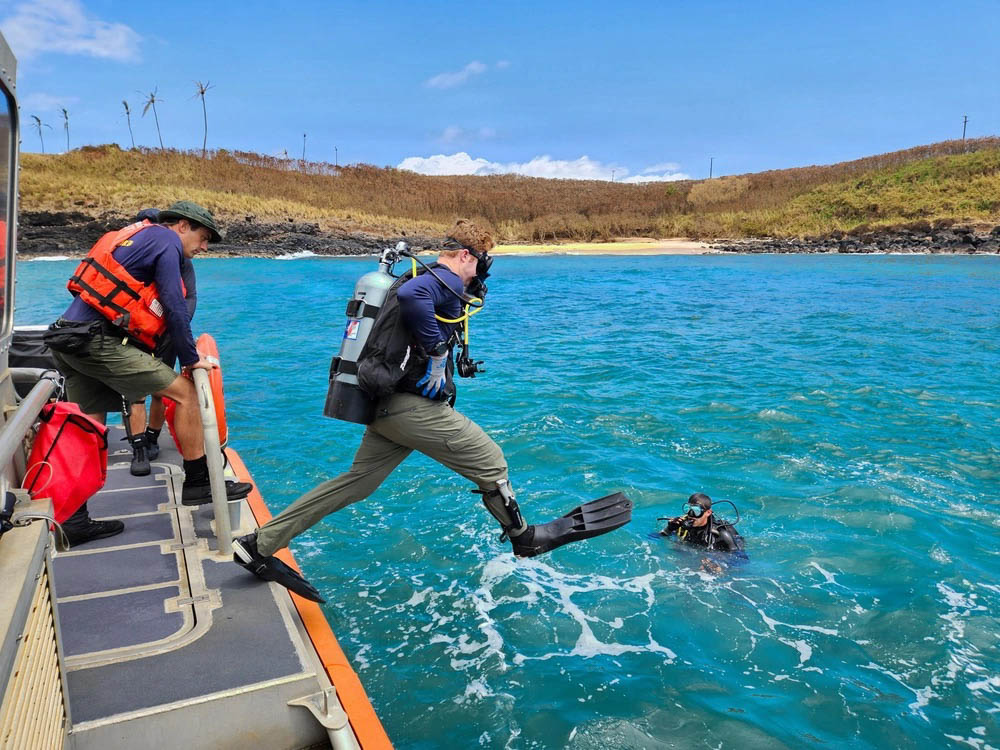
The Coast Guard’s newly released imagery shows a Regional Dive Locker Pacific diver entering the water from a 45-foot Response Boat-Medium offshore Kauaʻi on September 12. Other images document Coast Guard personnel returning from aids-to-navigation operations around the island.
Port Allen Reopens
The operation ultimately supported the Captain of the Port’s reopening of Port Allen, while restoration work also contributed to safe maritime access at Nāwiliwili Harbor.
Port Allen plays an important role beyond recreational boating. The harbor supports commercial fuel deliveries, government transport and local boat operators, including vessels taking visitors along Kauaʻi’s Nā Pali Coast. Nāwiliwili, meanwhile, serves as the island’s principal deep-draft commercial harbor and cruise ship facility.
The distinction is important because recovery across Kauaʻi’s maritime facilities remains uneven. Reopening a navigation channel does not necessarily mean every marina, small-boat facility or tourism operation has returned to normal.
The storm caused extensive damage around Port Allen Small Boat Harbor, and some tour operators have continued assessing when their individual operations can safely resume.
More Than Just Moving Buoys
Aids to navigation can become particularly dangerous following a major storm. Buoys can be moved away from their charted positions, mooring systems can be damaged and debris can create underwater hazards that are impossible to identify reliably from the surface.
That makes divers an important part of post-storm harbor assessment.
Regional Dive Locker Pacific has previously been used for exactly this type of work around Hawaiʻi. Coast Guard divers can inspect submerged infrastructure, recover navigation equipment and work in shallow areas where deploying larger buoy tenders may be difficult.
Following Lowell, crews recovered, repositioned, marked and re-established navigation aids throughout the response.
Similar dive operations took place off Oʻahu, where Regional Dive Locker Pacific personnel completed another 10 dives with support from Coast Guard Station Honolulu and Coast Guard Cutter Hollyhock. Aircraft from Air Station Barbers Point also transported personnel and equipment to Lānaʻi to assist restoration work at Kaumalapaʻu Harbor.
“Maintaining aids to navigation, especially after a storm like Hurricane Lowell, is essential for the flow of commerce throughout the Hawaiian Islands,” Sector Honolulu Response Department chief Cmdr. Andrew Williams said in the Coast Guard announcement.
For Kauaʻi, much of that work happened out of sight beneath the surface, where Coast Guard divers helped turn damaged waterways back into navigable harbors.
Comments