



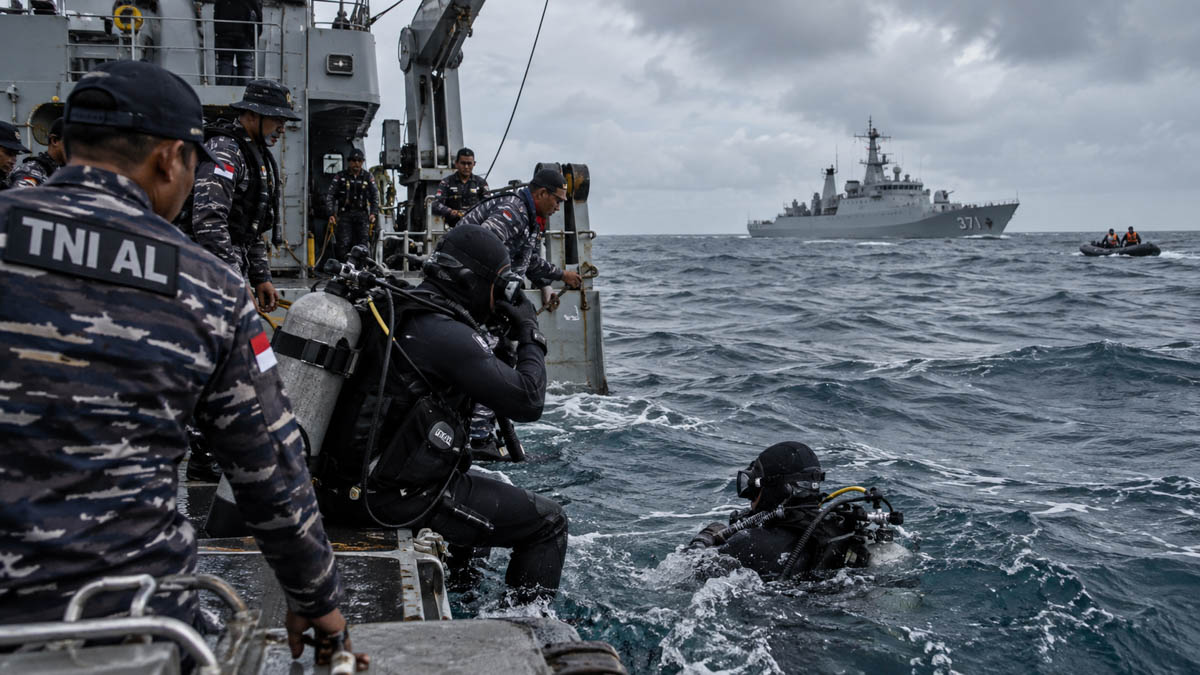

Indonesian Navy divers have reached the wreck of the Virgo Transport 8 as the search for 129 people missing following the passenger vessel’s capsize moves increasingly beneath the surface of the Java Sea.
The development marks a significant change in an operation that has been repeatedly frustrated by severe weather, powerful currents and the deteriorating position of the wreck.
According to Reuters, a Navy diving team accessed the wreck on the fifth day of the operation and recovered personal belongings from the site.
The vessel has now sunk completely to the seabed, adding another layer of difficulty to an already challenging underwater operation.
A Difficult Environment for Divers
Virgo Transport 8 capsized in the Java Sea on September 13 while travelling from Surabaya in East Java to Banjarmasin in South Kalimantan.
There were 243 people aboard. As of September 18, authorities report that 108 people have survived, six have been confirmed dead and 129 remain missing.
Getting divers onto the wreck has been exceptionally difficult.
Reuters reported separately on the underwater operation that rescue divers have faced strong currents reaching around seven knots, poor weather and the inherent hazards of entering a large overturned roll-on/roll-off vessel.
The ship’s internal spaces create additional risks. Compartments, vehicle decks and passageways can become disorientating overhead environments once a vessel is inverted, while loose equipment, debris and structural damage can create entanglement and access hazards.
Any trapped air inside the wreck can also complicate the operation.
Specialist Navy Diving Teams Deployed
Indonesia’s military had already deployed specialist underwater personnel to the operation.
An earlier Indonesian Armed Forces statement confirmed the deployment of specialist Navy personnel alongside several warships, aircraft and other search and rescue assets.
The operation has included personnel from Kopaska, the Indonesian Navy’s frogman command, together with specialist underwater diving and rescue personnel.
Navy vessel KRI Canopus has also been involved in supporting the underwater phase of the search.
Previous attempts to dive the wreck were restricted by conditions at the site. Currents approaching seven knots forced Navy teams to suspend diving operations earlier in the week.
Wreck Continues to Move
The condition and position of Virgo Transport 8 have also been changing.
The vessel initially remained partially visible after capsizing but subsequently sank farther beneath the surface.
Indonesian reporting citing the National Search and Rescue Agency, Basarnas said the wreck had shifted more than 450 metres from its earlier position as sea conditions continued to affect it.
Authorities have installed marker buoys around the site both to identify the wreck’s position and to warn passing vessels.
The movement of the ship has forced diving teams to continually reassess their plans rather than treating the wreck as a static underwater site.
Plans to Right the Ship
Attention is now also turning to a salvage operation that could prove critical to the search.
Authorities and the vessel’s owner are working on plans to right Virgo Transport 8, potentially providing better access to areas of the ship that divers have so far been unable to search.
Reuters reports that equipment is being brought in for the operation, with the ship’s owner working alongside the Navy, maritime police and search and rescue authorities.
Righting a large submerged vessel is itself a complex operation. Its orientation, structural condition, seabed contact and internal contents all have to be considered before significant forces are applied to the hull.
For the dive teams, however, changing the orientation of the wreck could ultimately make previously inaccessible sections available for inspection.
Families Await Answers
Surface and aerial searches have continued alongside the underwater operation, with ships and helicopters searching the surrounding Java Sea.
For relatives waiting in Banjarmasin, the lack of further recoveries has meant days of uncertainty.
Earlier in the week, Reuters reported on families waiting for information as conditions prevented rescue teams from carrying out the underwater searches many desperately wanted to see.
The arrival of divers at the wreck does not make the operation straightforward. It does, however, represent an important transition from searching primarily across the surface to investigating the vessel itself.
With 129 people still unaccounted for, the underwater search of Virgo Transport 8 is likely to remain one of the most difficult and closely watched parts of the continuing rescue and recovery operation.
The Scuba News will continue to follow developments as Navy divers and salvage teams work at the wreck site.
Comments