



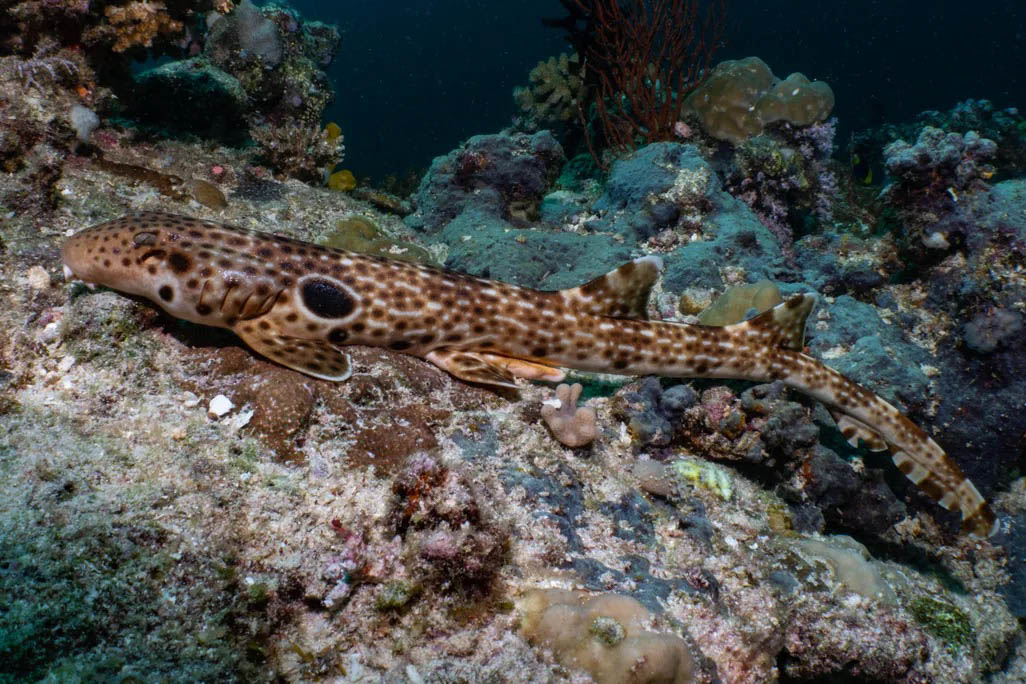

A newly identified species of walking shark has been discovered in the waters of Papua New Guinea, adding another remarkable member to one of the ocean’s most unusual groups of sharks while raising concerns that the species could already be vulnerable to extinction.
The new species, named Hemiscyllium dudgeonae and commonly referred to as Dudgeon’s Walking Shark, was identified by an international team of researchers studying shark populations in the remote reefs of Milne Bay Province. The discovery increases the number of known walking shark species and highlights just how much remains to be learned about life beneath the surface of some of the world’s most biodiverse marine environments.

Walking sharks belong to the bamboo shark family and are famous for their ability to use their muscular fins to move across reef surfaces and navigate shallow waters. Rather than relying solely on swimming, these small sharks can effectively “walk” across coral reefs, making them one of the most distinctive shark groups on the planet.

Researchers reported that the newly identified species appears to have an extremely limited geographic range. During surveys, only a small number of individuals were encountered, suggesting that the population may be naturally rare or highly localized. Because the species appears restricted to a relatively small area, scientists are already concerned about its long-term survival.
Like many reef-dependent species, Dudgeon’s Walking Shark could face a range of threats, including habitat degradation, climate change, coral reef loss, coastal development, and localized fishing pressure. Species with small distributions are often particularly vulnerable because a single environmental disturbance can affect a significant proportion of the entire population.

The discovery also underscores the importance of Papua New Guinea’s reefs as a global hotspot for marine biodiversity. The country’s waters are home to an extraordinary range of marine life, attracting divers from around the world while supporting important scientific research into reef ecosystems.
For divers, walking sharks have become something of a bucket-list encounter. Their unusual behavior, relatively small size, and tendency to inhabit shallow reef environments make them a fascinating subject for underwater photographers and marine life enthusiasts alike. Unlike many larger shark species, walking sharks pose no threat to humans and are known for their calm, elusive nature.
Scientists say the discovery demonstrates the value of continued exploration and research in remote marine environments. Even in the 21st century, entirely new shark species are still being identified, reminding us that the ocean continues to hold secrets waiting to be uncovered.
At the same time, the finding serves as a reminder that some species may face conservation challenges almost as soon as they are recognized by science. Understanding the distribution, population size, and ecology of Dudgeon’s Walking Shark will be critical in determining what measures may be needed to protect it for future generations.
As researchers continue their work in Papua New Guinea, the newly described walking shark stands as both an exciting scientific discovery and a symbol of the fragile biodiversity found within the world’s coral reef ecosystems.
Comments