


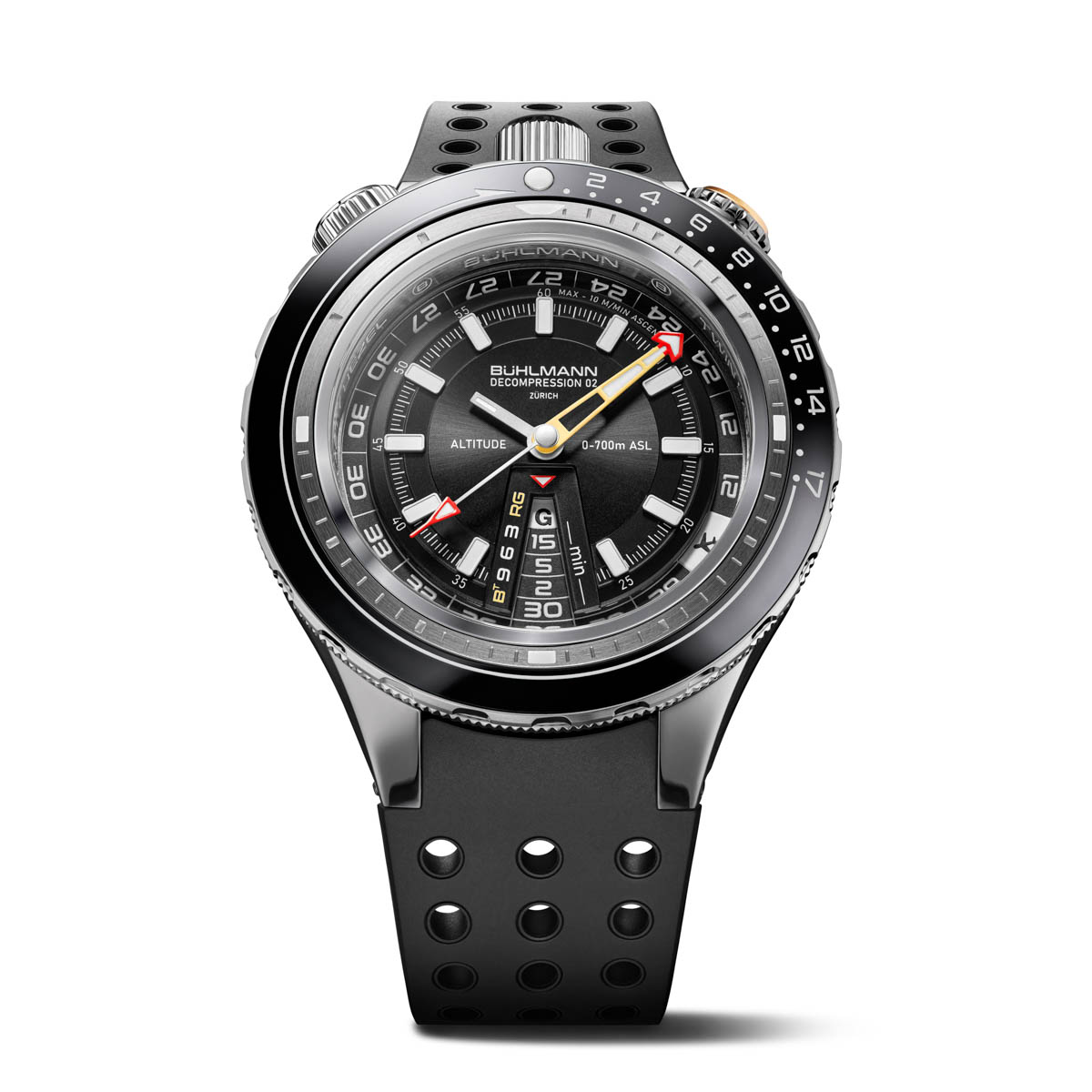
A Swiss watchmaker has taken an unusual approach to the traditional diving watch, incorporating 17 predefined decompression profiles and two independently operating timing bezels into a mechanical timepiece. The result is an ambitious connection between the scientific legacy of Dr. Albert A. Bühlmann and modern Swiss watchmaking.
Most diving watches are designed around a familiar principle: providing reliable timekeeping beneath the surface. The Bühlmann Decompression 02 takes that concept further, integrating selected decompression table information directly into a mechanical watch.
Developed by Swiss watchmaker Bühlmann Watches, the Decompression 02 is intended to function as a supplementary decompression reference and timing instrument without relying on batteries or electronic displays.
The watch is named after Dr. Albert A. Bühlmann, the Swiss physician whose research helped establish much of the mathematical foundation of modern diving decompression procedures.
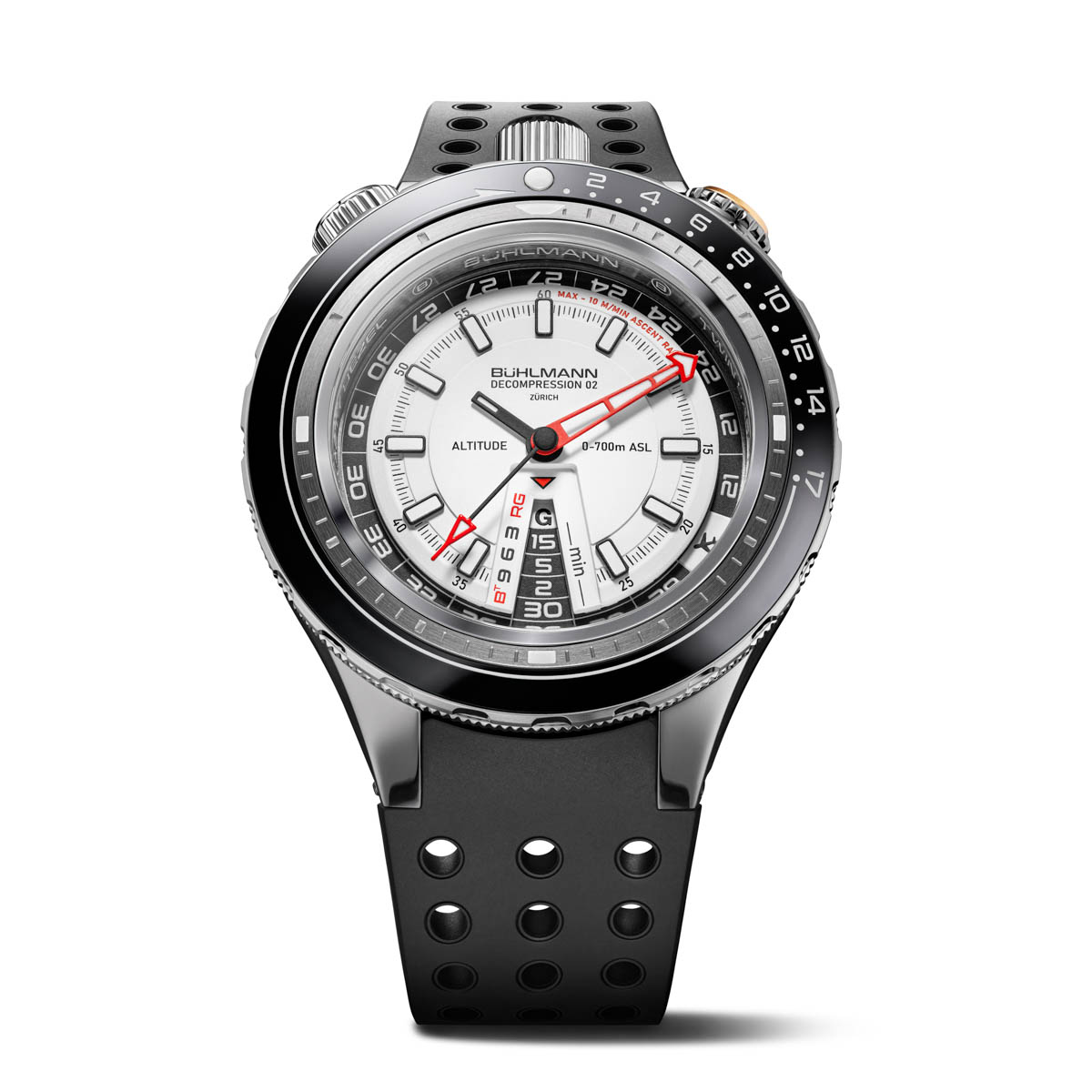
With new Black and White editions joining the collection, the company is seeking to demonstrate that traditional watchmaking can still offer something technically interesting to divers.
But the most significant aspect of the Decompression 02 is not its appearance. It is the engineering challenge behind its unusual functionality.
Translating Decompression Tables Into a Mechanical Watch
The foundation of the Decompression 02 is the Bühlmann ZH-L16 decompression model.
Developed from decades of research into the effects of pressure and dissolved gases on the human body, the Bühlmann approach has influenced generations of dive tables and electronic dive computers.
Rather than attempting to reproduce the full capabilities of an electronic decompression computer, the Decompression 02 incorporates 17 predefined dive profiles derived from the ZH-L16 tables.
These are displayed on a rotating disc positioned beneath the watch dial.
Before diving, the wearer selects a suitable depth-and-time profile. The corresponding decompression information can then be consulted through an opening in the watch face.
According to Guido Benedini, CEO of Bühlmann Watches, the company worked with Ernst Völlm, who had previously worked alongside Dr. Bühlmann, and Christian Wölfel, who is involved with CMAS and the European Underwater and Baromedical Society, to select the profiles.
The objective was to identify a practical selection of profiles that could be represented within the physical limitations of a mechanical display.
It is an unusual application of traditional watchmaking: instead of simply measuring elapsed time, the watch also presents information derived from established decompression tables.
Two Bezels With Different Responsibilities
One of the most distinctive engineering features of the Decompression 02 is its twin-bezel arrangement.
Conventional diving watches generally feature a single rotating bezel for measuring elapsed dive time.
The Decompression 02 incorporates two independently operating bezels.
One is used to track total dive time, while the other measures the duration of decompression stops.
The decompression bezel includes a timing scale extending to 17 minutes, reflecting the longest decompression stop among the 17 selected profiles.
The two bezels rotate in opposite directions, each with a unidirectional mechanism.
According to Benedini, the opposing rotation directions were selected so that accidental movement is intended to produce a more conservative timing indication.
This arrangement allows the diver to distinguish between total elapsed dive time and the timing of an individual decompression stop.
Importantly, the bezels provide timing references. They do not determine the diver’s actual decompression obligation.
A Mechanical Fly/No-Fly Indication
The watch also incorporates an unusual mechanical indication intended to provide a reference for elapsed time after diving.
The decompression disc contains an eighteenth position dedicated to this function.
Rather than developing an entirely separate mechanism, the watchmakers adapted the date mechanism of the Swiss automatic movement to operate the display.
This produces a mechanical reference for the passage of time following a dive.
However, there is an essential distinction between a time indication and an assessment of whether a diver is medically safe to fly.
In correspondence with The Scuba News, Benedini confirmed that the mechanism does not calculate the effects of repetitive dives, different exposure profiles or individual circumstances.
It measures elapsed time rather than assessing a diver’s actual decompression status.
This distinction is consistent with the wider limitations of fixed decompression tables and the importance of recognised flying-after-diving guidance.
For example, Divers Alert Network’s flying-after-diving guidance differentiates between single no-decompression dives, repetitive dives and dives involving mandatory decompression.
The US Centers for Disease Control and Prevention also explains that appropriate waiting periods depend on the diving exposure and that such intervals reduce, but do not eliminate, decompression sickness risk.
The watch’s mechanical indication should therefore be regarded as an elapsed-time reminder rather than a personal fitness-to-fly determination.
What the Decompression 02 Can and Cannot Do
The most important distinction for divers is that the Decompression 02 is not an electronic dive computer.
Its 17 profiles are predefined. They do not change automatically in response to the diver’s actual movements underwater.
The watch does not measure depth, ascent rate or breathing-gas pressure.
It cannot monitor a multilevel dive, calculate residual nitrogen from previous dives or automatically adjust decompression obligations following a deviation from the original dive plan.
Nor does it independently account for different breathing-gas mixtures, individual physiological differences or altitude beyond the published table’s operating assumptions.
The incorporated table reference covers an altitude range of 0 to 700 metres above sea level.
Benedini describes the product as a supplementary mechanical reference for appropriately trained divers using compatible, pre-planned profiles.
That distinction matters.
A diver experiencing an electronic dive computer failure should follow established contingency procedures rather than assume that a selected mechanical table profile accurately represents their accumulated decompression exposure.
The watch also requires separate instruments for essential information such as actual depth and remaining breathing-gas pressure.
Its potential usefulness lies in providing access to a predetermined reference and independent timing capability, not in replacing the monitoring and calculations performed by modern dive computers.
The Scientific Legacy Behind the Brand
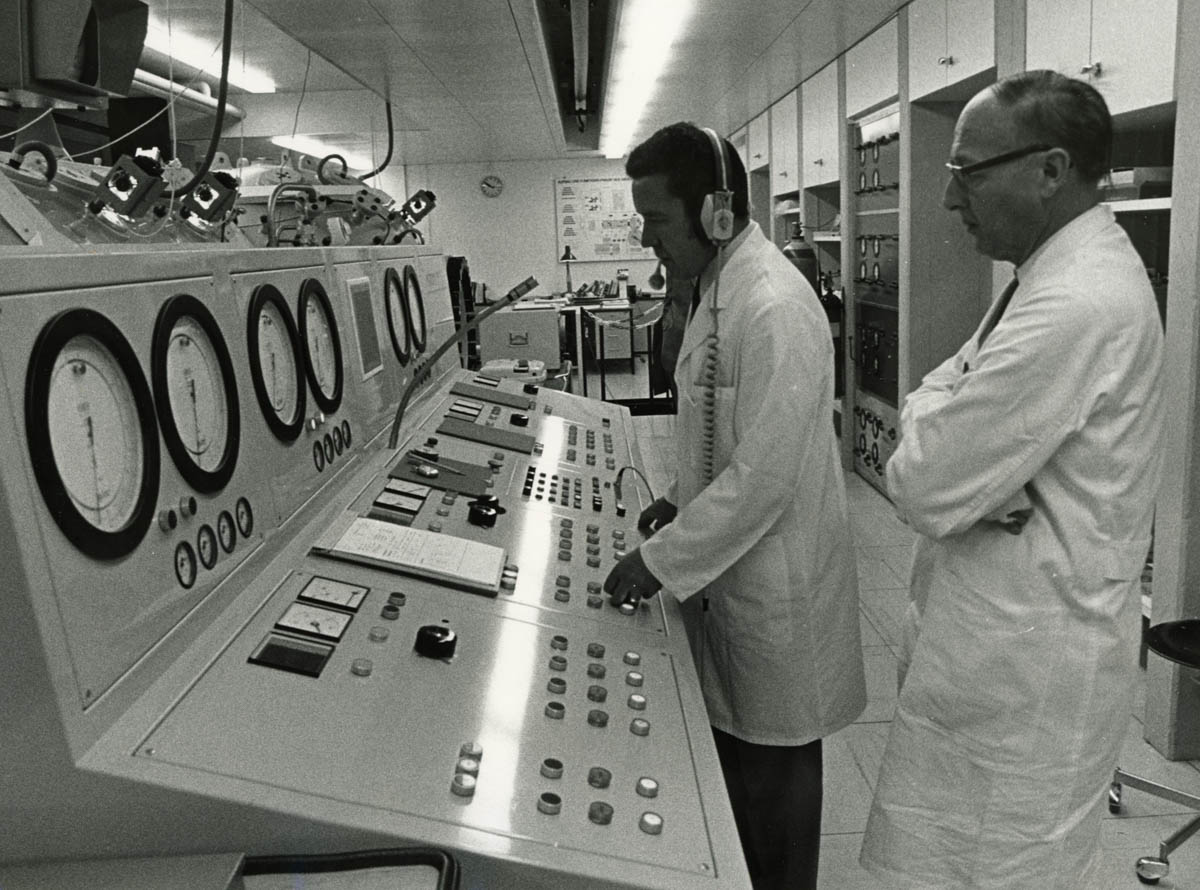
The Decompression 02 also reflects a personal connection to the scientist whose name it carries.
Dr. Albert A. Bühlmann conducted influential research at the University Hospital of Zürich into decompression physiology, breathing gases and the challenges of diving under pressure.
His work, including the development of the ZH-L family of decompression models, helped establish principles that remain relevant to modern diving.
The watch company has a direct family connection through Thomas Bühlmann, the scientist’s son.
According to Benedini, the project developed from discussions with Thomas in 2021 about finding a suitable way to preserve and communicate his father’s scientific legacy.
A mechanical watch offered a particularly relevant connection because of the relationship between time, pressure exposure and decompression planning.
Thomas subsequently became a co-founder of Bühlmann Watches, with responsibilities covering the family’s heritage and the scientific consistency of the project.
The original Decompression 01 established the concept. Its successor develops the functionality further through the twin-bezel design and revised display arrangement.
The result combines a family scientific legacy with a contemporary watchmaking interpretation of traditional decompression planning.
Swiss Mechanical Engineering
Beneath the technical dial, the Decompression 02 uses a Swiss-made Sellita SW300 automatic mechanical movement.
The manufacturer specifies a 56-hour power reserve.
The stainless steel case measures 48.5 millimetres in diameter and 17.2 millimetres in thickness, with a manufacturer-stated water-resistance rating of 575 metres.
Additional features include a sapphire crystal, ceramic bezel components, luminous dial markings and a rubber strap with an extension for wearing the watch over a diving suit.
The case is inclined by five degrees, a design detail intended to improve readability.
The combination creates a substantial mechanical watch whose design is driven partly by its unusual display and timing functions.
The manufacturer has also introduced limited-edition Black and White versions of the Decompression 02, each restricted to 20 pieces.
Both are currently listed on the Bühlmann Watches website at CHF 4,500.
Is There Still a Place for Mechanical Decompression Instruments?
Modern dive computers offer capabilities that a mechanical watch cannot match.
They continuously monitor depth and time, maintain a record of exposure and update their decompression calculations as a dive progresses.
For most divers, those functions make an electronic computer a far more practical primary instrument.
Nevertheless, the Decompression 02 presents an interesting engineering proposition.
Its mechanical system offers a way to consult selected decompression-table information and time different phases of a dive without depending on an electronic display or battery.
The important question is not whether this replaces modern technology. It clearly does not.
Instead, the Decompression 02 demonstrates how a scientific concept can be translated into a physical, mechanical reference instrument.
Its practical value depends on the diver’s training, the suitability of the selected profile and the use of appropriate independent instruments and contingency procedures.
As a piece of Swiss watchmaking, it is an unusual technical achievement.
As diving equipment, its limitations need to be understood just as clearly as its capabilities.
And as a tribute to Dr. Albert A. Bühlmann, it provides a tangible connection between the development of modern decompression science and the continuing engineering traditions of Switzerland.
Further information: Bühlmann Watches
This article is based on technical information and written responses provided directly to The Scuba News by Guido Benedini, CEO of Bühlmann Watches, alongside published product specifications and independent diving-safety guidance. The Scuba News has not independently tested the Decompression 02 or certified its decompression functionality.
