

ScubaGaskets did not enter the regulator market because the world lacked another regulator. It entered because years at the service bench revealed the need for a different approach to ownership, maintenance and spare-parts availability.
A regulator can remain mechanically capable for many years. Its practical working life, however, depends on more than the metal, springs and diaphragms inside it. It also depends on whether the correct service parts can be obtained, whether technicians can access dependable technical information, and whether the equipment can be returned to service without lengthy delays.
For an individual diver, a servicing delay is inconvenient. For a dive centre operating a training or rental fleet, it can remove revenue-producing equipment during the busiest part of the season. A small seal, seat or washer can determine whether an otherwise sound regulator remains in use or sits on a shelf.
That reality shaped the unusual route by which ScubaGaskets moved from supplying O-rings and service components to placing its own name on a complete breathing system.
Learning From the Smallest Components
The first ScubaGaskets website appeared in the early 2000s, although meaningful commercial activity did not begin until around 2010. The company started with a deliberately narrow specialisation: scuba O-rings.
From there, customer requests steadily widened the range into lubricants, specialist tools, service kits and difficult-to-source replacement parts.
Working at this level provides a different view of diving equipment. The glamorous part of a regulator may be its appearance or breathing performance, but the service bench reveals the details that determine how easily it can be maintained. O-ring material and hardness, component tolerances, assembly torque, washer placement and access to clear procedures can all affect consistency and service life.
As ScubaGaskets supplied technicians and dive operations around the world, the same concerns appeared repeatedly: missing technical information, restricted parts, discontinued components and long supply chains.
The company says it now sends parts and equipment to customers in approximately 95 countries. That experience created both the opportunity and the obligation to approach an own-brand regulator differently.
A Sample Was Only the Beginning
The project began when a representative and service-technician associate introduced ScubaGaskets to a regulator manufacturer and supplied a complete piston-type set for evaluation.
The sample was not obtained for immediate sale. Its machining and manufacturing quality appeared promising, but appearance alone was not sufficient for life-support equipment.
The sample was placed with a dive centre and used under normal operating conditions over approximately one year, completing around 40 dives. The field evaluation indicated that the regulator deserved further investigation.
It did not, however, answer a question ScubaGaskets considered fundamental: how would the regulator be serviced correctly years after its purchase?
At that point, detailed service manuals did not exist. The manufacturer did not initially regard them as essential. ScubaGaskets did.
Rather than producing a short illustrated disassembly guide, the company commissioned independent US regulator technician Robert Singler to dismantle and evaluate the piston regulator and develop complete servicing procedures.
When the manufacturer later produced a promising diaphragm model, ScubaGaskets followed the same process of technical evaluation and service-manual development.
Turning Criticism Into Engineering Input
Singler was not selected because he was an unquestioning supporter. According to ScubaGaskets, he had previously been one of the company’s strongest critics.
That scepticism made him valuable. The assignment required someone willing to challenge assumptions, document weaknesses and judge the equipment from a technician’s perspective.
New samples were sent to the United States for complete disassembly and performance evaluation. The work went beyond writing manuals. ScubaGaskets asked for test reports and design recommendations first.
Those recommendations were then returned for engineering revision, followed by new samples and another round of evaluation. The cycle occurred twice before the final service procedures were written.
Over roughly two years, the process produced structural revisions and improvements involving sealing specifications, component support and first-stage geometry.
The precise changes remain part of the product’s technical development, but their purpose was straightforward: prevent known servicing difficulties and make correct rebuilding repeatable.
Documentation as Part of the Product
For ScubaGaskets, the service manual was not an accessory to be created after the regulator. It became part of the development process itself.
The manuals for the SGS2 first stage with the SGT2 second stage, and for the SGS3 first stage with the SGT4 second stage, identify components, inspection points, replacement requirements, torque values and adjustment procedures. Robert Singler’s authorship is openly credited.
That technical information is not being treated simply as internal manufacturer documentation. ScubaGaskets makes regulator servicing information and documentation available to support technicians working with its equipment.
This does not suggest that untrained divers should service life-support equipment. Regulator servicing requires suitable training, tools, test equipment and careful adherence to established procedures.
It does mean that qualified technicians should be able to obtain the information and parts needed to do the work properly.
That distinction is especially important to dive centres. The purchase price of a rental regulator is only one part of its cost. Service-kit pricing, parts availability, technician access, turnaround time and lost operating days all contribute to the true cost of ownership.
A regulator that cannot be returned to service promptly may be expensive regardless of its original price.
From Technical Confidence to Independent Certification
Field use, independent evaluation and service documentation were important, but the market asked the questions it should ask of any unfamiliar life-support product: How has it been tested? Does it comply with the relevant European requirements? Is there evidence beyond the company’s own claims?
ScubaGaskets therefore proceeded with independent EN 250:2014 testing of its regulator configuration.
The existing service manuals also supported the technical documentation required during the process. Obtaining access to an appropriate test laboratory proved considerably more difficult than expected, according to ScubaGaskets, but the project eventually moved forward with specialist assistance in France.
The submitted regulator configuration successfully completed the applicable testing, and certification has now been granted.
ScubaGaskets currently identifies its SGS3 balanced-diaphragm first stage and regulator system as EN 250A certified.
The test programme included cold-water performance down to 4°C and the use of a primary and auxiliary second stage under the conditions specified by EN 250:2014. Strictly speaking, the letter “A” identifies testing with an auxiliary air source. Cold-water suitability is established by the applicable temperature marking and test results rather than by the letter alone.
For ScubaGaskets, certification is not presented as the end of the work. It provides independent confirmation that the submitted configuration met the applicable test requirements.
Long-term confidence will still depend on production consistency, parts support, competent servicing and experience accumulated in real dive-centre use.
ScubaGaskets also intends to pursue EN 250 validation for the SGS2T2 piston regulator system, although no completion date has been set.
A further development objective is testing of the SGS3T4 in accordance with EN 13949, which covers additional requirements for open-circuit breathing apparatus intended for use with compressed Nitrox containing more than 22% oxygen, including oxygen applications.
This remains a planned validation programme and should not be interpreted as completed approval.
The SGS3T4-T3 Octo System
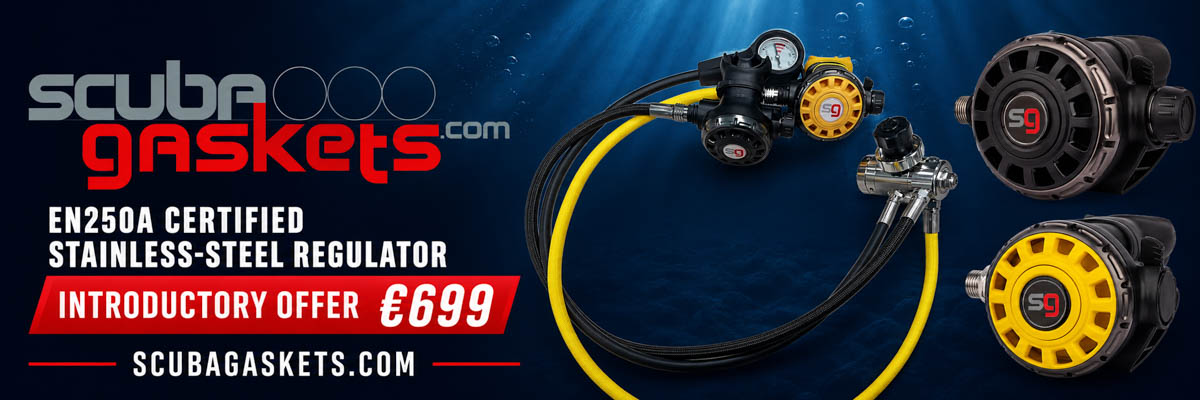
The resulting ScubaGaskets regulator range includes the SGS3T4-T3 Octo breathing system, built around the five-port, balanced-diaphragm SGS3 first stage.
The SGS3 uses 316 stainless-steel components and provides two high-pressure and five low-pressure ports, with DIN and yoke configurations available.
The standard breathing-system configuration includes an adjustable balanced SGT4 primary second stage, an SGT3-OCTO auxiliary second stage, hoses and an SPG.
Its commercial proposition, however, is not based on specifications alone.
It combines independently tested performance with published servicing information and a commitment to replacement-parts availability. That reflects the service-bench experience from which the regulator project originally emerged.
Even before the formal EN 250 certification announcement, ScubaGaskets regulator sets had reached customers in Sweden, Finland, Greece, the United States, the Netherlands and Papua New Guinea.
These geographically diverse early sales reflect the international distribution capability built through years of supplying specialised maintenance products. Custom configurations are also available. Customers in Sweden, for example, selected an SGS2 first stage paired with an SGT4 second stage.
For dive-centre owners, the relevant question is therefore not simply whether another regulator has entered the market. It is whether a supplier that grew from O-rings, service kits and workshop tools can offer a more maintainable ownership model for working equipment.
A Regulator Developed From the Service Bench
ScubaGaskets does not claim to have reinvented the basic principles of the scuba regulator.
Instead, it took an OEM regulator platform through field use, independent technical scrutiny, repeated design revision, detailed documentation and third-party performance testing before presenting it as a ScubaGaskets product.
The journey from a single O-ring to a complete breathing system was not a departure from the company’s original purpose. It was an extension of it.
The same question that guided ScubaGaskets when sourcing a small seal now guides its regulator programme: will the correct component, information and support still be available when the equipment needs to return to the water?
For dive centres and technicians evaluating the SGS3T4, that may ultimately matter as much as the regulator’s price or appearance.
A breathing system is purchased on one day, but its real value is demonstrated over years of use, servicing and support.