




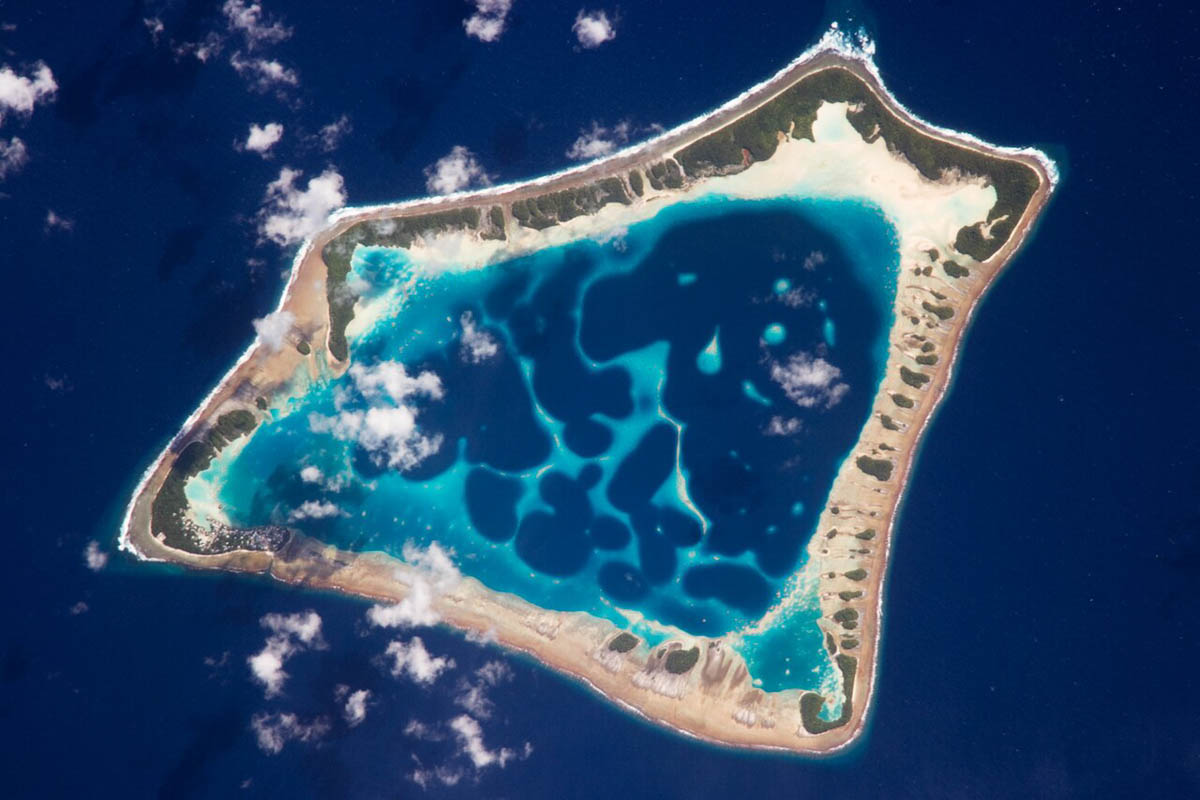

National Geographic Pristine Seas has begun a major scientific expedition to Tokelau, where divers, researchers and filmmakers will undertake the first comprehensive baseline study of the Pacific territory’s nearshore reefs, offshore waters and deep-sea environments.
The expedition is taking place at the invitation of the Government of Tokelau and in partnership with its Ministry of Climate, Ocean & Resilience. The research is intended to provide new biodiversity data that can support Tokelau as it develops a National Ocean Policy and marine spatial plan.
Despite having a total land area of only around 12 square kilometres across the three coral atolls of Atafu, Nukunonu and Fakaofo, Tokelau has an ocean territory covering approximately 319,000 square kilometres.
That gives researchers an enormous marine environment to investigate, much of which remains scientifically unexplored.
Divers Join Survey of Tokelau’s Reefs
Working from the Pristine Seas research vessel Argo, local and international scientists will use a combination of scuba diving and remote research technology to document marine life across different depths and habitats.
Divers will survey reef ecosystems directly, while researchers will also deploy deep-sea cameras, underwater video systems and environmental DNA sampling.
The eDNA work involves collecting and filtering traces of biological material present in seawater. Those samples can subsequently be sequenced to identify organisms that researchers may not encounter visually during dives or camera surveys.
Tokelau’s lagoons and surrounding reefs support a range of significant marine species, including giant clams, endangered green and hawksbill sea turtles, blacktip reef sharks and endangered humphead wrasse.
The surrounding open ocean is also used as a migratory corridor by whale sharks.
Going Beyond Recreational Diving Depths
Some of the expedition’s exploration will extend far beyond the depths accessible to scuba divers.
Researchers will use Pristine Seas’ Argonauta submersible to investigate Tokelau’s deeper “twilight zone”, an environment that remains considerably less understood than the shallow coral reefs above it.
The submersible provides its occupants with an almost 360-degree underwater view and carries equipment including imaging sonar and systems for collecting water and sediment samples.
Molly Timmers, research lead for the Tokelau expedition, said the underwater environment surrounding the territory remains virtually unexplored by scientists.
Each dive, sample and piece of underwater footage will therefore contribute to establishing the baseline needed to better understand Tokelau’s marine biodiversity.
Science to Support Future Ocean Protection
The expedition has a clear conservation purpose.
Tokelau declared its entire marine zone a shark sanctuary in 2011 and has begun planning the development of a National Ocean Policy. Data collected during the Pristine Seas expedition is expected to help identify important areas for protection and contribute to future marine spatial planning.
Tokelau’s reefs and marine ecosystems nevertheless face pressures ranging from climate change and coral bleaching to overfishing, pollution and invasive species.
For a territory consisting of extremely low-lying coral atolls, changes in the ocean and climate have implications extending well beyond marine biodiversity.
The National Geographic Pristine Seas programme says its work is intended to provide Tokelau’s leaders and communities with scientific information that can help guide future decisions about management of the surrounding ocean.
Every Student in Tokelau Invited Aboard
The four-week expedition also includes a significant education programme.
Working alongside Tokelau’s Department of Education, the Pristine Seas team will involve secondary students in scientific activities and provide educator training covering subjects including environmental DNA.
National Geographic says every student in Tokelau will be invited to tour the Argo during the expedition.
Filmmakers are meanwhile documenting both the scientific work and Tokelau’s relationship with the ocean for a future documentary.
The Tokelau expedition forms part of the wider Pristine Seas Global Expedition, launched in 2023 as a five-year programme focused on the tropical Pacific.
Previous work during the programme has taken Pristine Seas researchers to locations including the Southern Line Islands, Niue, the Marshall Islands, Palau, Papua New Guinea, Samoa, the Solomon Islands, Fiji, Tuvalu and Vanuatu.
For Tokelau, the latest expedition could provide something considerably more fundamental: the first detailed scientific picture of marine ecosystems stretching from its shallow coral reefs into the largely unexplored deep Pacific surrounding them.
Comments





.jpg)