


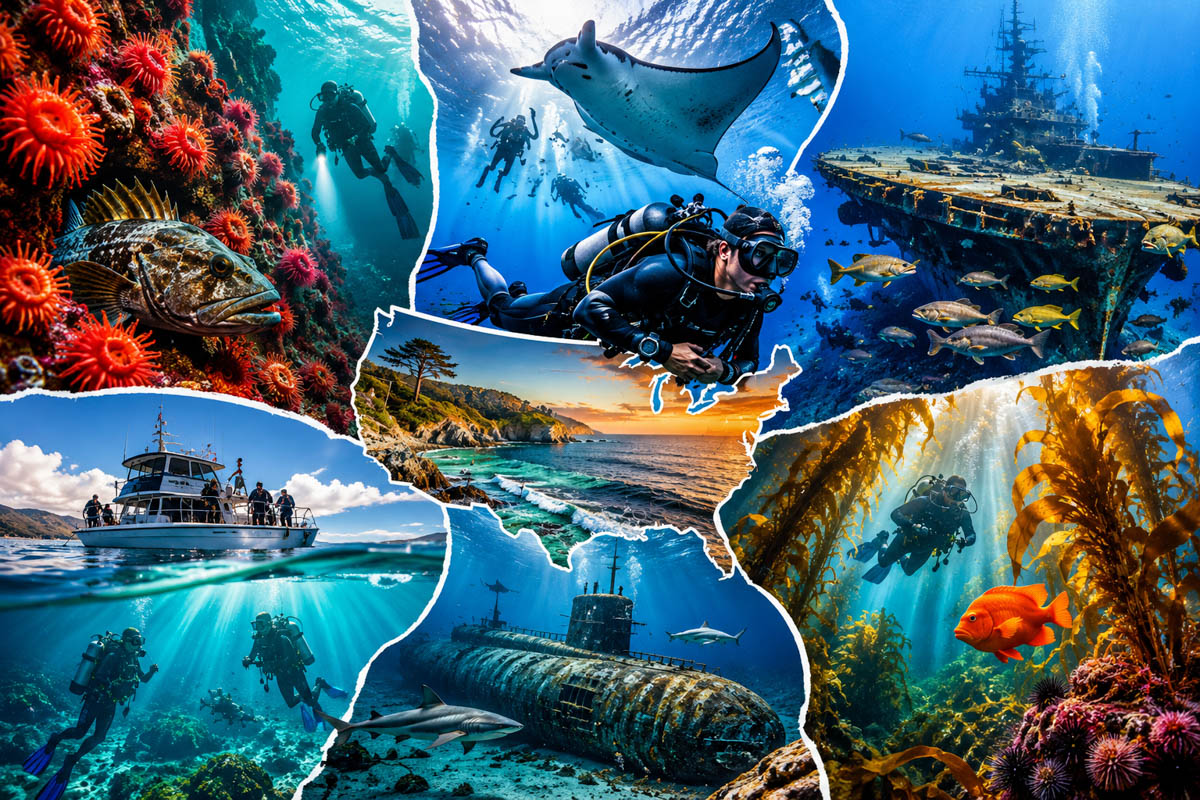
The United States has some of the most diverse underwater landscapes in the world, including cold water walls off the Pacific Northwest, volcanic drop-offs in Hawaii, and the unique coast of North Carolina. Regardless of whether you’re a beginner diver or a professional one, you don’t need to take a plane to experience something genuinely unforgettable. Here are the five destinations that are definitely worth every dollar.
Why Is America the Best Place for Scuba Diving?
The United States has a huge geographic diversity. How many other nations can offer a combination of diving with cold-water Pacific octopuses, tropical mantas, and old wrecks within the boundaries of their homeland?
American coastlines have an interesting mix of environments that range from the waters of the Pacific Ocean, the Atlantic Ocean, and the Gulf of Mexico, all with different ecosystems, visibility, and species. When you factor in the highly organized dive industry and protection provided by NOAA’s National Marine Sanctuaries, you have a diving experience that is safe and accessible.
What It Costs to Be a Scuba Diver in America
Scuba diving in America comes with a price tag that surprises many newcomers. Earning your initial Open Water certification typically runs between $350 and $600, depending on the dive shop and region. Once certified, gear becomes the next major expense. A complete personal setup, including a BCD, regulator, wetsuit, mask, fins, and dive computer, can easily cost $1,500 to $3,000, and that is before you factor in tanks or replacement parts. Ongoing costs add up quickly, too. Annual equipment servicing averages $100 to $200, while local boat dives generally charge $80 to $150 for a two-tank trip.
Dive travel pushes the numbers higher, with weekend trips to Florida or California often topping $500. For passionate divers committed to staying active in the sport, the yearly investment frequently lands somewhere between $1,000 and $4,000. Experienced divers tend to manage this through a mix of approaches: monthly gear funds, buying used equipment, selling old kit, and, for unplanned trips, short-term cash from Dave, Easy Loans, or MoneyLion is commonly used alongside traditional savings.
We also asked financial experts how it is possible that scuba diver numbers are growing in this economy. Kayla Harris, financial expert at 15M Finance, was open about this topic. She noted that scuba diver numbers are growing as access to money has become easy in the 21st century. Digital lenders, traditional banking programs, easy ways to make money on weekends (DoorDash, Uber, Garage Sales, eBay re-selling & freelance work) made this possible. Kayla admitted one interesting fact — scuba divers mostly spend money only on essential gear and save money every month for their passion.
Strawberry Wall, Washington
The Strawberry Wall near San Juan Island offers a fantastic diving experience, even though it is not usually on the list of good diving spots. This wall goes down to about 80 feet and is covered in bright-red or orange strawberry anemone, and it is home to lingcod, wolf eel, and rockfish.
For better visibility, divers come in late summer when average visibility ranges from 30 to 40 feet. Average water temperature is about 50°F throughout the year, making a 7mm wetsuit or drysuit essential. Access can be organized with local charters from Anacortes or Friday Harbor for $100-$130 per two-tank dive.
Manta Night Dive, Kona, Hawaii
It truly lives up to its name. Each night, dive operators in Kona position divers at 40 feet underwater and snorkelers above the surface. Both groups point their lights downward, drawing plankton that, in turn, attracts manta rays with wingspans up to 14 feet. The mantas circle and barrel-roll right in front of your face. One of the most guaranteed crazy wildlife experiences in U.S. scuba diving. Trips run $130 to $165 with nightly departures from most operators. If you want to be a part of the experience, book your spot at least one week prior.
U-352 Cape Lookout, North Carolina
The U-352 is a German submarine that was sunk by the United States Coast Guard in 1942. It is currently located on the sandy bottom, 115 feet deep, off the coast of Morehead City, North Carolina. Here, divers can see sand tiger sharks, barracuda, and spadefish. Go to the Outer Banks of North Carolina to see protected wrecks, which are referred to as the Graveyard of the Atlantic.
This is an advanced dive. You’ll need an Open Water certification at minimum, and real deep-dive experience genuinely helps. Charter trips from Morehead City run $100 to $140 per person.
Catalina Island, California
Only 22 miles away from Los Angeles, Catalina Island is considered to be one of the most easily accessible spots in the country. At the Casino Point Underwater Park, a marine conservation area, the visibility underwater may range from 60 to 100 feet. Garibaldi fish, which are the state marine fish of California, are everywhere here. You’ll also see sheephead fish, kelp forests, and even bat rays. Divers may access the shore for free, with the equipment rentals right at the site. If you want to explore the depths, it is highly recommended to have a boat dive from Two Harbors, around the back end of the island.
USS Oriskany, Pensacola, Florida
The USS Oriskany is the largest ship ever sunk to form an artificial reef. It lies about 7 miles off of Pensacola, Florida, in water depths ranging from 40 ft to 212 ft. Its flight deck is approximately 70 ft deep and provides easy access via dive boats by certified divers. It has become a home to all kinds of marine life, including amberjack, goliath grouper, spadefish, and even some silky sharks. A guided two-tank dive runs around $100 to $120.
The Bottom Line
You don’t have to travel halfway around the world to dive in an unforgettable place. These five diving sites offer all kinds of dive experiences from cold water, warm water, wrecks, reefs, to unique wildlife encounters. Make sure to do your research, be properly certified as a diver before you go, and create a budget beforehand. The money spent on it all will be returned to you through priceless memories that are very difficult to replace.
Frequently Asked Questions
Where’s the best place to scuba dive in the US?
It depends on what you’re planning to see. If you want warm water and to explore marine life, locations like the Florida Keys and Hawaii are at the top of most lists. For wreck diving, North Carolina’s Graveyard of the Atlantic is a good option. Basically, the best spot for you will depend on your certification level and the type of underwater environment you wish to discover.
What is the 120 rule in diving?
The 120 rule is a practical guideline for managing nitrogen narcosis risk. For that, you’d need to subtract your depth in feet from 120 to estimate how many safe minutes you have before nitrogen narcosis may become a concern. This is a relatively rough method for estimating how long you can safely stay on the bottom and should never be used in place of a dive computer or proper deep-dive training.