




Technical diving has always relied on careful gas planning, disciplined calculations, and a healthy respect for physics. Now a new mobile tool called Dalton is aiming to make those calculations easier to verify without replacing the training and judgment divers depend on.
Developed by Tools for Divers, Dalton is a technical diving gas calculator designed for iPhone, iPad, Android, and soon Mac. The app is positioned not as a dive planner or dive computer replacement, but as a verification tool that divers can use to double-check gas calculations for air, nitrox, and trimix before entering the water.

According to the developer, Dalton is meant to replicate the kinds of calculations many technical divers already perform on slates, notebooks, or mental math, but with a clear focus on transparency and verification.

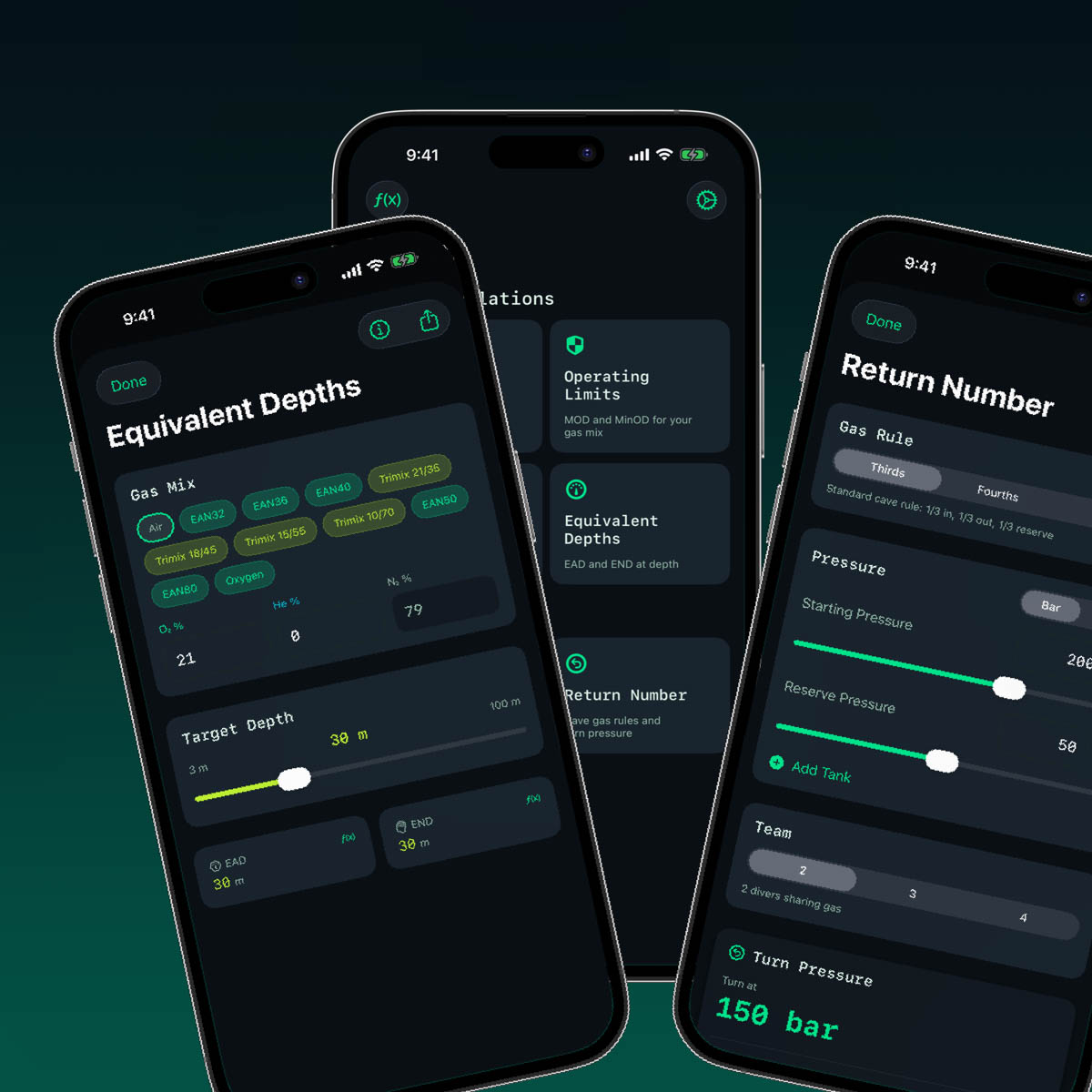
Unlike many mobile dive utilities, Dalton makes its calculations visible to the user. Each result links to the full mathematical formula used, along with citations from published sources, allowing divers to see exactly how the result was derived rather than relying on hidden algorithms.
Gas Calculations Built for Technical Diving
The app includes a suite of tools covering core gas calculations commonly used in both recreational nitrox diving and more advanced trimix planning.

These include calculations for maximum operating depth, equivalent air depth, equivalent narcotic depth, best mix selection, gas density, and breathing resistance at depth. The app also includes tools designed to assist with dive planning such as bottom time calculations and multi-level dive profile guidance.
One feature likely to attract attention among cave and wreck divers is a dedicated Return Number calculator. This tool focuses on minimum return gas volume, incorporating factors such as SAC rate, ascent profile, and safety stops. These calculations are commonly used by divers operating in overhead environments but are often worked out manually.
Dalton provides configurable reserve fractions, including thirds, fourths, and custom settings, allowing divers to adapt the calculation to their preferred gas management strategy.
A Focus on Transparency and Safety
A major design goal of the app appears to be transparency.
Each calculation links to its formula derivation and reference sources so divers can review the underlying mathematics and compare results with published tables. According to the app description, calculations have been verified against established training agency materials and dive computer references, including PADI enriched air tables, TDI trimix tables, and Shearwater dive computer documentation.
Dalton also incorporates gas density monitoring, something that many mobile tools overlook. The app provides real-time density calculations at depth and flags values that exceed the 5.7 g/L threshold identified in research by Simon Mitchell and Gavin Anthony Doolette related to breathing resistance and work of breathing.
In addition, the software includes a three-tier warning system that categorizes outputs as informational, cautionary, or dangerous based on recognized physiological thresholds rather than arbitrary limits.
Built for the Boat, the Fill Station, or the Briefing
Dalton is designed to work offline, allowing divers to run calculations anywhere without needing an internet connection. The app is also intentionally lightweight and simple to use in environments where divers may only have a few minutes to confirm a gas mix or verify a plan.
Four of the gas calculation tools are available in the free version of the app. Three additional dive planning tools can be unlocked through a one-time Pro purchase. The developer says the app contains no advertising, subscriptions, or account requirements, reflecting a design philosophy focused on practical use rather than ongoing monetization.
The app currently supports English, Spanish, and French and is available on both major mobile platforms.
Divers interested in trying the tool can download Dalton from the App Store or from Google Play, with the developer also planning a Mac version in the near future.
As with any dive planning tool, the developer emphasizes that Dalton is not a substitute for proper training or dive computers. Instead, it is intended to act as a second opinion that divers can carry with them to the boat, the classroom, or the fill station.
For technically minded divers who like to verify the math behind their gas planning, that extra layer of transparency may be exactly the point.
Comments