




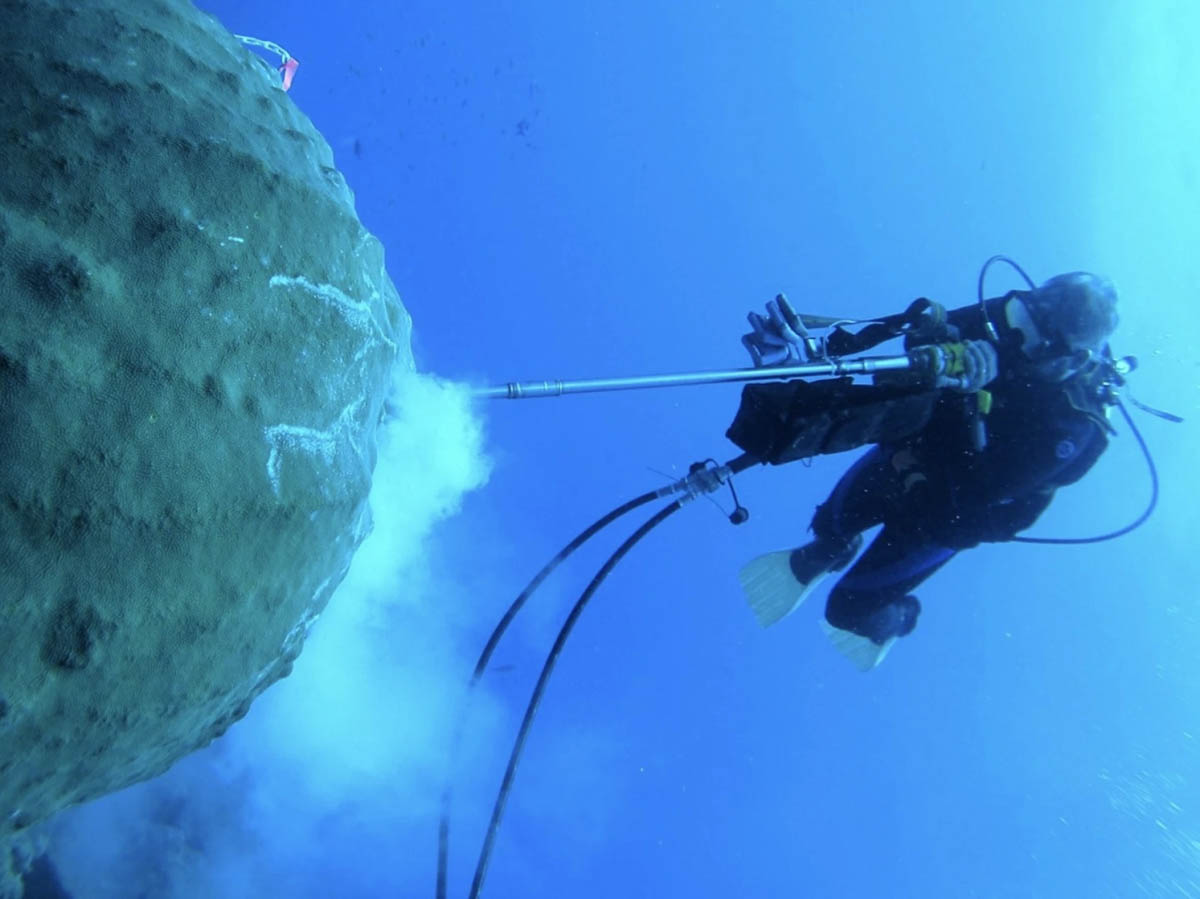

One of the healthiest coral reef systems in the continental United States is recording the effects of human activity taking place hundreds of miles away.
Scientists studying corals at Flower Garden Banks National Marine Sanctuary have found evidence that increasing quantities of nitrogen carried into the Gulf by the Mississippi River are reaching the offshore reefs.
The findings come from a new peer-reviewed study published in Science Advances, in which researchers reconstructed approximately 270 years of nitrogen inputs using chemical records preserved inside coral skeletons.

The results suggest that Mississippi-derived nitrate has grown to account for more than 60% and, during some recent periods, as much as 80% of the nitrogen reaching Flower Garden Banks.
The discovery raises concerns that nutrient pollution could be weakening the resilience of a reef system that has historically survived conditions that have severely affected coral reefs elsewhere.
A 270-Year Record Hidden Inside Coral
Flower Garden Banks lies in the northwestern Gulf, well offshore from Texas and Louisiana.
Its relative isolation has helped make the sanctuary unusual. Despite widespread coral decline elsewhere in the Caribbean and western Atlantic, the reefs at Flower Garden Banks have maintained exceptionally high coral cover.
Researchers have now used the reef’s long-lived corals to investigate how conditions surrounding them have changed.
The study published in Science Advances analysed coral-bound nitrogen isotopes from two coral cores covering the period between 1753 and 2023.
Much like tree rings, layers deposited within a coral skeleton can preserve information about the environmental conditions that existed as the coral grew.
For roughly the first century of the record, the nitrogen signatures were consistent with relatively natural conditions.
That began changing around 1850.
Researchers identified an increasing contribution from human-derived nitrogen that coincided with agricultural expansion and fertilizer use within the Mississippi River basin.
The change accelerated sharply after the 1960s as synthetic fertilizer use expanded during the Green Revolution.
Mississippi Nitrogen Now Dominates
The researchers used modelling to estimate how much of the nitrogen reaching Flower Garden Banks originated from the Mississippi system.
By the end of the 20th century, Mississippi-derived nitrogen represented an estimated 30% to 50% of nitrogen reaching the reefs.
During the last decade, that proportion exceeded 60%, while in 2023 researchers estimated it reached approximately 80%.
The research also points towards an important legacy problem.
Nitrogen accumulated over decades in agricultural soils and groundwater can continue moving through river systems long after it was originally applied, meaning changes in fertilizer use do not necessarily translate immediately into lower nutrient loads reaching the ocean.
Flower Garden Banks is around 448 kilometres, or 278 miles, from the mouth of the Mississippi River, according to the Max Planck Institute for Chemistry, which led the international research team.
That distance makes the chemical signal preserved in the corals particularly significant.
Heat And Nutrients Acting Together
The research does not suggest nitrogen pollution alone is responsible for recent problems at Flower Garden Banks.
Instead, scientists are concerned about its interaction with increasingly severe thermal stress.
The highest Mississippi River nitrogen contributions found during the entire 270-year record occurred in 2016 and 2022-2023, periods that also coincided with coral disease and thermal stress at the sanctuary.
Flower Garden Banks experienced a significant coral disease outbreak in 2022, while extreme temperatures during 2023 produced substantial bleaching.
NOAA’s long-term monitoring data show that reef-depth temperatures exceeded 30°C for 53 days at East Flower Garden Bank during 2023. By late September, bleaching affected approximately 28% of reef-wide coral cover there, while more than half was either bleached or pale.
Thermal stress continued into 2024. NOAA subsequently reported that 2023 and 2024 represented the first consecutive bleaching years recorded at Flower Garden Banks.
The new study suggests nutrient enrichment could make corals less capable of coping with these additional pressures.
A Reef That Has Defied Wider Decline
That matters because Flower Garden Banks remains an important exception to the deterioration seen across many western Atlantic coral reefs.
NOAA’s 2024 monitoring found mean coral cover of approximately 56% across the East and West Flower Garden Bank study sites. The agency describes the sanctuary as one of the few western Atlantic reef systems to have resisted substantial degradation over recent decades.
The sanctuary’s isolation does not, however, make it immune from events occurring closer to shore.
NOAA has previously recognised that pollutants associated with major river systems, including the Mississippi and Atchafalaya, can affect water quality across the northern Gulf. Changes in circulation following storms and other events can transport land-based runoff considerable distances offshore.
A major mortality event at East Flower Garden Bank in 2016 had already demonstrated this connectivity. Previous research concluded that coastal floodwaters transported offshore helped create low-oxygen conditions associated with the mortality of corals and other reef organisms
The new research extends that picture dramatically by finding the Mississippi’s nitrogen signature preserved through generations of coral growth.
What Happens Hundreds Of Miles Away Can Reach The Reef
Flower Garden Banks may therefore offer scientists something increasingly valuable: both a refuge for comparatively healthy coral communities and a centuries-long record of how human activity has altered the northern Gulf.
The Mississippi watershed drains an enormous portion of North America. Agricultural nutrients entering streams and groundwater far inland can eventually move into the river and towards the Gulf.
For divers, the findings underline how the future of a remote coral reef can depend on environmental decisions made far beyond the coastline.
Flower Garden Banks has demonstrated extraordinary resilience.
The new research suggests that resilience should no longer be taken for granted.
Comments