




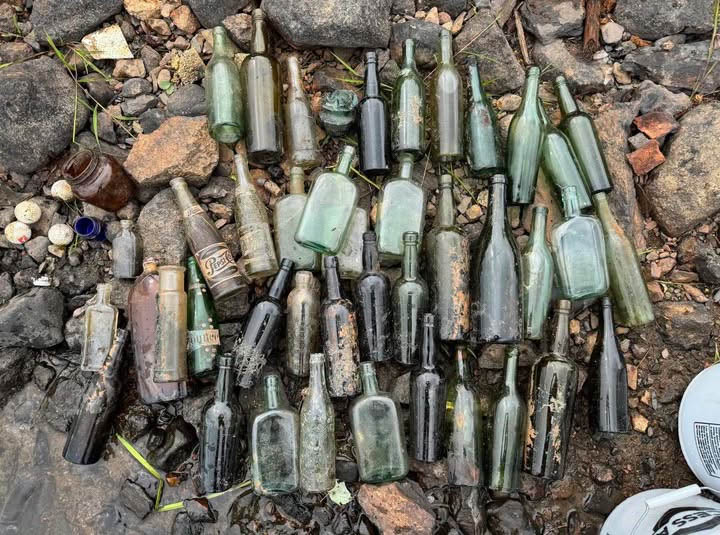

Ever wonder why we keep pulling 100-year-old bottles out of the mud? Grab your coffee, here’s why.
Nova Scotia has always been a rum province.
In 1749, the Canadian government dangled rum as part of the deal to get people to settle here. Construction contracts stipulated it. Farm crews got rum breaks at 11 and 4. Fishermen wouldn’t leave the wharf without it. When a ship wrecked, rum was the first thing saved.

Enter Joshua Mauger. He arrived as victualler (supplier of food and provisions) to the Royal Navy, and in 1751 built a rum distillery near Halifax, a rare thing for this part of British America at the time. He went on to become the largest shipowner in town, moving fish and lumber to the West Indies and bringing back rum, molasses and sugar.
By the 1860s, Halifax had 200 to 300 drinking houses and shops, about one for every 100 people. The tavern wasn’t just a bar. It was the hiring hall, the meeting hall, the living room.
Then came the backlash. West River, Pictou County organized what’s still locally claimed as one of the first temperance groups in North America, in 1827 (a title several other Maritime towns also claim, the temperance wave hit fast and everywhere at once). The Sons of Temperance arrived in 1847 and had ten divisions running within five months. By 1892, Nova Scotia had made it law to teach the effects of alcohol in public schools.
In 1906, the WCTU, the Sons of Temperance, and the Presbyterian, Methodist and Baptist temperance committees joined forces as the Nova Scotia Temperance Alliance. The Temperance Act of 1910 made the whole province dry, except Halifax. Halifax finally went dry too, in 1916.
When the U.S. banned alcohol in 1920, this province became the centre of the liquor trade. Halifax, Lunenburg and Yarmouth were the main ports, with a smuggling headquarters set up in the North West Arm by 1925. Supply ran through the French islands of Saint Pierre and Miquelon, which went from a trickle to over 4 million litres of whisky alone flowing through in a single year, on top of West Indies rum, Champagne, gin, and Canadian whisky repacked into plain burlap sacks to look like anything else.
Rum runners ran dark, no lights. They sank loads at drop points tethered to buoys, dumped cases overboard the second a cutter appeared, and wrecked in the fog, overloaded and running blind. On shore, “blind pigs” were built like fortresses, with metal-lined walls, hidden hatches, and stairways built for a quick vanishing act.
Why “blind pig”? The term came from the U.S. in the 1800s. The trick was you didn’t sell alcohol, which was illegal. You charged people to see an attraction, like a blind pig or a striped pig and you gave them a free drink with admission. On paper you were running a pig show, not a bar. The name stuck for any illegal, low-end drinking house
So why is there still so much down there?
Before the late 1800s, Halifax had no real municipal landfill. The harbour was the dump. If you worked a tavern or a schooner, the easiest way to get rid of a broken bottle was to throw it in the water. Glass survives in cold, low-oxygen mud for centuries, so 150 years of everyday drinking is still sitting on the bottom, waiting. This practice remained for a long time. Not just in the ocean, but in the woods, lakes and rivers.
Rum running just added a second layer on top of that: concentrated clusters of the same bottle, burlap packing, dense little deposits near the old smuggling hideouts.
That’s the two-layer story under every cove, lake and river around here. The everyday tavern layer is everywhere, and the smuggling layer is still washing out of the shore fill.
There’s a lot more down there and I plan on finding it.
If you’ve spotted old glass, pottery or bottles on the shoreline, drop the location in the comments or send me a DM. There’s a chance there’s old stuff under the water. I might just come take a look.
Story and picture submitted by Coastline Chronicles.
Comments