

Florida State University Panama City’s Advanced Science Diving Program will benefit from new funding to support underwater surveys, scientific diving equipment and long-term monitoring of the world’s largest artificial reef.
Just weeks after the historic SS United States was deliberately sunk off Florida’s Gulf Coast, new funding has been announced to support scientific research into the vessel’s transformation into a marine ecosystem.
The St. Joe Community Foundation plans to donate $91,106 to Florida State University Panama City’s Advanced Science Diving Program, supporting research conducted in partnership with the Woods Hole Oceanographic Institution (WHOI).
According to a report published by WJHG on November 24, 2026, the funding will support specialist equipment purchases and training, enabling researchers to undertake underwater surveys and monitor the development of the artificial reef over time.
Investment in Scientific Diving and Rebreather Technology
The funding is expected to support the acquisition of several pieces of specialist equipment, including CHIRP sonar, closed-circuit rebreathers and a thermally insulating drysuit, as well as training in the use of rebreather technology.
Closed-circuit rebreathers offer several advantages for suitably trained scientific divers, including improved breathing gas efficiency and reduced bubble emissions. These characteristics can be particularly valuable during extended underwater observations and research involving marine wildlife.
The investment will also expand opportunities for university students to participate directly in scientific diving and underwater research.
Florida State University Panama City’s Advanced Science Diving Program provides specialist education and training in scientific diving techniques in accordance with standards established by the American Academy of Underwater Sciences.
The SS United States project provides an opportunity to apply these skills to a research site of exceptional scale.
Studying the Birth of an Artificial Reef Ecosystem
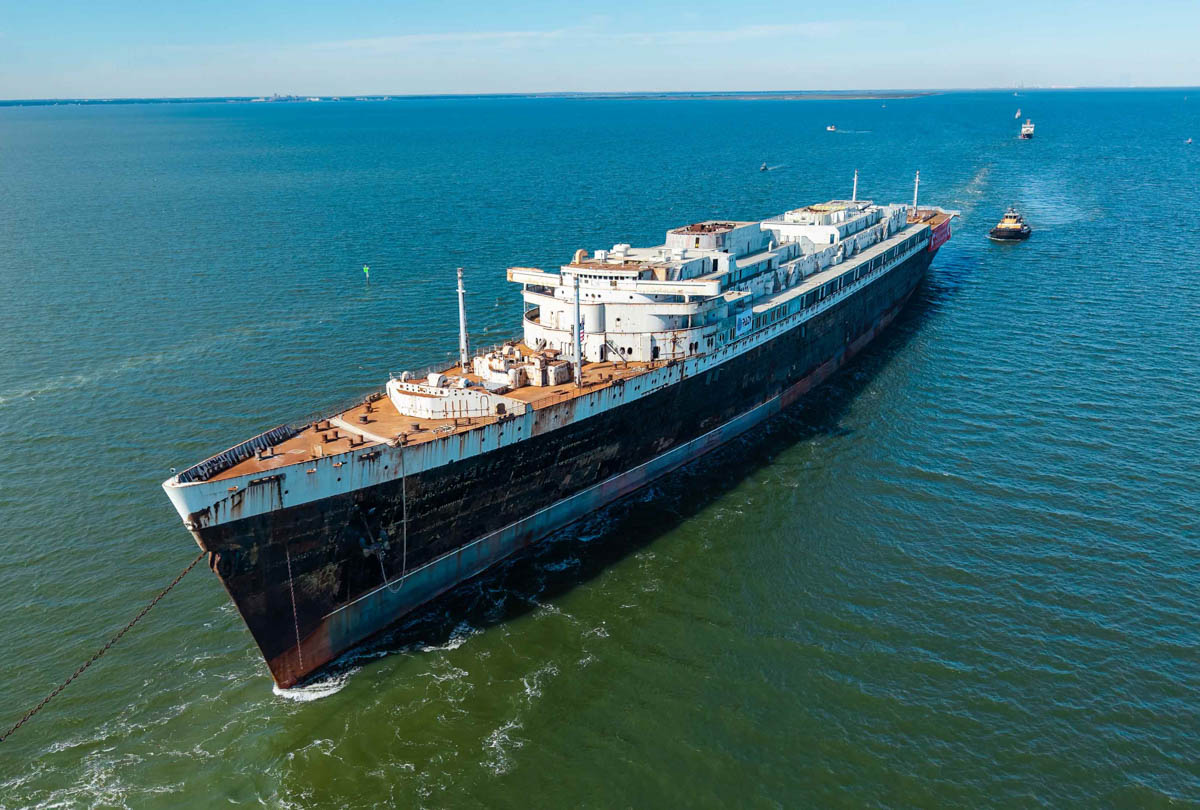
As previously reported by The Scuba News, the SS United States was successfully deployed as an artificial reef on November 11, 2026, approximately 22 nautical miles southwest of Destin, Florida.
At approximately 990 feet (302 metres) in length, the former ocean liner became the world’s largest deliberately deployed artificial reef.
While much of the attention surrounding the sinking has focused on its potential as an internationally significant wreck diving destination, the vessel also represents an unusual scientific opportunity.
Most historic shipwrecks are discovered or studied long after marine organisms have established themselves. In contrast, the documented deployment of the SS United States allows researchers to observe ecological changes from the earliest stages of colonisation.
In a research announcement published on the day of the sinking, the Woods Hole Oceanographic Institution outlined a multi-year programme investigating the relationship between biological colonisation, water chemistry and changes to the submerged structure.
Researchers intend to establish an early baseline against which subsequent changes can be measured, helping to build a clearer understanding of how marine communities develop around large artificial structures.
The research could have implications extending beyond the SS United States itself, informing the design, construction and monitoring of future artificial reefs and other offshore infrastructure.
Could Recreational Divers Contribute to the Research?
One particularly interesting aspect of the wider research programme is the potential involvement of the recreational diving community.
WHOI marine biologist Kirstin Meyer-Kaiser has identified the development of a citizen science initiative as a longer-term objective.
Under such an initiative, recreational divers visiting the wreck could potentially contribute underwater photographs to supplement information collected during scheduled scientific expeditions.
Repeated photographic observations could help researchers document changes to the wreck and the marine communities developing across its extensive surfaces.
Although a formal citizen science programme has yet to be announced, the proposal highlights the potential for recreational wreck diving and professional marine research to complement one another.
A New Chapter for the SS United States
The latest funding announcement adds another dimension to the former ocean liner’s evolving underwater legacy.
Interest from the recreational diving community continues to grow, with a dedicated SS United States wreck diving guide already announced for November 2027, coinciding with the first anniversary of the sinking.
However, the scientific value of the wreck may ultimately prove just as significant as its appeal to visiting divers.
Over the coming years, researchers will have the opportunity to document how a landmark of American maritime engineering becomes part of the marine environment, providing insights that could influence artificial reef projects around the world.
The Scuba News will continue to follow both the scientific and recreational diving developments surrounding the SS United States.
