
During World War II, four historic shipwrecks settled on the seabed of Conception Bay near Bell Island, Newfoundland, marking a chilling turning point for North American security. These daring 1942 strikes by German U-boats directly against Canadian coastal waters served as a stark wake-up call to the Allied powers, proving that distance alone would offer no sanctuary if Great Britain collapsed. Uncovering this underwater history begins with an exploration of Conception Bay’s sunken fleet, starting with the tragic loss of the SS Saganaga—the initial target destroyed during U-513’s covert assault.
The shores of Bell Island in Conception Bay became a direct target of German U-boats during two separate 1942 assaults, resulting in the destruction of four cargo vessels and the loss of over 60 sailors. As vital arteries in the Battle of the Atlantic, these waters served as a critical convoy passage for transporting crucial supplies from the United States to Allied troops in Europe. By intercepting these trade routes, Nazi forces delivered a rare direct blow to the Dominion of Newfoundland, demonstrating how vulnerable Atlantic supply lines were to enemy attack.
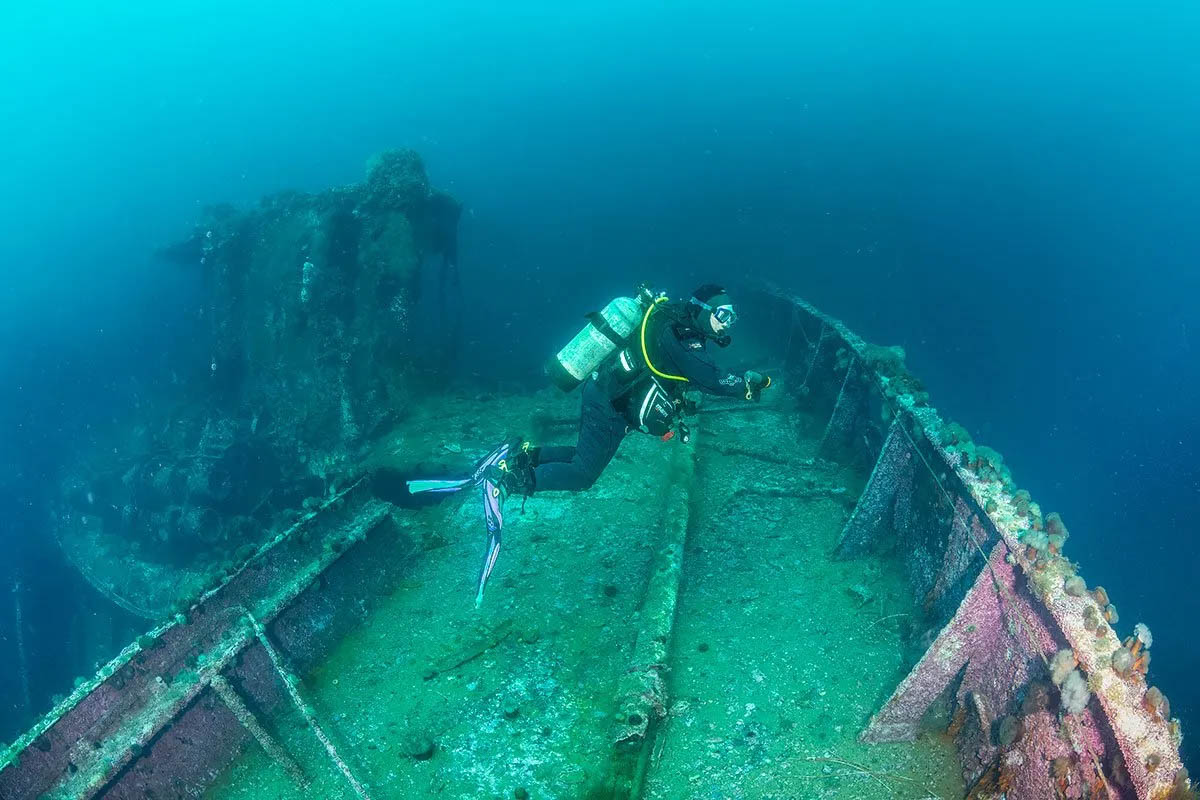
On the morning of September 5, 1942, six iron ore ships were positioned off Bell Island, four fully laden at anchor in the Tickle and two actively loading at the Scotia and Dominion loading docks. The calm was shattered at 11:46 a.m. when a torpedo detonated against the SS Saganaga, blasting a cloud of debris, ore, and crewmen into the sky. A second torpedo struck seconds later, nearly severing the ship in half.
During this coordinated strike, the German submarine U-513, commanded by Kapitänleutnant Rolf Ruggeberg, targeted another anchored vessel awaiting departure instructions for North Sydney. A torpedo struck the 124-meter (407-foot) ship on her portside amidships. Loaded with 8,300 tons of heavy iron ore, the vessel sank in approximately 30 seconds. That dense cargo weighted the hull as it went down, keeping the ship mostly upright and structurally intact on the seabed. The sudden catastrophe claimed the lives of 29 to 30 crew members out of the 44 to 48 aboard.
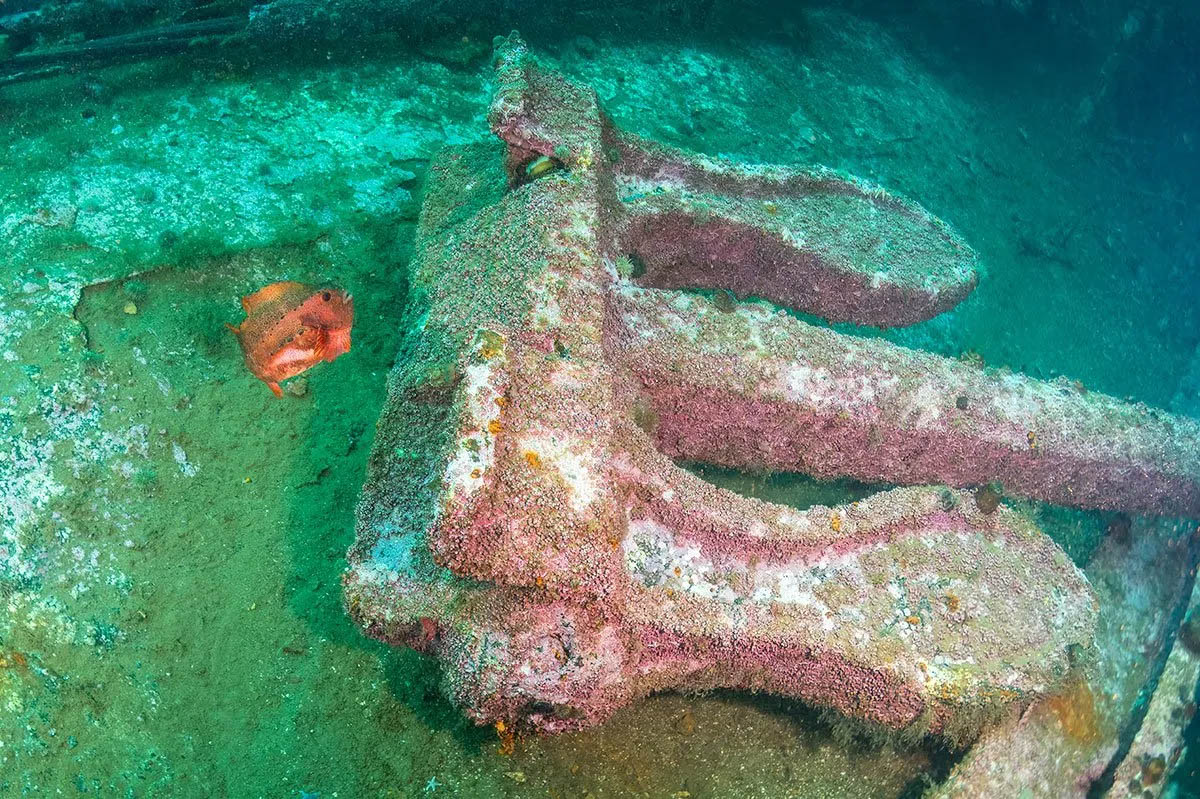
Resting at a relatively accessible depth, the wreck’s superstructure rises to approximately 60 feet (18 meters) beneath the surface, while the main deck and seabed stretch between 70 and 110 feet (21 to 34 meters) down. These dimensions establish it as one of the shallowest dive sites among the Bell Island shipwrecks.Today, the vessel is officially designated as a protected war grave as part of the historic Bell Island shipwrecks. To ensure safety for visitors and the surrounding marine environment, the site was thoroughly cleared of active unexploded ordnance by a specialized Canadian Armed Forces operation in 2021.