




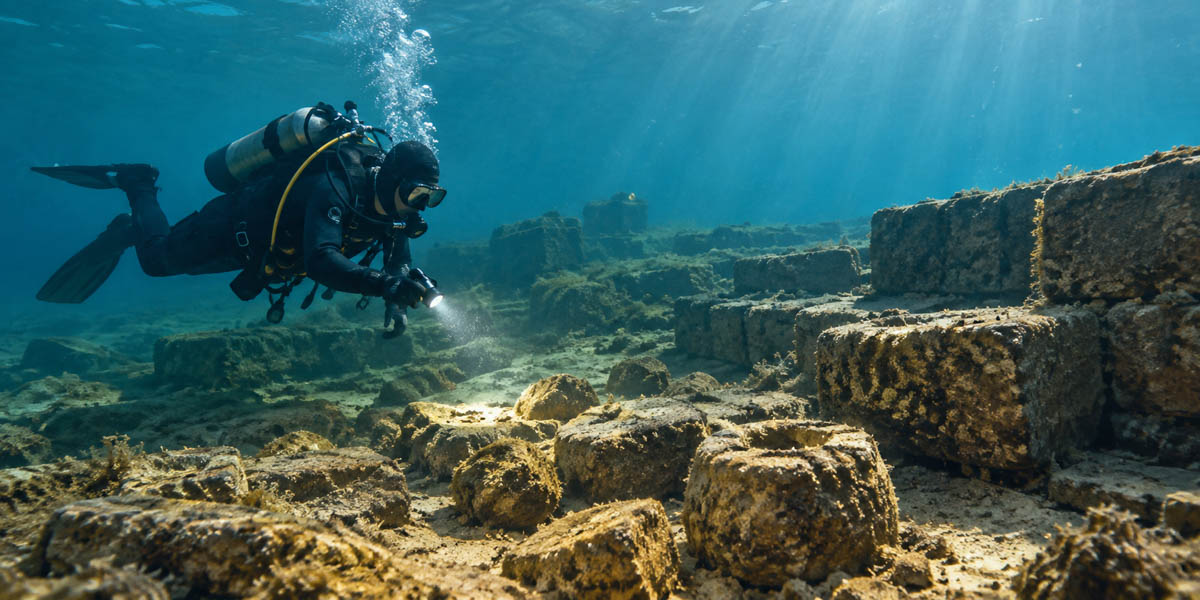

Divers and archaeologists have returned to the submerged remains of a medieval settlement beneath Lake Issyk-Kul in Kyrgyzstan, recovering pottery fragments and animal bones as researchers continue piecing together the history of a community that once stood on one of the great trading routes between East and West.
The latest underwater work is focused on the Toru-Aygyr archaeological complex in the northwestern part of Issyk-Kul, a vast mountain lake surrounded by the Tian Shan range.
The site is not a new discovery. Archaeological remains beneath the lake have been known for generations, but systematic underwater investigation has accelerated in recent years. The Russian Geographical Society announced the latest phase of fieldwork in September 2026, with researchers continuing to investigate the medieval settlement and the changing landscape around it.
During dives on 22 September, members of the expedition brought animal bones and pieces of pottery back from the lakebed for further study.
The finds may appear modest compared with spectacular shipwreck discoveries, but for archaeologists they can provide important evidence about when the settlement was occupied, what its inhabitants ate and where goods used by the community originated.
Pottery can potentially help researchers refine the chronology of the site and identify manufacturing techniques or connections with other regions. Animal remains may provide information about diet and everyday life.
Among previously recovered objects from the complex is an unusually well-preserved child’s chamber pot, or tuvaq, a type of object that expedition director and archaeologist Maxim Menshikov noted remains familiar in parts of Central Asia and the Caucasus.
A City Beneath Issyk-Kul
Toru-Aygyr is considerably more complex than the romantic image of a single lost city suddenly appearing beneath the water.
Research by the Institute of Archaeology of the Russian Academy of Sciences has identified archaeological remains spread across an extensive area south of the modern village of Toru-Aygyr.
The underwater zone includes evidence of burial grounds, structures and a substantial medieval settlement. Earlier surveys documented rectangular buildings constructed from fired brick as well as other features that may represent kilns or traditional ovens.
The archaeological landscape extends for several kilometres along the shore, with submerged remains found in relatively shallow water.
Research during the 2025 season produced further evidence of the importance of the site. The Russian Geographical Society reported the discovery of a Muslim necropolis dating to the 13th and 14th centuries, alongside large ceramic vessels and remains of buildings constructed from fired brick.
The settlement appears to have flourished during the medieval period when routes through this part of Central Asia formed part of the wider Silk Road network connecting China, Central Asia, the Middle East and Europe.
Researchers have associated its period of occupation with the era of the Karakhanids, the Turkic dynasty that controlled extensive parts of Central Asia between roughly the 9th and early 13th centuries.
The original name of the settlement remains uncertain.
Divers Mapping a Lost Landscape
The underwater investigation is being conducted by specialists from Kyrgyzstan and Russia.
Kyrgyz researcher Valery Kolchenko said when the 2026 season began in June that archaeologists were gradually establishing the boundaries of the site. Researchers had already determined that the settlement and one of its burial areas were once separated by a river.
According to Kyrgyz news agency 24.kg, the 2026 programme was divided into two phases, with the second scheduled for September following the World Nomad Games.
The September expedition brought researchers back into water approximately three to four metres deep.
The wider project combines traditional archaeological diving with modern surveying techniques. Previous expeditions have employed underwater drones, hydroacoustic navigation and photogrammetry to document features without unnecessarily disturbing them.
That approach is particularly important at Toru-Aygyr. Researchers have said they deliberately try to remove as little material as possible from the lakebed while gathering enough evidence to understand the site.
What Happened to the Settlement?
Exactly how Toru-Aygyr became submerged remains one of the major questions surrounding the project.
Lake Issyk-Kul lies within a seismically active region, and researchers are examining whether an earthquake or related geological event contributed to the destruction and flooding of the settlement.
One possibility involves a landslide or sudden seismic disaster. Another is that tectonic activity created a natural dam that caused the lake level to rise, progressively inundating settlements around its shore.
Previous archaeological work has placed substantial parts of the settlement between the 10th and 13th centuries, while evidence suggests areas of the complex subsequently disappeared beneath the lake.
The precise chronology remains under investigation, making the latest pottery, biological material and mapping work particularly important.
Expedition researchers hope that combining archaeology with geological evidence will eventually reveal not only who lived at Toru-Aygyr, but how the landscape changed around them.
For divers working just a few metres beneath the surface of Issyk-Kul, that means exploring something considerably larger than a collection of isolated ruins.
Beneath the lake is a submerged cultural landscape containing homes, burial grounds and evidence of everyday life along one of the most important networks of trade and cultural exchange in medieval Eurasia.
The latest artefacts recovered from its shallow waters are another small part of the effort to reconstruct that lost world.
Comments