




Along the southern coast of South Korea, a remarkable diving tradition that has survived for centuries is confronting a very modern question: who will enter the water when its ageing practitioners finally stop?
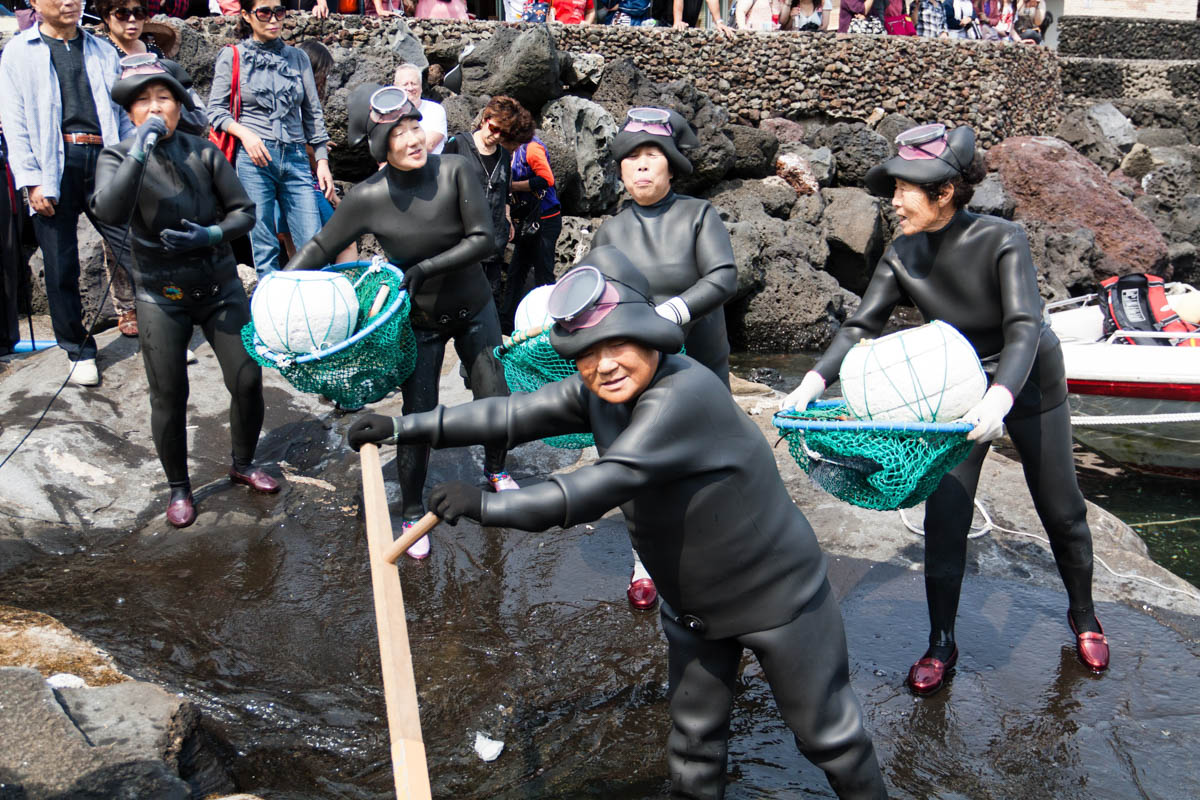
The haenyeo, often translated as “sea women”, are female divers who descend beneath the surface without breathing apparatus to gather seafood by hand.
Their culture is most closely associated with Jeju Island, where generations of women have developed an extraordinary knowledge of the sea, weather, marine life and breath-hold diving.
But the number of women continuing the tradition has been falling sharply.
Now, a younger generation is entering the water.
Leaving City Life For The Sea
Among them are Jin So-hee and Woo Jung-min, two haenyeo working around Geoje on South Korea’s southern coast.
According to recent AFP reporting published by The Korea Times, Jin grew up in Busan and trained in skincare and nail art before working as a nursing assistant.
Long working hours, limited time off and low pay eventually prompted her to leave city life. At 25, she moved to Geoje.
There she encountered women in their 70s who were still making their living from the sea.
She decided to join them.
It was far from an easy escape.
Jin reportedly lost seven kilograms during her first year as a haenyeo. The physical demands of repeatedly descending underwater, harvesting marine life and returning to the surface left her exhausted.
Pressure presented another problem.
Severe ear pain and headaches eventually led Jin towards modern freediving and scuba diving training, where she learned techniques including equalisation that helped her cope more effectively with the pressure changes involved in diving.
It is an interesting meeting point between two worlds: centuries of traditional diving knowledge and techniques now familiar to today’s recreational freedivers and scuba divers.
Diving Without A Tank
Haenyeo diving is fundamentally different from scuba.
The women enter the water wearing equipment that can appear relatively simple to a modern diver: typically a wetsuit, mask or goggles, fins, weights and a tewak, the distinctive floating buoy that accompanies them on the surface.
There is no cylinder and no regulator.
They descend on a single breath.
The UNESCO description of Jeju haenyeo culture describes divers descending to around 10 metres to gather shellfish such as abalone and sea urchins. Traditionally, they may work for hours, repeatedly diving and surfacing throughout a working day.
One of the most recognisable sounds associated with the haenyeo is the sumbisori, a distinctive breathing sound produced as a diver surfaces and rapidly exhales and inhales before another descent.
But reducing the haenyeo to impressive breath-hold divers misses much of what makes the tradition remarkable.
Their expertise includes generations of accumulated knowledge about currents, tides, weather, seasonal marine life and the sustainable harvesting of the waters on which their communities depend.
Experienced divers also pass knowledge to less experienced women.
UNESCO added the Culture of Jeju Haenyeo to the Representative List of the Intangible Cultural Heritage of Humanity in 2016.
The Science Behind Extraordinary Divers
Scientists have also become increasingly interested in what generations spent repeatedly entering cold water may have done to the haenyeo themselves.
Research has examined both learned physiological responses and possible genetic adaptations associated with their diving lifestyle.
Like other breath-hold divers, haenyeo benefit from the human diving response. Immersion and breath holding can slow the heart and constrict peripheral blood vessels, helping preserve oxygen for organs including the heart and brain.
But recent research suggests the story may go deeper.
Studies comparing haenyeo with other Korean populations have identified physiological and genetic characteristics potentially associated with coping with cold water and the cardiovascular demands of repeated breath-hold diving.
That does not mean someone can simply inherit the ability to become a haenyeo.
Training remains crucial.
The emerging picture instead suggests an extraordinary combination of culture, lifelong conditioning, learned diving skills and, potentially, adaptations developed within a population that has spent generations working in the sea.
A Tradition Running Out Of Divers
The greater threat to haenyeo culture may not come from the difficulty of diving itself.
It is demographics.
AFP reports that the number of haenyeo on Jeju fell from 3,437 in 2021 to 2,371 in 2025.
The significance of younger women such as Jin and Woo entering the profession therefore extends far beyond two new divers.
They represent the possibility of knowledge being transferred before the generation carrying much of it disappears.
The two women have also embraced something their predecessors never had: social media.
They have documented younger haenyeo and their working lives online, creating a record that Woo told AFP could one day become an asset for future generations.
It is another intriguing combination of old and new. A tradition built around oral knowledge and experience passed between women is increasingly being recorded digitally.
The Sea Is Changing Too
Even recruiting another generation of divers cannot guarantee the future of the profession.
The underwater environment supporting it is changing.
Warming seas around South Korea are altering marine ecosystems and the distribution of species on which coastal communities depend.
For haenyeo, these changes are not abstract measurements.
They are witnessed underwater.
Jin recalled how red sea squirts once covered areas of seabed so extensively during spring that they resembled a field of roses.
That spectacle, she told AFP, has disappeared.
The observation fits into a wider pattern being documented around South Korea’s southern islands.
Marine scientists and divers around Jeju have reported changing coral communities, warming water and shifts in the ecosystems that have sustained traditional fisheries.
For a profession based on harvesting what the sea naturally provides, ecological change can directly determine whether the work remains economically viable.
More Than A Story About Freediving
For divers, the haenyeo are fascinating because their lives challenge our modern conception of what diving is.
There are no computers counting no-decompression limits, no buoyancy compensators and no cylinders strapped to their backs.
Instead, there is a breath, a descent and generations of knowledge about the water below.
But the survival of haenyeo culture is about considerably more than exceptional breath holding.
It is about whether a body of maritime knowledge, developed and handed down largely between women over generations, can survive profound social and environmental change.
Younger divers are entering the water.
Schools are teaching new recruits. Modern freediving techniques are meeting traditional practice. Cameras are recording knowledge that was once passed primarily from person to person.
The question is whether that will happen quickly enough.
Because preserving the haenyeo ultimately requires more than preserving the story of the women.
It requires preserving the sea that made their way of life possible.
Comments