

Nestled in Saskatchewan, Little Manitou Lake at Manitou Beach offers a unique swimming experience where visitors float effortlessly on the surface. Because the body of water is a terminal lake fed continuously by underground springs with no outflow, it has accumulated extraordinarily high concentrations of natural minerals like sodium, magnesium, and potassium. With a salt content of approximately half that of the Dead Sea, creating the intense natural buoyancy that makes taking a dip there so famous.
Carved out over 10,000 years ago during the retreat of the last ice age, the lake occupies an ancient glacial spillway. It stretches 22.5 kilometers (14 miles) in length, spans 1.6 kilometers (1 mile) across, and encompasses a surface area of 1,524 hectares (3,770 acres).
While far less famous than Israel’s Dead Sea, Little Manitou Lake offers Canadians a remarkably similar mineral-rich experience right in Saskatchewan. Its waters are packed with natural compounds: including magnesium, sulphate, potassium, calcium, silica, sulphur, and iron oxide. Thanks to this unique chemical composition, the lake is widely celebrated for its therapeutic benefits, helping to soothe skin conditions, ease joint pain, relieve allergies, and support overall immune health.
Often called Canada’s “Dead Sea,” Little Manitou Lake is a terminal salt lake located in Saskatchewan, roughly 120 kilometers southeast of Saskatoon and 5 kilometers north of Watrous. Its name comes from the Algonquin word Manitou, which refers to a spiritual or supernatural power. The lake lies in an ancient glacial meltwater channel carved out at the end of the last ice age, sustained entirely by subterranean spring flows. Because it lacks any natural outflow, mineral deposits have built up heavily over time, leaving the water rich in sodium, magnesium, and potassium salts. As a result, the lake boasts a salinity roughly five times greater than that of the ocean and about half that of the Dead Sea.
There are no fish in the lake as the high salt content of the water supports little other than brine shrimp.
Since the 1800s, Indigenous communities have brought the ill to a lake they named in honor of the spirit Manitou. The tradition of utilizing these waters for healing reportedly began when Assiniboine individuals suffering from smallpox recovered after drinking from and bathing in the lake.
By the early 1900s and through the Great Depression, the lake transformed into a popular retreat owing to its distinct mineral composition. Beginning in the late 1980s, renewed interest in its therapeutic properties and high salinity, which allows swimmers to float effortlessly, re-established the area as a major travel destination.
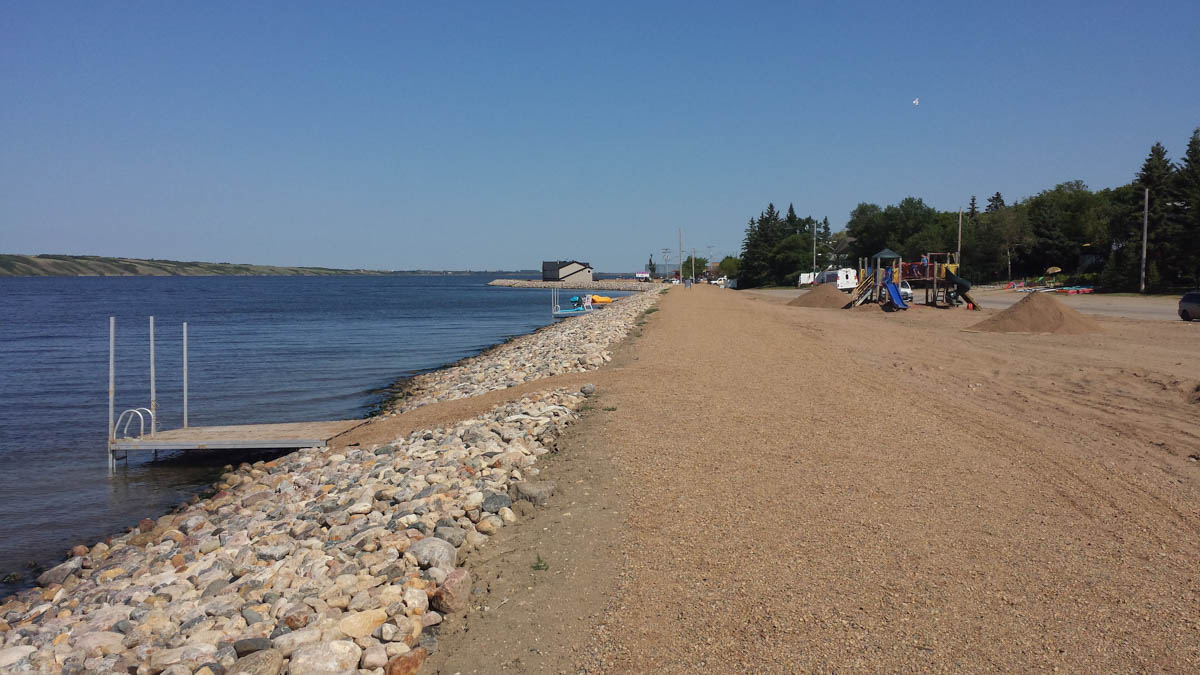

Over the course of the 2000s and 2010s, Little Manitou Lake experienced historic high water levels, surging past its typical elevation of roughly 495 meters (1,624 feet) above sea level. Starting in 2007, the lake repeatedly set new high-water marks, prompting the construction of a protective berm in 2011 to safeguard Manitou Beach, local properties, and regional infrastructure.
Situated 8 kilometers (5 miles) north of Watrous along Highway 365, Manitou & District Regional Park is divided into three main zones surrounding the lake. The public beach area stretches along the shoreline, while the Manitou Beach Golf Club lies further south on the west side of the highway. Directly across from the golf course to the east, the park’s regional campground sits beside the historic Jubilee Drive-In Theatre, which remains one of Saskatchewan’s few surviving open-air cinemas.