



What is a Seiche?

A seiche is a type of standing wave that forms in a body of water where the water level rises and falls in a regular pattern. The greatest vertical movement occurs at the ends of the basin, while very little movement happens near the middle, known as the node or center. For a seiche to develop, the water must be at least partially confined so that the wave can reflect back and forth and remain in place.

The concept was formally introduced in 1890 by Swiss hydrologist François-Alphonse Forel, who was the first to study the phenomenon scientifically while observing Lake Geneva. The word itself had been used locally for many years to describe the back-and-forth movement of water in alpine lakes. Linguistic research suggests the term originates from a Swiss French dialect derived from the Latin word siccus, meaning “dry,” referring to how the shoreline becomes exposed as the water retreats.

Lake Erie is one of the five Great Lakes of North America, ranking fourth in surface area and eleventh among the world’s largest lakes. It lies farthest south of the Great Lakes and is the shallowest, with the smallest water volume. The lake also has the quickest average turnover of water compared to the others. Its maximum depth reaches about 210 feet (64 meters), which makes it unique among the Great Lakes because its deepest point is still above sea level.
The western basin of Lake Erie is its most shallow area, with typical depths of only about 25 to 30 feet (7.6 to 9.1 meters). Because the water is so shallow, even light winds can produce strong, rolling waves, often referred to as seiches. These waves can form rapidly, catching people off guard. The surrounding region is often called Canada’s “thunderstorm capital” due to its frequent and impressive lightning storms. At times, sudden and powerful waves have created dangerous conditions that have resulted in dramatic rescue efforts.
A seiche is a type of standing wave that forms in a body of water where the water level rises and falls in a regular pattern. The greatest vertical movement occurs at the ends of the basin, while very little movement happens near the middle, known as the node or center. For a seiche to develop, the water must be at least partially confined so that the wave can reflect back and forth and remain in place.
The concept was formally introduced in 1890 by Swiss hydrologist François-Alphonse Forel, who was the first to study the phenomenon scientifically while observing Lake Geneva. The word itself had been used locally for many years to describe the back-and-forth movement of water in alpine lakes. Linguistic research suggests the term originates from a Swiss French dialect derived from the Latin word siccus, meaning “dry,” referring to how the shoreline becomes exposed as the water retreats.
In harbors, seiches can be triggered by long-period waves, also known as infragravity waves. These waves result from complex interactions between wind-driven waves and slower, lower-frequency motions, producing oscillations that last longer than the original wind-generated waves.
According to Meteorologist Chris Vickers
“Update from Lake Erie: The “Seiche” due to high winds Monday officially resulted in a water level that was +13.5 FEET higher in Buffalo than Toledo. It was a plunge of 7.5 feet in Toledo that drained the western basin of Lake Erie followed by a near simultaneous rise of just over 6 feet in Buffalo.”
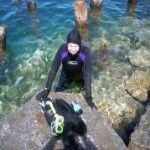
The most recent Seiche on Lake Erie, which took place on December 29, 2025, revealed several intriguing objects that had long been hidden beneath the water’s surface.


Comments