

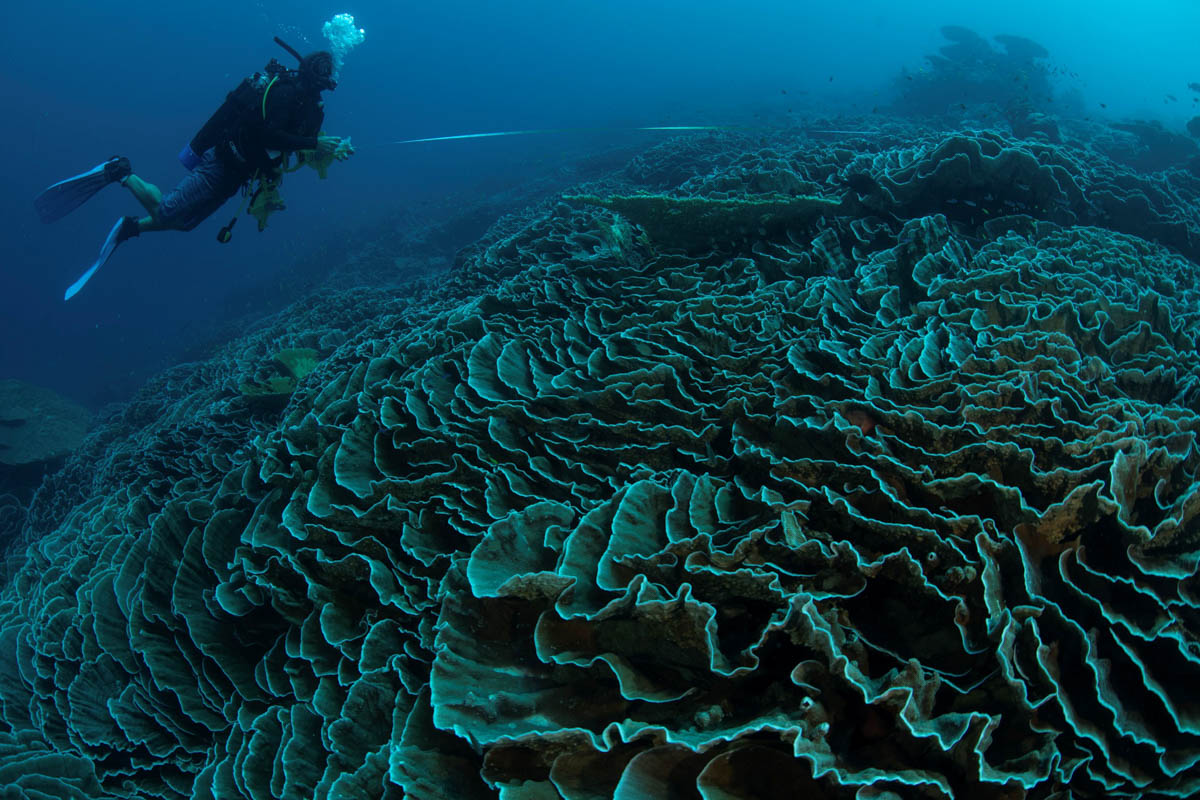

Scientists exploring the remote Cocos (Keeling) Islands in the Indian Ocean have mapped an enormous coral formation stretching 1.56 kilometres along the outer reef, revealing one of the largest known coral colonies ever recorded.
The remarkable discovery has raised questions about how such an extensive coral formation developed, how long it has survived, and whether the entire structure could be a single living organism.
The formation, commonly known as rose coral and belonging to the genus Pachyseris, extends across approximately 56,940 square metres of seabed. It occupies depths ranging from 14 to 65 metres, with an average width of 36.5 metres.
To put its scale into perspective, the coral stretches roughly the length of 100 buses parked end to end and covers an area equivalent to more than three Melbourne Cricket Ground playing fields.
Researchers from Adelaide University, Queensland Museum and James Cook University have been investigating the formation, combining detailed underwater surveys with scientific sampling to understand its extraordinary dimensions and biological structure.
A Discovery Hidden in Plain Sight
Although the coral’s immense scale has only recently been documented, parts of the formation have been familiar to local divers for more than three decades.
Cocos Islands dive operator Dieter Gerhard first encountered extensive areas of rose coral while exploring the outer reef. Over the years, different sections became associated with separate dive sites, but there was little indication that they might form part of a much larger continuous structure.
His observations eventually attracted the attention of marine biologist Dr Jean-Paul Hobbs from Adelaide University.
What began as an attempt to establish whether the sections were connected developed into an extensive underwater mapping project.
Researchers initially used measuring tapes to document the coral, but quickly discovered that the formation extended far beyond their expectations.
Dr Hobbs repeatedly reached the limits of his available breathing gas before reaching the end of the coral. By recording his progress using GPS and returning on subsequent dives, he gradually established the formation’s full mapped extent.
The survey required 12 dives over several months before the team could finally document the entire 1.56-kilometre structure.
Additional areas of rose coral have been identified extending another 200 to 300 metres beyond the main mapped formation, suggesting that the wider area occupied by this coral may be even greater.
One Giant Coral or Thousands Growing Together?
Perhaps the most intriguing question concerns the biological identity of the formation.
Although it appears to form an enormous continuous expanse of coral, scientists have not yet established whether it represents one genetically identical organism or numerous separate colonies that have grown together over time.
Corals are colonial animals composed of individual polyps, which can reproduce asexually and gradually expand across suitable surfaces.
Under certain conditions, coral colonies can become exceptionally extensive, particularly when environmental disturbances are limited.
The research team has collected approximately 50 samples from different sections of the formation for genetic analysis.
Those results should help determine whether the coral developed from a single original organism or represents multiple genetically distinct colonies.
Until that analysis is completed, the discovery is best described as one of the largest known coral formations, rather than the world’s largest individual coral organism.
What Makes the Cocos Islands So Special?
Situated in the eastern Indian Ocean, the Cocos (Keeling) Islands are among Australia’s most isolated inhabited territories.
Their location and surrounding oceanic conditions support distinctive marine ecosystems, including coral communities that remain relatively poorly understood compared with those on more accessible reefs.
The extraordinary size of the rose coral formation suggests that conditions along this particular reef slope may have favoured extensive coral growth over a prolonged period.
Researchers are particularly interested in how environmental stability, competition, storms, disease and other disturbances influence the development of large coral colonies.
Another important question concerns the potential role of deeper reef habitats in supporting coral survival.
Some sections of the formation occur considerably deeper than the shallow reefs commonly associated with tropical coral ecosystems.
Studying these environments could provide valuable insights into whether deeper waters offer some protection against disturbances such as marine heatwaves, coral bleaching and severe storms.
However, depth alone does not guarantee protection from environmental change, and further research will be needed to understand the conditions responsible for the colony’s remarkable extent.
A New Chapter for Marine Research
The discovery also highlights the importance of collaboration between local diving communities and scientific researchers.
Without decades of observations by divers familiar with the Cocos Islands, the full significance of the rose coral formation might have remained unrecognised.
The research forms part of growing scientific interest in the marine environments surrounding the islands.
The Australian Government established the Cocos (Keeling) Islands Marine Park in March 2022, recognising the environmental importance of the territory’s reefs, marine habitats and surrounding ocean.
According to Parks Australia, ongoing research and monitoring are central to protecting the biodiversity of Australia’s Indian Ocean Territories Marine Parks.
The newly mapped coral formation provides another compelling example of why these remote ecosystems deserve scientific attention.
For divers, the discovery is a reminder that some of the ocean’s most remarkable natural features can remain largely undocumented even when they have been visited for decades.
And for the researchers investigating the Cocos Islands rose coral, the next major discovery may come not from further exploration, but from the genetic evidence that could reveal whether this enormous underwater formation is truly one living organism.
