



A fatal diving accident in New Zealand has prompted calls for a ban on one portable “tankless” breathing system and triggered a wider government examination of similar equipment marketed to recreational divers.
The case centres on the death of 58-year-old Shengwei Cao, who drowned off Mana Island near Wellington on 5 March 2023 while using a Wolach 919 surface-supplied breathing apparatus that he had purchased online.
Coroner Amelia Steel has now recommended that the Wolach 919 be banned from importation into New Zealand. Crucially, however, the recommendations extend beyond one particular product.
New Zealand’s Ministry of Business, Innovation and Employment has confirmed directly to The Scuba News that it is seeking expert advice and examining the broader category of tankless diving equipment used by recreational divers.
The case raises a bigger question for the international diving community: as relatively inexpensive breathing systems become increasingly accessible online, can equipment capable of keeping somebody underwater on compressed air really be treated like an ordinary consumer product?
What Happened At Mana Island?
Cao had reportedly been freediving for around five to six years but had not undergone scuba training.
According to the coronial findings reported by 1News, he had recently purchased a Wolach 919, a portable surface-supplied breathing system sometimes described as a tankless or hookah diving system.
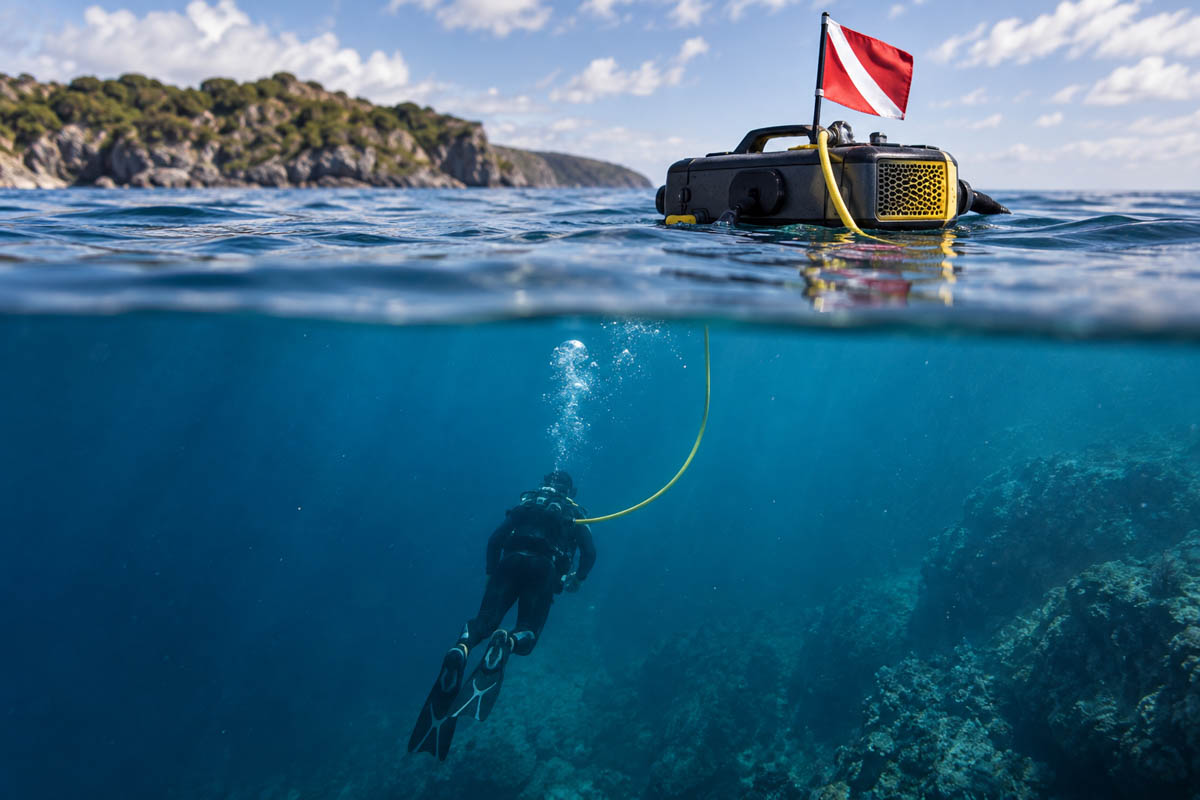
Instead of carrying a compressed-air cylinder on the diver’s back, the system uses a compressor floating at the surface to supply air to the diver through a hose and regulator.
Cao reportedly tested the unit in his bathtub the day before taking it into open water.
On 5 March, he travelled with friends to Mana Island. At approximately 11:30am, he began using the Wolach in the sea for the first time while other members of the group were scuba diving.
After several dives over approximately 10 to 15 minutes, Cao returned to the boat and told his friend Chen Koo that the Wolach was not working. He was also feeling seasick and needed assistance getting back aboard.
After around ten minutes he felt better and returned to the water.
He subsequently continued diving alone around 30 metres from the boat.
When attempts to attract his attention received no response, a passing boat was alerted. Cao was eventually found in approximately five metres of water, still connected to the surface buoy.
The breathing mouthpiece was beside his head rather than in his mouth, while the compressor was reportedly still operating.
Forensic pathologist Dr Judy Melinek determined that Cao died from drowning, with decompression complications and cardiovascular disease contributing.
Police Testing Raised Serious Concerns
Testing of the Wolach 919 by a specialist from the New Zealand Police National Dive Squad subsequently identified problems with the way the system supplied air.
According to the findings, drawing air became particularly difficult at depths of around 4.5 to five metres.
The compressor operated in response to falling pressure rather than providing an entirely consistent supply. The resulting breathing resistance could leave a diver with the sensation that adequate air was unavailable.
The police specialist described the equipment as a “dangerous system”.
That is particularly significant because increased breathing resistance underwater can become much more than an inconvenience. A diver struggling for gas may increase their breathing effort, potentially contributing to carbon dioxide accumulation, anxiety and panic.
Investigators also identified several other important factors in Cao’s death.
He was not scuba trained. He was diving without a dive computer, decompression tables or a depth gauge. He was heavily weighted using two harnesses and a weight belt, with weights that could not all be quickly released, and was negatively buoyant.
He also returned to the water after feeling unwell and was subsequently diving alone.
The findings therefore do not establish the Wolach 919 as the sole cause of Cao’s death. Instead, they show a combination of equipment, training, diving practice and health factors culminating in a fatal accident.
That distinction matters when considering the wider tankless diving market.
Coroner Recommends An Import Ban
Coroner Steel ruled Cao’s death accidental and made three significant recommendations.
The first was that the Wolach 919 should be banned from importation into New Zealand.
The second called for MBIE to examine similar tankless or hookah-style systems to determine their consumer risks, presence in the market and possible regulatory responses.
The third recommended a public-awareness campaign addressing the use of the Wolach 919 and similar equipment, involving organisations including the Police National Dive Squad, WorkSafe New Zealand, Coastguard New Zealand, Maritime New Zealand and Water Safety New Zealand.
Water Safety New Zealand has separately highlighted the circumstances of Cao’s death and reiterated the importance of divers not undertaking underwater activities alone.
New Zealand Government Examining The Wider Market
The Scuba News approached MBIE to establish whether its response would focus solely on the Wolach 919 or whether the ministry regarded consumer tankless diving equipment as a wider product-safety issue.
Simon Gallagher, Manager, Consumer Services at MBIE, confirmed that the ministry is considering the coroner’s findings and recommendations.
MBIE told The Scuba News that it is currently seeking expert advice from WorkSafe and industry bodies concerning tankless diving systems and their use by recreational divers.
More significantly, the ministry confirmed:
“We are also seeking more information on the Wolach 919 itself and will be looking at the category of product as a whole.”
MBIE said the Wolach 919 is not currently available for sale in New Zealand, but acknowledged the importance of understanding potential risks associated with the broader category.
There is currently no timetable for the review.
The ministry said it would continue working with relevant agencies and stakeholders to assess consumer-safety risks and determine whether further advice or guidance is required.
That moves the issue beyond an investigation into a single piece of equipment.
New Zealand authorities are now considering whether the way this entire category of consumer diving system is sold and used requires closer attention.
Tankless Does Not Mean Risk-Free
Surface-supplied breathing systems are not inherently unsafe.
Versions of surface-supplied equipment have been used successfully in commercial, occupational and recreational diving for decades. Properly engineered systems operated by appropriately trained divers can have legitimate applications.
The potential problem is the gap between the apparent simplicity of some consumer systems and the realities of breathing compressed gas underwater.
Removing the cylinder from a diver’s back does not remove diving physiology.
A diver breathing compressed air at depth remains exposed to many of the same fundamental risks faced by a scuba diver, including pulmonary barotrauma and arterial gas embolism following an inappropriate ascent, decompression sickness where sufficient depth and exposure are involved, gas-supply problems and the consequences of panic underwater.
A diver also needs to understand buoyancy, weighting, ascent procedures, equipment failure and emergency responses.
A product that appears to offer a simple way to remain underwater without conventional scuba equipment can therefore create a dangerous misconception if the user believes scuba knowledge and training are no longer necessary.
The Risks Are Not Merely Theoretical
Research into surface-supplied breathing apparatus fatalities provides important context.
A 2021 study published in Diving and Hyperbaric Medicine examined 84 known Australian deaths involving surface-supplied breathing apparatus between 1965 and 2019.
Equipment issues, particularly compressor-related problems, were identified as a predisposing factor in 48 percent of incidents and as a trigger in 24 percent.
Researchers also identified recurring problems involving equipment configuration, planning, supervision, training and experience.
Of the 84 fatalities, 21 victims were known to have been untrained, while training status was not reported in another 24 cases.
The study concluded that preventable surface-supplied diving deaths continued to occur and specifically identified incorrect equipment configuration and inadequate training among recreational users as ongoing problems.
The researchers suggested improved education and, if that proved insufficient, regulatory oversight.
The study covers a much broader range of surface-supplied diving equipment and circumstances than today’s portable battery-powered consumer products, so its figures should not be interpreted as a fatality rate for modern tankless systems.
They do, however, demonstrate that breathing from a surface supply introduces hazards that have been documented for decades.
Tankless Systems Have Faced Recalls Before
The Wolach case is also not the first time concerns have arisen around a modern portable tankless system.
In December 2022, the US Consumer Product Safety Commission announced the recall of approximately 1,300 BLU3 Nomad battery-powered tankless diving systems.
According to the US Consumer Product Safety Commission recall notice, the compressor head could fracture during use and restrict airflow, creating a drowning hazard.
BLU3 had received 21 reports of divers experiencing restricted airflow. No injuries were reported.
The manufacturer cooperated with the recall and affected units were subject to repair.
The Nomad recall involved a specific identified component issue and should not be conflated with the circumstances surrounding the Wolach 919. It nevertheless illustrates why breathing equipment designed to support somebody underwater warrants particularly rigorous product-safety scrutiny.
An Emerging Consumer-Safety Question
The wider concern is not whether every tankless diving system is unsafe.
There are significant differences in engineering, depth limits, safety systems, instructions, manufacturer support and intended use between products.
The more difficult issue is what consumers understand they are buying.
Compact systems can appear dramatically simpler than traditional scuba equipment. A floating compressor, hose and regulator can visually suggest that the complexity of scuba has somehow disappeared with the cylinder.
It has not.
Once a person breathes compressed gas underwater, the rules governing pressure and human physiology still apply.
Training, appropriate weighting, monitoring depth and time, buddy procedures, emergency planning and an understanding of safe ascent practices remain relevant regardless of where the breathing gas originates.
Cao’s case is particularly sobering because he was not completely inexperienced underwater. He had years of freediving experience.
But freediving and breathing compressed gas underwater are fundamentally different activities.
Experience in one does not automatically provide the knowledge required for the other.
What Happens Next?
MBIE has not yet committed to banning the Wolach 919 or imposing restrictions on the wider category.
Instead, it is gathering information, consulting WorkSafe and industry organisations and considering what action, if any, is appropriate.
The ministry told The Scuba News:
“We recognise the importance of understanding and addressing the potential risks associated with this broader category of products.”
There is currently no established timetable.
For manufacturers and retailers, the New Zealand review could become significant well beyond one product or one country.
Portable surface-supplied systems occupy an unusual position between conventional scuba equipment and general consumer recreation products. Their increasing accessibility online makes questions around standards, instructions, training requirements and marketing increasingly difficult to ignore.
For divers, the lesson is simpler.
A tank may be absent.
The physics of diving are not.
Comments