




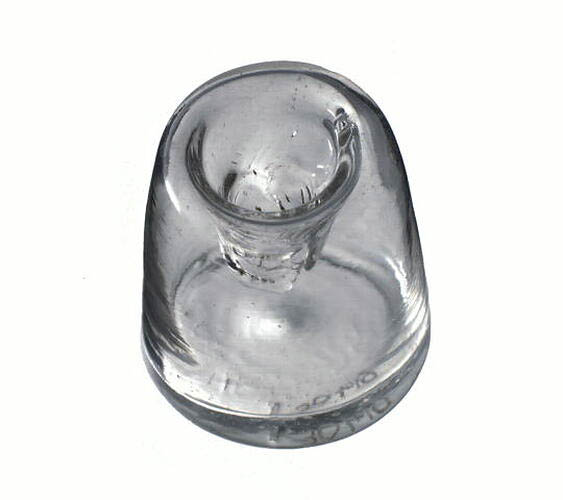
“This tiny bottle may be one of the oldest finds I’ve recovered from the Sackville River.” Saltwater Sean
“Standing just 8 centimetres tall, it was hand blown and features a pontil scar on the base, suggesting it was made in the mid 1800s.
What makes it especially unusual is the glass chamber inside. Bottles like this are believed to have been used as non spill traveling ink bottles, allowing people to carry ink without leaking during travel.
To put its age into perspective, this bottle may have been in use around the same time Charles Dickens was writing A Tale of Two Cities. In this 1858 photograph in the video, Dickens is shown writing with a quill pen, exactly the kind of work that relied on ink bottles like this one.
A small piece of everyday life from more than 150 years ago, recovered from the Sackville, Nova Scotia river bottom”. Saltwater Sean
In the 1880s, traveling with ink was a daily necessity. Fountain pens with internal reservoirs were in their infancy and largely unreliable, meaning anyone traveling by train or steamship had to bring a bottle of ink along to use with steel dip pens.
To solve the mess, Victorian inventors engineered two brilliant, entirely mechanical types of “safety” and “travelling” inkwells.

1. The Spring-Loaded Mechanical Safety Inkwell
This was the most popular high-end design of the 1880s. These inkwells were small, heavily engineered metal boxes—often clad in leather, brass, or sterling silver.

- The Mechanism: You pressed a small release button on the outside, and the top lid would spring open. Inside, a thick rubber or leather washer was mounted under a secondary, spring-loaded brass cap. When the outer box was closed and latched, the spring compressed the washer tightly against the mouth of the glass ink vial inside, forming an airtight, leak-proof seal.
- The Design: They were typically built like heavy pocket watches or small square trunks. They were meant to be thrown into a leather writing slope or Gladstone bag without a single drop escaping.
- 2. The Clever Inverted Funnel Capillary Bottle
If you didn’t have the money for a fancy mechanical box, you used an ingenious geometry-based bottle. (pictured above)
The Mechanism: The glass itself was molded with an internal cone or funnel that extended downward from the top opening into the center of the bottle.

Why it didn’t spill: When the bottle was sitting upright, you could easily dip your pen into the funnel to get ink. However, if the bottle tipped over on its side or was turned completely upside down, the ink pool naturally flowed around the outside of the cone rather than through the hole, trapped by gravity and surface tension.
The Sackville River begins its journey in the rural wetlands of Hants County, winding its way down through Upper, Middle, and Lower Sackville, as well as the community of Bedford. Ultimately, the 40-kilometer waterway empties directly into the northern tip of the Bedford Basin, the large and deep bay that forms the inner part of Halifax Harbour. Sean has been known to frequent the Sackville River for underwater treasures.
YouTube Saltwater Sean
Comments